Good morning. Today's news is about deployment surface — where AI runs, who controls the substrate, and who can be trusted with it. OpenAI's Codex moving on-prem with Dell is the cleanest enterprise-deployment signal of the quarter. NVIDIA's first Vera CPUs going hand-delivered to the four labs that matter is a hardware milestone you only get to see once per chip generation. And the ex-OpenAI watchdog group forming around the SpaceX IPO is the kind of story that doesn't move quarterly numbers but does move procurement risk models. If you'd rather get this once a week, subscribe to the weekly brief.
- OpenAI and Dell bring Codex on-prem and into hybrid enterprise environments
- NVIDIA's first Vera CPU — a chip built for agents — lands at Anthropic, OpenAI, SpaceXAI, and Oracle
- Ex-OpenAI staffers form a watchdog group to warn SpaceX investors about xAI's safety record
- SandboxAQ wires its drug-discovery models directly into Claude
- Gemini is in danger of going full Copilot across Google Workspace
1. OpenAI and Dell bring Codex on-prem and into hybrid enterprise environments
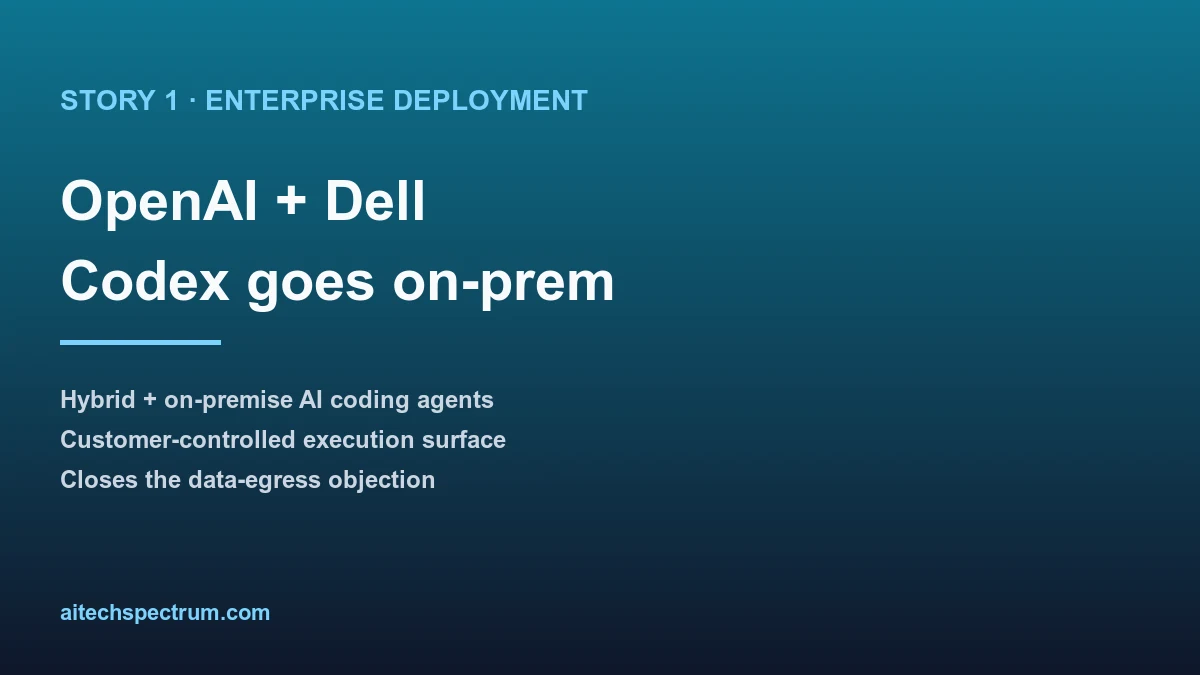
OpenAI announced a partnership with Dell to bring Codex — its agentic coding model — into hybrid and on-premise enterprise environments. The framing is about giving large enterprises a way to deploy AI coding agents against code, data, and workflows that can't legally or operationally leave their perimeter. Until now, "we can't use Codex" has been the universal answer from regulated and security-sensitive shops; the Dell deployment surface is OpenAI's attempt to close that objection with hardware and integration rather than with another row of compliance certifications.
The deployment side is the more interesting half of the announcement. Cloud-only Codex is a known quantity. What the Dell partnership produces is a defined enterprise reference architecture: Dell hardware as the local execution substrate, OpenAI's models running in a customer-controlled environment, and the agent reaching into the customer's repositories, ticketing systems, and CI without that data crossing the cloud boundary. That pattern is what Anthropic's Claude has been winning enterprise deals on for the last two quarters via partnership with the hyperscalers; OpenAI now has a counterpart on the hardware-led side of the procurement chart. Pricing and the exact split of which model weights land where aren't public yet — that's the detail to watch.
Why it matters. If you're an enterprise CTO who has been blocked from giving developers a real AI coding assistant because of data-egress rules, this is the first OpenAI offering you can plausibly bring to the security and compliance committee without rewriting the request. If you're a competing vendor — Anthropic, GitHub Copilot Enterprise, Cursor, Cognition's Devin — the lane that's now genuinely contested is "AI agent that runs where your code lives," not "best autocomplete in the cloud." And if you're a Dell sales rep, your AI story just got materially more concrete than "we sell the GPUs you'll need." See our review of the best AI coding assistants of 2026 for the field this partnership now reshapes.
2. NVIDIA's first Vera CPU — a chip built for agents — lands at Anthropic, OpenAI, SpaceXAI, and Oracle
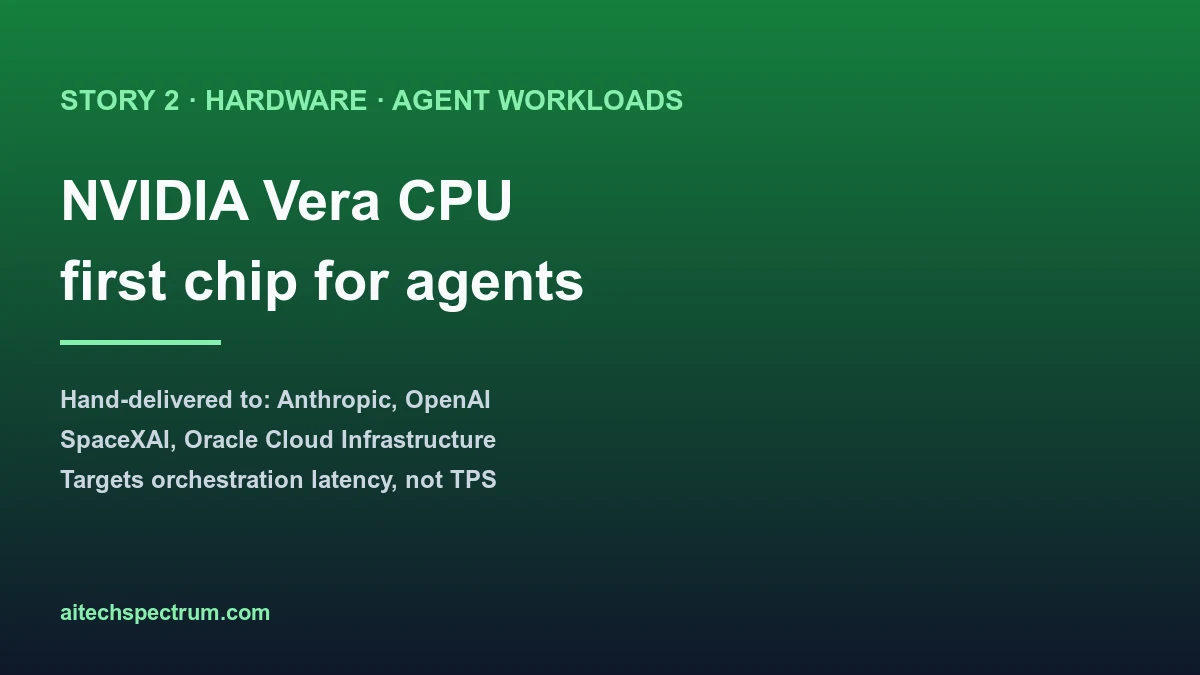
NVIDIA posted that the first NVIDIA Vera CPUs arrived at three top AI labs on Friday — Anthropic in San Francisco, OpenAI in Mission Bay, and SpaceXAI in Palo Alto — with a fourth delivery to Oracle Cloud Infrastructure in Santa Clara on Monday. Ian Buck, NVIDIA's VP of Hyperscale and HPC, hand-delivered them. Vera is NVIDIA's first CPU designed specifically for agent workloads — the orchestration, tool-call, and memory-management work that surrounds the actual model inference and that has been eating an embarrassing share of latency in production agent systems.
The customer list is the more telling signal than the chip itself. The four launch customers — Anthropic, OpenAI, SpaceXAI, and Oracle — are NVIDIA's bet on who will actually be running agents at scale a year from now. Notable for who's not on the list (yet): Google, Meta, Amazon. The first three are vertically integrating around their own silicon (TPU, MTIA, Trainium); whether they end up Vera customers will depend on whether the agent-side performance gap NVIDIA is targeting is wide enough that the hyperscalers buy it as a complement rather than treat it as a competitor. NVIDIA's bet is that orchestration latency is the next bottleneck after raw token-generation throughput. If they're right, Vera is the chip pattern that defines agentic computing for the next two generations.
Why it matters. If you're an AI infrastructure buyer, the practical read is that NVIDIA is no longer just the GPU vendor — they're now competing for the CPU socket inside AI servers, which is where Intel and AMD have lived undisturbed. If you're an agent-framework engineer (LangGraph, LlamaIndex, the Anthropic and OpenAI agent SDKs), the implication is that the orchestration side of your runtime now has a hardware target it can optimize for, the same way model training optimized for GPUs years ago. And if you're a competitor on the CPU side — AMD with Turin, Intel with Granite Rapids — the agent workload is the lane you'll need to answer in your next chip cycle, not the one after.
3. Ex-OpenAI staffers form a watchdog group to warn SpaceX investors about xAI's safety record
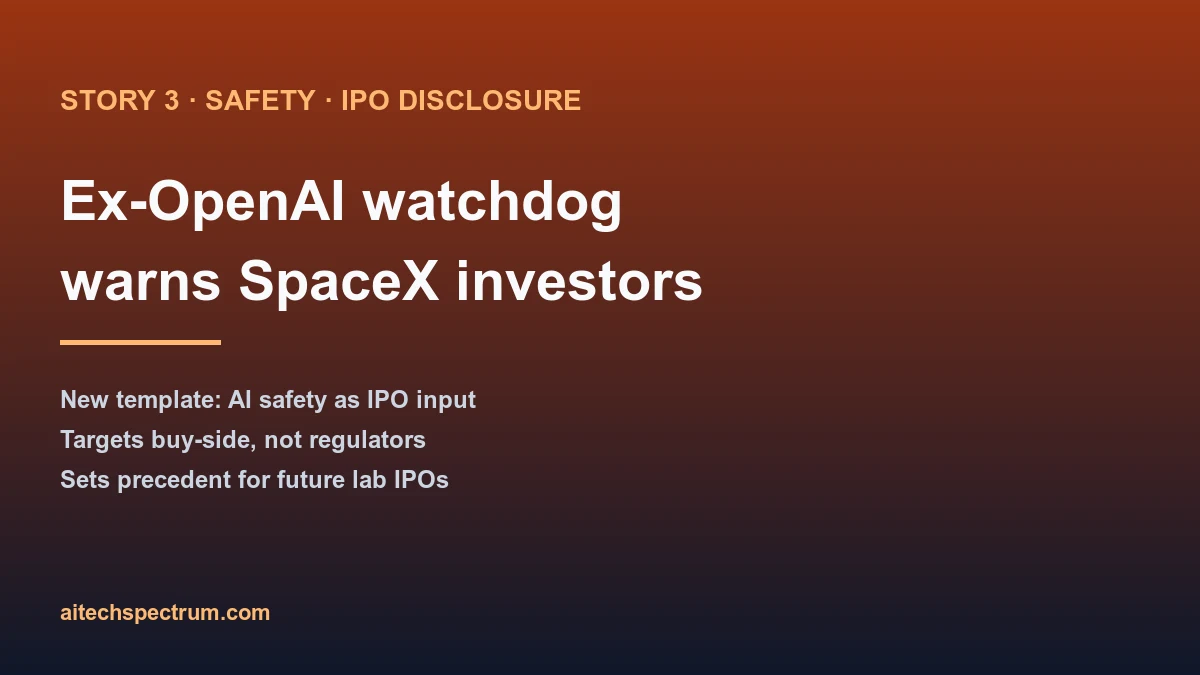
Wired reports that a group of former OpenAI employees has cofounded a new AI watchdog organization specifically to warn SpaceX investors about xAI's safety practices ahead of the long-rumored SpaceX IPO. The argument is structural: xAI is privately held inside the Musk corporate orbit, but it shares infrastructure, talent, and brand association with SpaceX, and the watchdog group's claim is that the safety-process gap between xAI and the frontier labs is wide enough that public-market investors deserve more visibility before they buy SpaceX equity.
This is a new template. AI-safety advocacy as an explicit input into an IPO disclosure process — rather than as a regulatory submission or an open letter — is a more legible pressure for the buy-side to act on than the conscience-of-the-field letters of the last three years. It also creates a precedent: any future IPO of an entity with adjacent AI exposure will now have an external party producing a "safety-gap memo" the way short-sellers produce a fundamentals memo. The question for SpaceX bankers — and for the labs that may IPO later — is whether the disclosure regime adapts to this voluntarily or under regulatory pressure.
Why it matters. If you're an institutional investor sizing the SpaceX IPO, the watchdog group's memo is a piece of the bear case you'll need to read regardless of whether you accept its claims — failing to engage with it leaves it as an unanswered argument in your investment committee. If you're an AI-safety researcher, the pattern is the first credible non-regulatory mechanism for translating safety concerns into capital-market consequences. And if you're a frontier lab thinking about its own eventual public-market exit, the obvious takeaway is that the safety-process documentation you're producing internally is now a financial disclosure document, even if it isn't filed as one.
4. SandboxAQ wires its drug-discovery models directly into Claude
TechCrunch reports that SandboxAQ — the Alphabet spinout focused on quantitative AI for drug discovery and other scientific domains — is exposing its drug-discovery models inside Anthropic's Claude. The framing is about access: SandboxAQ's bet is that the bottleneck in modern drug discovery is no longer the quality of the models (Chai Discovery, Isomorphic Labs, and others have raced to credible parity on the model side), but who can actually use them. By living inside the Claude conversational surface, the SandboxAQ models become callable by domain scientists who can describe a problem in English without needing a computational chemistry pipeline.
The integration pattern is the broader story. The "scientific model surfaced inside an LLM assistant" pattern — which a year ago felt like a stretch on both ends — is now a credible distribution strategy for verticalized AI. The model vendor gets reach without having to build a UI. The LLM vendor (Anthropic, in this case) gets a verticalized capability without having to train domain-specific weights. The user gets a tool they can interrogate in natural language. The shape of the deal — what SandboxAQ pays Anthropic, what Anthropic pays back in distribution, whose name lives on the brand surface — is the design question every vertical-AI company will face over the next eighteen months as model marketplaces inside LLM surfaces become real.
Why it matters. If you're a biotech ops leader, the practical signal is that "ask Claude to run a drug-discovery query" is now a real workflow, not a demo. If you're a vertical-AI founder, the implication is that distribution-through-Claude (or ChatGPT, or Gemini) is a genuine alternative to building your own user interface — but the terms of that distribution matter, and they're being set now in the SandboxAQ-class deals. And if you're at Anthropic, the strategic read is that the model marketplace inside Claude is the company's most underrated lever; the deals signed in 2026 will shape who shows up there for the next decade.
5. Gemini is in danger of going full Copilot across Google Workspace
The Verge argues that Gemini is creeping. The little sparkle icon — first introduced as a contextual tool inside Gmail and Docs — has now appeared in essentially every Workspace surface, and the I/O 2026 announcements push it further. The piece's frame is that Gemini's ambient-everywhere posture risks repeating the same trajectory Microsoft Copilot ran in 2023–24: ubiquitous, low-cost-to-spawn, but not load-bearing for any specific workflow, with the result that users notice the icon, ignore the icon, and never form the habit.
The pattern matters because it's the inverse of the on-prem and verticalized stories above. OpenAI's Dell deployment and SandboxAQ's Claude integration are both bets that AI value lives in a specific, deep, deployable workflow. Gemini-across-Workspace is the opposing bet: AI value lives in ambient ubiquity, available from any text field, with the assumption that frequency-of-presence eventually translates to depth-of-use. Both can be true; neither is true in every category. The risk Google is running is that Copilot demonstrated the failure mode of the ambient-ubiquity bet — adoption metrics that look healthy at the company level but don't translate into the per-user habit Google needs for retention.
Why it matters. If you're a Google Workspace admin, the practical question is whether you'd rather your users have Gemini available everywhere shallowly or in three places deeply — the company's current posture is the first, and there is an admin path to the second if you want it. If you're a competitor (Microsoft Copilot, Notion AI, the OpenAI-Apple Intelligence stack), the moment is the first time Google has been pinned with the "going full Copilot" frame, which is the criticism each of you has worn yourself; the lane that's now open is "AI value in specific, named workflows" rather than "AI everywhere." And if you're a builder of an AI feature embedded in a productivity tool, the design question to take from this is whether you can survive the user noticing you and then never using you again — which is what Gemini-everywhere risks.
What to take from today
Three threads. First, the deployment surface for enterprise AI is splitting — OpenAI is now competing for the on-prem and hybrid lane with Dell, which is exactly the lane Anthropic has been winning via Claude-on-AWS-Bedrock. Second, NVIDIA's Vera CPU is the first hardware acknowledgment that agentic computing is a different workload than pure model inference, and the launch-customer list is a map of who's expected to operate agents at scale a year from now. Third, the ex-OpenAI watchdog memo aimed at SpaceX investors is a new mechanism — AI safety as IPO disclosure input — that the next set of frontier-lab and frontier-lab-adjacent IPOs will have to engage with whether they want to or not.
Tomorrow's brief lands at 08:00 UTC. If you'd rather read this in your inbox once a week — just the five stories that actually matter — subscribe here.