Good morning. Today's throughline is capability versus control. Anthropic just made its most capable model ever generally available — and wrapped it in classifiers, a retention mandate, and a subscription window. The reaction was immediate: Microsoft is reportedly fencing it in, and a pair of Datadog veterans raised money on the premise that you should never depend on one lab. Meanwhile capability keeps spreading anyway — into live translated speech and drivable simulated worlds. Start with Anthropic's announcement. Prefer this once a week? Subscribe to the weekly brief.
- Claude Fable 5: Mythos-class AI for everyone — until June 23, anyway
- Microsoft reportedly limits Fable 5 internally over Anthropic's 30-day retention rule
- Gemini 3.5 Live Translate speaks 70+ languages, a few seconds behind you
- Decart's Oasis 3 makes world models a developer product — caveats included
- Datadog veterans raise $7M on the bet that nobody wants AI lock-in
1. Claude Fable 5: Mythos-class AI for everyone — until June 23, anyway
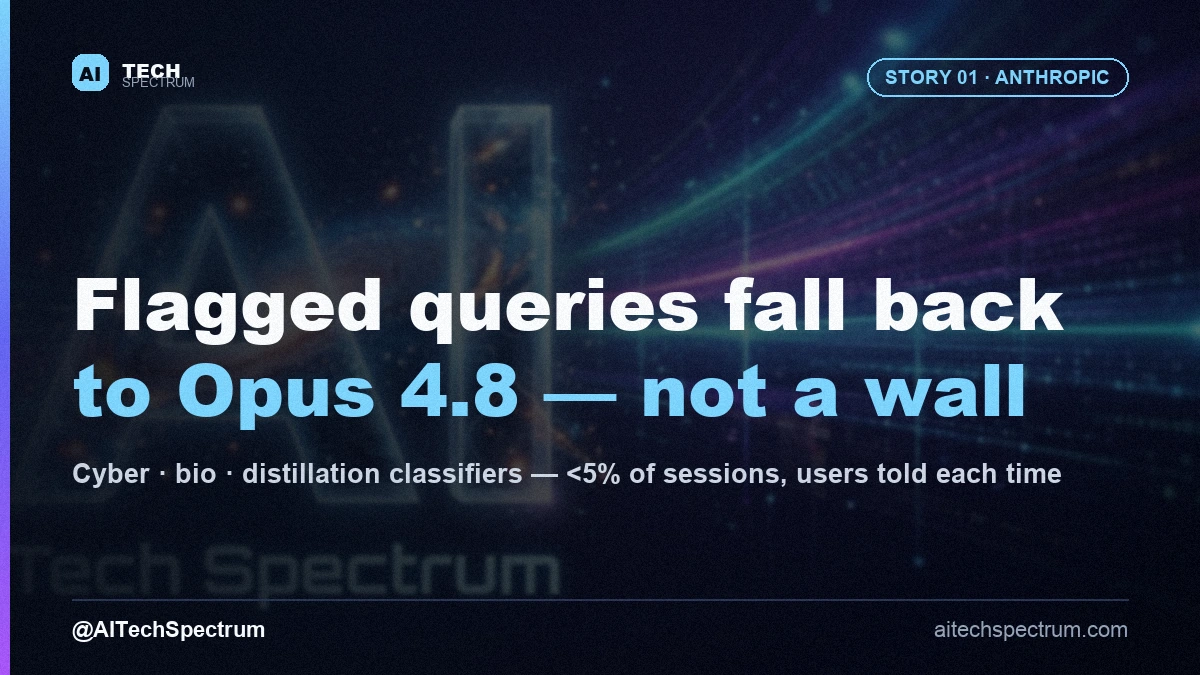
Anthropic launched Claude Fable 5 on Tuesday, calling it a "Mythos-class" model — a tier above Opus — "that we've made safe for general use," with capabilities the company says exceed any model it has ever made generally available. The design choice worth understanding is the safeguard architecture: instead of refusing flagged requests, separate classifier systems route queries touching cybersecurity, biology and chemistry, or suspected distillation attempts to Claude Opus 4.8, with the user informed each time. Anthropic says more than 95% of Fable sessions involve no fallback at all, and acknowledges the classifiers are deliberately tuned cautious — The Verge found even high-school-level biology questions getting handed to the older model. A sibling release, Claude Mythos 5, is the same underlying model with cyber safeguards lifted, restricted to vetted defenders under Project Glasswing.
The numbers that matter for buyers: $10 per million input tokens and $50 per million output — less than half the price of Claude Mythos Preview — and the model string is claude-fable-5 on the API. Among early-access anecdotes Anthropic published, Stripe reported the model performed a codebase-wide migration in a 50-million-line Ruby codebase in a day, work it estimates would have taken a team over two months by hand (a vendor-published customer claim, not an independent benchmark). The fine print on access is unusually concrete: Fable 5 is included on Pro, Max, Team, and seat-based Enterprise plans at no extra cost only through June 22. On June 23 it comes off those plans and requires usage credits, until capacity lets Anthropic restore it as standard.
Why it matters. This is the first time frontier-beyond-the-flagship capability has shipped to the general public, and the fallback-instead-of-refusal pattern is a genuinely new UX for safety — you get a slightly older model, not a brick wall. What to watch: if you're already paying for Pro or Max, the next 12 days are effectively a free trial of the strongest model Anthropic sells — run your hardest real workload before June 23 and decide whether it clears the bar Opus 4.8 doesn't. Our model comparison framework is the place to start; we'll fold Fable 5 in as third-party evals land.
2. Microsoft reportedly limits Fable 5 internally over Anthropic's 30-day retention rule
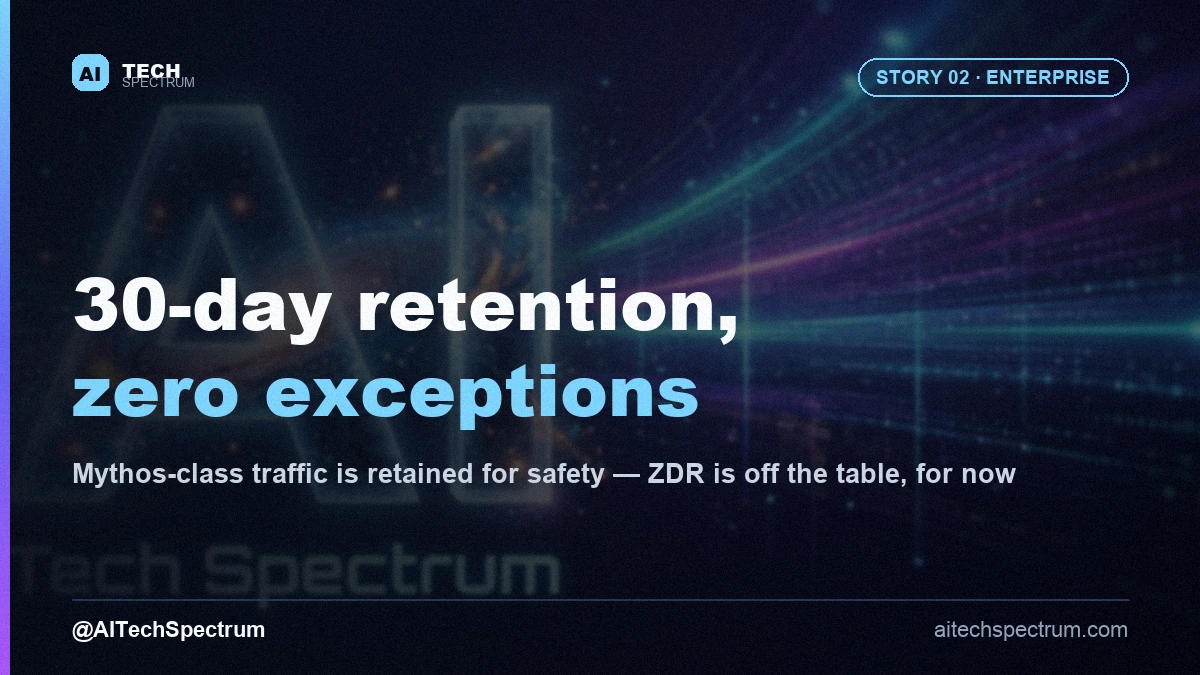
The first enterprise pushback arrived within a day. The Verge reports, citing sources, that Microsoft is limiting employees' internal use of Claude Fable 5 because of Anthropic's new data retention requirements — even as Microsoft moved quickly to offer the model to its GitHub Copilot and Foundry customers. The policy in question is stated plainly in Anthropic's launch post: all traffic on Mythos-class models now carries mandatory 30-day retention, on both first- and third-party surfaces. Anthropic says the data won't train new models and won't be used for any non-safety purpose, that every human access is logged, and that deletion happens after 30 days "in almost all cases" — the point, per Anthropic, is catching novel jailbreaks and attacks that operate across many requests.
Zero-data-retention agreements have been table stakes in enterprise AI procurement for years; many security teams treat them as non-negotiable. A frontier model that cannot be run under ZDR forces an uncomfortable choice between the most capable model on the market and a data-governance policy written before models like this existed. Microsoft drawing that line internally while reselling the model to customers — if The Verge's reporting holds — is the contradiction every large IT department is about to face in miniature.
Why it matters. Safety-motivated retention and enterprise confidentiality are now in direct tension at the frontier, and the resolution will be contractual, not technical. What to watch: whether Anthropic offers carve-outs for regulated industries, whether other labs adopt similar retention mandates for their most capable tiers, and whether "ZDR-compatible" becomes a model selection criterion in its own right — alongside price and benchmarks — in your procurement checklist. For how we think about cloud-AI data exposure generally, see our sister site's privacy-tooling reviews.
3. Gemini 3.5 Live Translate speaks 70+ languages, a few seconds behind you
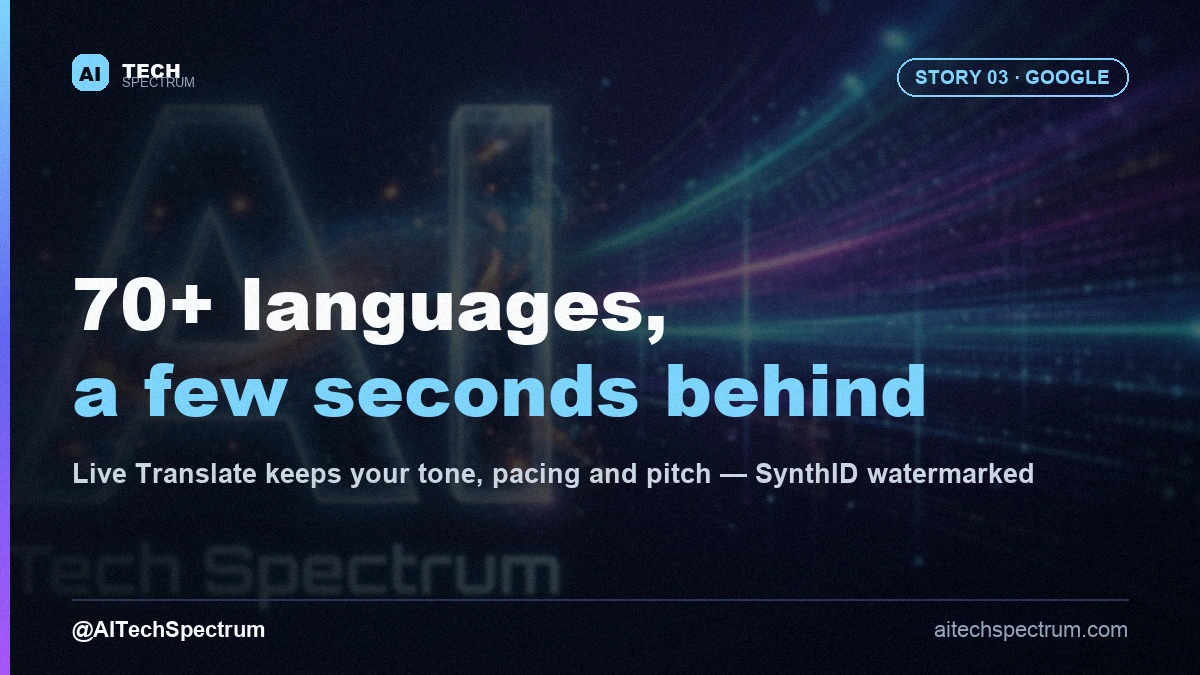
Google released Gemini 3.5 Live Translate, an audio model for live speech-to-speech translation that auto-detects 70+ languages and generates translated speech preserving the speaker's intonation, pacing and pitch. The architectural shift is continuity: rather than waiting for a speaker to finish (the turn-by-turn pattern), the model generates speech continuously, balancing context-gathering against staying just a few seconds behind the speaker. It's rolling out three ways: public preview for developers via the Gemini Live API and AI Studio, private preview in Google Meet for select Workspace customers this month, and globally in the Google Translate app on Android and iOS.
Two deployment details stand out. In Meet, speech translation jumps from five supported languages to 70+, and from English-pivot-only to what Google counts as 2,000+ language combinations in a single meeting. And on Android, a new "listening mode" streams translated audio through the phone's earpiece — hold the phone to your ear like a call and hear the translation privately, no headphones needed. Google says partner Grab is testing the model for driver-traveler pickup calls, a use case it puts at over 10 million voice calls per month, and all generated audio carries an imperceptible SynthID watermark so AI speech stays detectable.
Why it matters. Real-time translation that preserves how you sound — not just what you said — moves this from an accessibility feature to something you'd actually run a business call through. What to watch: latency and accuracy reports from the Live API preview (marketing demos are always clean; loud rooms are not), and whether the SynthID watermark survives the audio processing chains of real telephony. If you're choosing an AI meeting stack, our meeting-tools comparison covers where translation features fit.
4. Decart's Oasis 3 makes world models a developer product — caveats included
Decart unveiled Oasis 3, a real-time interactive world model that generates photorealistic driving environments, TechCrunch reported exclusively — and unlike the research previews that have defined this category, it ships with API access from day one at $0.02 per second of generation. The initial target is autonomous-vehicle companies that need rare driving scenarios at scale; the longer bet, per CEO Dean Leitersdorf, is seeding a developer ecosystem around world models the way OpenAI's API did for language models. The launch lands a few weeks after Decart raised $300 million at a valuation TechCrunch puts near $4 billion, with Toyota, Adobe and eBay joining as strategic investors alongside Nvidia.
TechCrunch's hands-on testing is the useful part, and it's refreshingly specific about the limits. The model sets up a strong, prompt-faithful initial scene, but thematic coherence degrades as you drive — a New York street gradually becomes Generic Western City, and turning around reveals the original intersection is simply gone. Cars also drive through other cars: object-level physics isn't simulated yet, which Leitersdorf attributes to training data skew ("there's drastically more data on good driving compared to accidents"). The architectural reason consistency is hard: Oasis 3 is auto-regressive, and at roughly 8,000 tokens per frame across tens of frames per second, the context window fills in moments. Memory compression is the research frontier.
Why it matters. World models just crossed from demo to product, with a price sheet and the same degradation caveats every early API era carries. What to watch: whether the next version's video-conditioned generation fixes scene persistence, and which non-AV use cases developers actually build — Decart's existing 100,000-strong developer community formed around e-commerce and streaming, not driving.
5. Datadog veterans raise $7M on the bet that nobody wants AI lock-in
Niteshift, founded by early Datadog engineers Sajid Mehmood and Conor Branagan, raised a $7 million seed round led by Greylock's Jerry Chen, with angels including Reid Hoffman and Datadog founders Olivier Pomel and Alexis Lê-Quôc. The pitch isn't another coding agent — it's the layer underneath: an "AI coding cloud" that routes work across Claude Code, Codex and open-source models based on each project's needs, so a company's development infrastructure isn't welded to any single lab. Notably, it charges per-minute like a cloud provider rather than selling tokens. "Everybody's worried about getting stepped on by these giants," Mehmood told TechCrunch, comparing it to Datadog's early multicloud business built on retailers who refused to run on AWS while Amazon competed with them.
The timing writes its own argument. The same week Niteshift launched, the frontier model everyone wants became something that appears on your subscription June 9 and comes off it June 23 — pricing, access windows and retention terms all set unilaterally by the lab. Model-routing isn't a novel idea, and the field is crowded (Cursor, Cognition, Amazon Bedrock, OpenRouter — which raised $113 million two weeks ago), but the macro trend Niteshift is selling against is real and visible in this very brief.
Why it matters. Lock-in anxiety is becoming its own product category, funded by people who watched the AWS era play out. What to watch: whether routing layers can keep up with capability gaps — when one model is clearly strongest, abstraction has a cost — and how the majors respond; our Codex vs Claude Code comparison covers the agents these platforms route between.
What to take from today
Capability and control are being priced separately now. Fable 5 gives everyone Mythos-class capability but on Anthropic's terms — classifiers, retention, a window that closes June 23. Microsoft's reported internal line-drawing and Niteshift's funding are both responses to exactly that. The practical move: take the free Fable 5 window as the trial it is, but make the switching cost visible in your own stack — know today which of your workflows would survive a model swap, a price change, or a retention policy you can't accept. That's not paranoia; as of this week it's just reading the terms.
Tomorrow's brief lands by 15:30 UTC. If you'd rather read this in your inbox once a week — just the stories that actually matter — subscribe here.