Good morning. Five stories, and the throughline is a useful tension: AI is getting genuinely more capable and pushing onto new surfaces — the lab bench, the entire Creative Cloud, the kitchen counter — at the same moment the industry started seriously counting what all of it costs. Start with the result that shows what "AI for science" looks like when it has to survive contact with real molecules: an AI chemist improved a real reaction. Prefer this once a week? Subscribe to the weekly brief.
1. A near-autonomous AI chemist improves a real drug reaction
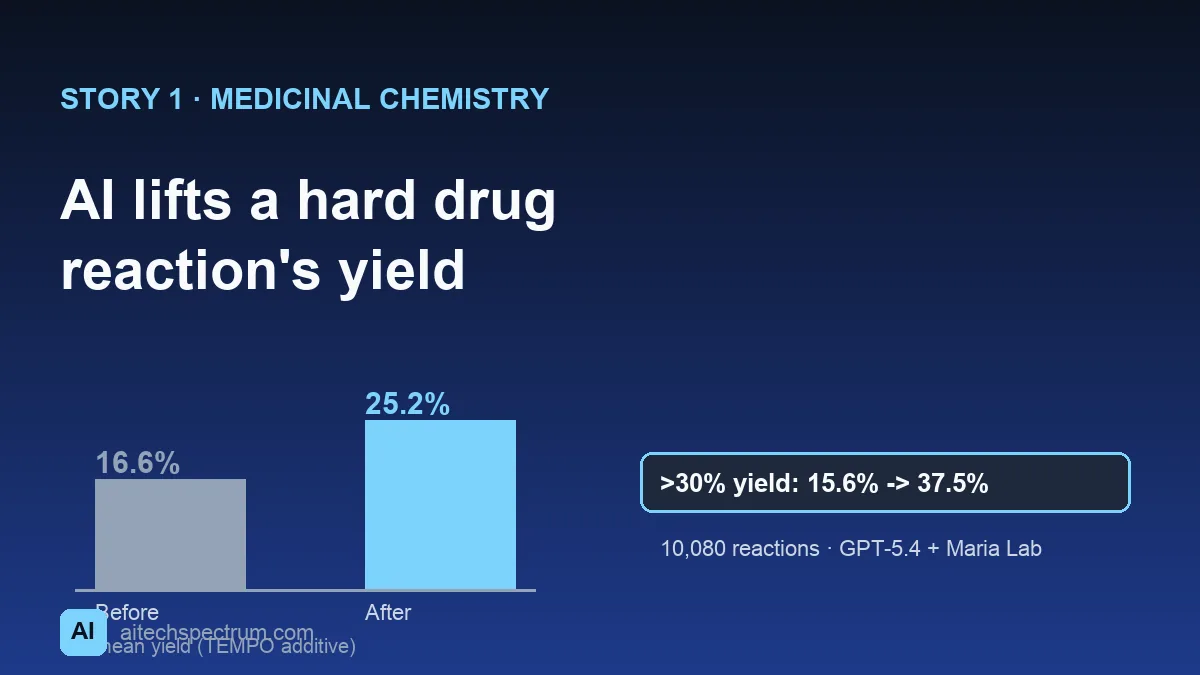
OpenAI and the chemistry-AI startup Molecule.one say they have produced what they believe is the first near-autonomous discovery in organic chemistry. As OpenAI describes it, they connected GPT-5.4 to Molecule.one's "Maria" — an agentic chemistry AI wired to a high-throughput lab — and gave it an open-ended goal: improve a useful reaction. The model zeroed in on a hard, valuable case: the Chan-Lam coupling of primary sulfonamides (a chemical family found in anticancer drugs, antibiotics, and diuretics) with boronic acids, which has historically given low yields. GPT-5.4 proposed a surprising fix — adding the mild oxidant TEMPO — and across two cycles totaling 10,080 reactions, mean yield rose from 16.6% to 25.2%, with the share of reactions clearing a practically useful 30% jumping from 15.6% to 37.5%. Human chemists then reproduced the effect by hand, seeing higher yields for 11 of 14 representative substrate pairs.
Why it matters. Synthesis is the bottleneck in drug discovery — scientists can only test molecules they can actually make — so a model that proposes a non-obvious, lab-validated improvement is the "research partner" story made concrete, not a chat demo. It's deliberately framed as near-autonomous: humans wrote the steering prompts, picked which of four proposals to test, corrected the experimental plans, and did the bench validation over a three-month run. What to watch: independent replication (the real test), whether the trick generalizes beyond this one reaction and substrate class, and how labs price the specialized high-throughput hardware that made it possible. One reviewer, University of Michigan medicinal chemist Tim Cernak, called it "a powerful demonstration" of high-throughput experimentation merged with modern AI.
2. Adobe spreads its Firefly AI Assistant across Creative Cloud
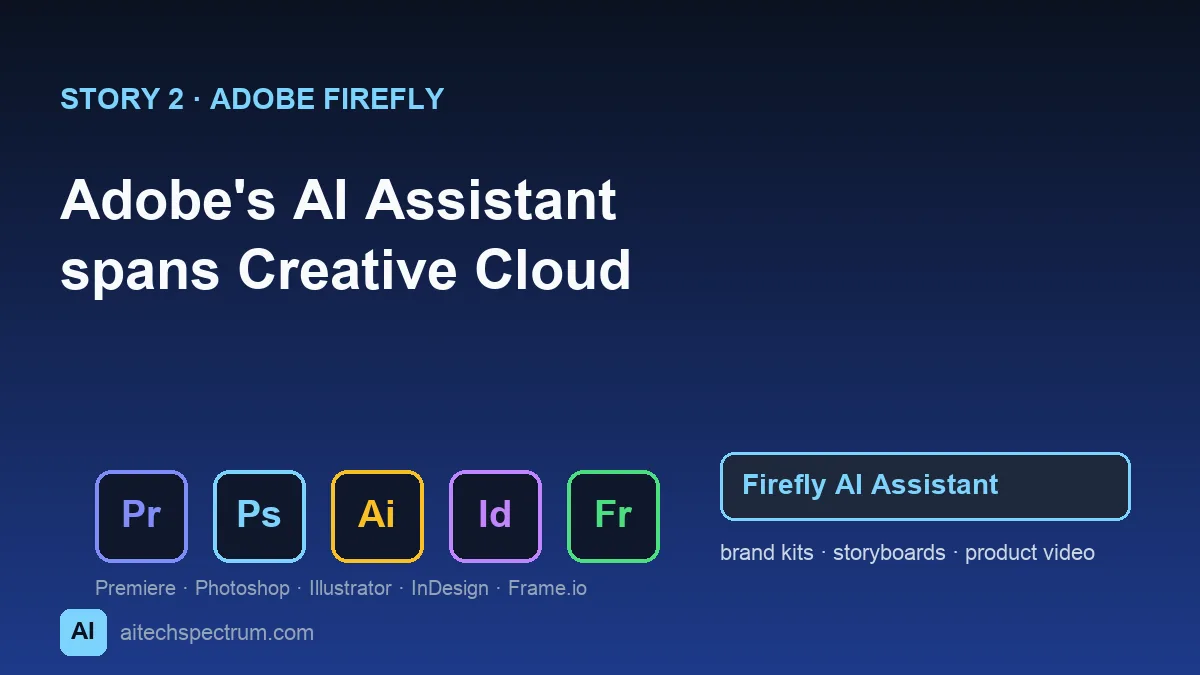
Adobe is putting its Firefly AI Assistant inside far more of Creative Cloud. As TechCrunch reports from Adobe's announcement, the assistant — already available in Express, Photoshop, and Acrobat — now reaches Premiere, Illustrator, InDesign, and Frame.io as a public beta, appearing as a sidebar inside each app. Rather than a generic chatbot, each integration targets the grunt work of that tool: in Premiere it can sort assets into bins, batch-rename clips, flag interview questions, and drop markers; in Illustrator it can reorganize layers or check for missing fonts. Firefly itself gains new tricks too — generating brand kits, storyboards, and product videos — plus an "Elements" feature to save AI-generated characters and locations for reuse. Adobe says the assistant already works with ChatGPT, Claude, and Copilot, with Google Gemini and Slack support coming.
Why it matters. This is AI assistance becoming a default fixture inside the tools that hundreds of millions of creative professionals already open every day — and the value is less in flashy generation than in automating the multi-step busywork that eats production time. What to watch: whether the assistant reliably completes real production tasks instead of demo-friendly ones, how Adobe's broader cross-app "creative agent" ambition lands, and whether opening Firefly to rival models (Claude, Gemini) keeps creators inside Adobe rather than defecting to Canva-style all-in-one tools.
3. Google's $100 Gemini Home Speaker ships June 25
Google opened pre-orders for the new Google Home Speaker — its first audio device built for the Gemini for Home assistant — at $99.99, with units shipping June 25. The pitch is conversational control: instead of memorizing rigid commands, you can stack multiple requests in one breath ("dim the kitchen lights, play something relaxing, set a timer for 20 minutes"), correct yourself mid-sentence, and ask multi-step questions, with Gemini holding short-term context for back-and-forth. It ships with ten new voices, balanced 360° sound, a listening light-ring, and a mic-mute toggle, and can pair (up to two units) with a Google TV Streamer for surround sound. A Google Home Premium subscription unlocks the more advanced features — free-flowing Gemini Live chats, Camera History Search across Nest cams, and "Home Briefs" summaries of what happened while you were out.
Why it matters. After the Android 17 push earlier this week, this is Gemini claiming the next surface — ambient hardware in the home — at an accessible $100 price that undercuts premium smart speakers. The assistant war is moving from phones to rooms. What to watch: whether natural-language reliability actually feels better than the old Assistant in daily use, how hard Google leans on the Premium upsell to monetize, and whether buyers worried about always-listening hardware trust a camera-history-searching speaker in their living room.
4. OpenAI's LifeSciBench humbles the best models
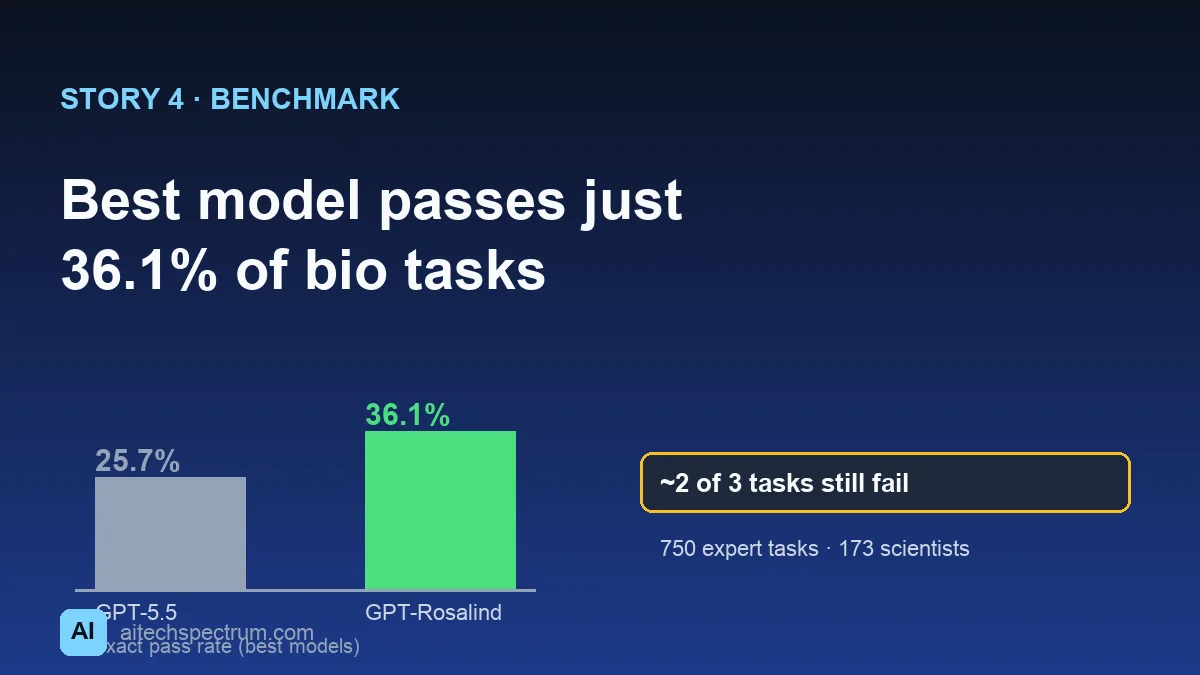
The perfect reality check sits right next to today's headline. OpenAI also introduced LifeSciBench, an expert-authored benchmark of 750 real-world life-science research tasks — spanning seven workflows and seven biological domains, written by 173 PhD-level scientists from biotech and pharma and validated by 453 independent expert reviewers. These aren't trivia questions: 79% of tasks need multiple reasoning steps (four on average), and each is graded against a detailed rubric (19,020 criteria in all). The sobering result: the strongest model, GPT-Rosalind, reaches an exact pass rate of just 36.1% — real progress over GPT-5.5's 25.7%, but still a failure on nearly two of every three tasks. Performance drops further on artifact-heavy work, falling from 45.1% on text-only tasks to 28.1% when a model must reason over figures, sequences, or data files.
Why it matters. Read against the AI-chemist result, this is the honest other half of the picture: frontier models are improving fast at scientific reasoning and communication, yet still fall well short of a competent human across realistic research work — which is exactly why benchmark transparency beats vendor hype. What to watch: OpenAI says the next step is connecting benchmark scores to live-research deployment, where the real value (or its absence) will show up.
5. Enterprise AI hits its "ROI reckoning"
The counter-narrative to "AI everywhere" got louder. On TechCrunch's Equity podcast, NEA partner Tiffany Luck argued enterprise AI has entered an "ROI reckoning": deploying AI is easy, proving the return is the hard part, and vertical tools that deliver finished work products (legal memos, equity research, compliance outputs) are best positioned to survive tighter procurement. The evidence is piling up. Uber burned through its entire 2026 AI-tools budget in four months after rolling Claude Code out to roughly 5,000 engineers — power users ran $500–$2,000 a month — and capped spending at $1,500 per employee per tool. And Microsoft's Experiences + Devices division was told to stop using Claude Code by June 30 and move to GitHub Copilot, a shift The Verge tied partly to usage-based pricing (a per-seat fee plus API tokens) versus Copilot's flat seat rate.
Why it matters. Usage-based agent pricing can explode when a tool is genuinely good — the better it works, the more it costs — and buyers are responding by capping spend, mixing models, and demanding proof of return. What to watch: whether the industry shifts toward flat-rate or capped agent pricing, and whether "finished-output" vertical AI wins the budgets that horizontal copilots are now fighting to keep. The practical takeaway for any team: keep your stack priced and portable so you can move when the economics change.
What to take from today
Read the five together and you get a more honest snapshot of mid-2026 than any single headline. AI is genuinely advancing — it proposed and helped validate a real chemistry improvement — and it's spreading onto every surface, from Adobe's apps to a $100 speaker on your counter. But the same week delivered the counterweight: a rigorous benchmark showing the best model still fails most real life-science tasks, and hard numbers showing that "use AI everywhere" can wreck a budget in a quarter. The builder's takeaway is the one we keep landing on — match the tool to the task, insist on measurable return, and keep your stack priced and portable, because both the capabilities and the costs are moving fast.
Tomorrow's brief lands by 15:00 UTC. If you'd rather read this in your inbox once a week — just the stories that actually matter — subscribe here.