Good morning. Five stories, and the throughline is proof — the difference between a claim and a result, a roadmap and a megawatt, a demo and a benchmark. Start with the one that spent six weeks as a question mark and just produced its homework: a startup's long-context "bottleneck" claim, now with a technical report attached. Prefer this once a week? Subscribe to the weekly brief.
1. Subquadratic finally shows its receipts
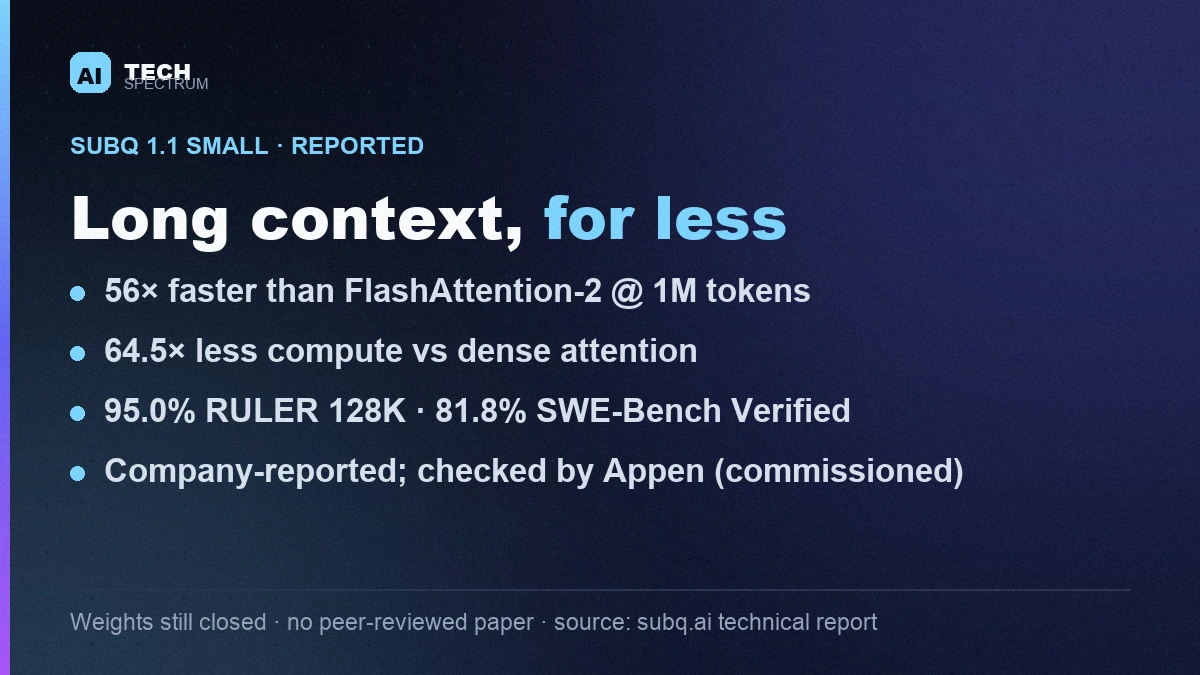
Six weeks after coming out of stealth with $29 million and an outsized claim — that it had cracked the quadratic-attention bottleneck behind expensive long context — Miami's Subquadratic answered its skeptics with paper, not just press. The company published a SubQ 1.1 Small technical report reporting that its "Subquadratic Sparse Attention" runs about 56× faster than FlashAttention-2 at a one-million-token context and uses roughly 64.5× less compute than dense attention, alongside scores of 95.0% on RULER 128K and 81.8% on SWE-Bench Verified. It also commissioned a third-party assessment from data-evaluation firm Appen across long-context retrieval, coding, and reasoning — the first outside check on numbers that, six weeks ago, were entirely self-reported. MIT Technology Review covered both the claim and the continuing doubts.
Why it matters. If genuinely cheap long context holds up, it reshapes pricing for the entire agent economy — context windows are where a lot of inference money goes. A commissioned evaluation and a technical report are a real step up from a launch-day blog post. What to watch. The weights are still closed and there is no peer-reviewed paper, so independent academic reproduction — not a vendor-commissioned benchmark — remains the bar; some researchers also suspect SubQ may be a sparse-attention adaptation of an existing base model rather than a from-scratch subquadratic train, which would shrink the headline efficiency. Treat the "1,000× efficiency" full-context figure as marketing and the report's concrete 56×/64.5× numbers as company-reported-and-checked, pending someone outside the company running them.
2. Reliance puts a number on India's sovereign AI
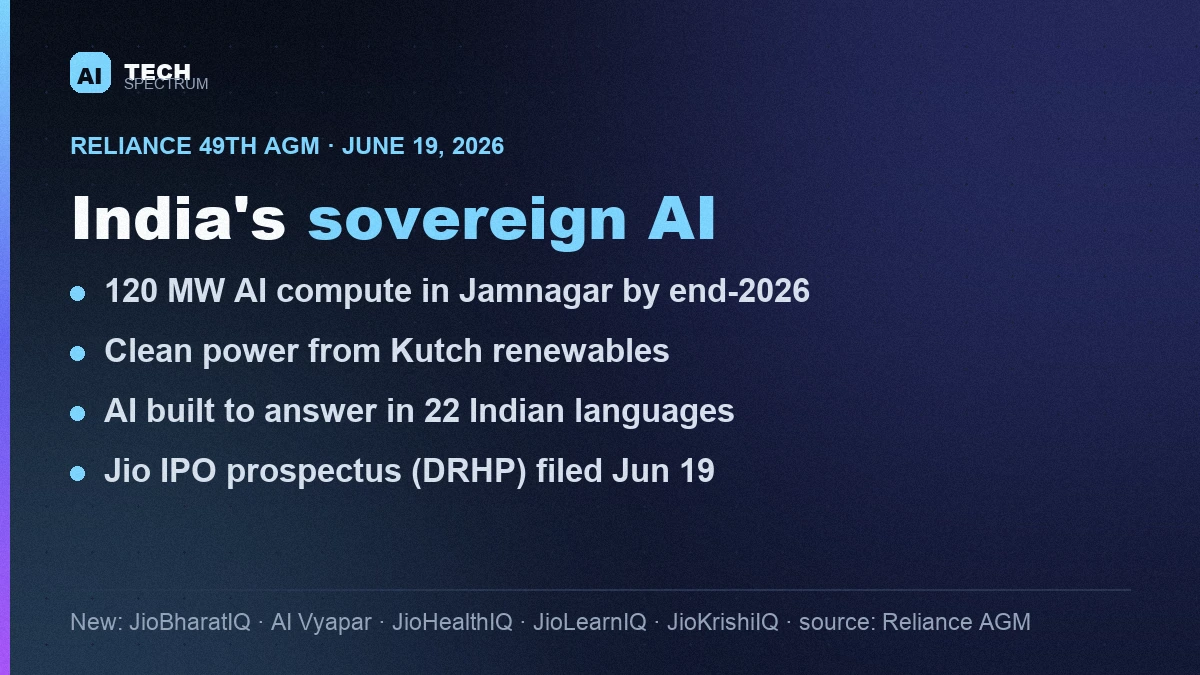
At Reliance Industries' 49th Annual General Meeting on June 19, Mukesh and Akash Ambani turned a year of "sovereign AI" talk into specifics. Reliance said it will commission the first 120 megawatts of AI compute by the end of 2026, built in Jamnagar, Gujarat and run on clean power from its Kutch renewable projects — the opening tranche of what Akash Ambani called India's "sovereign AI backbone." The group also said it is building AI to respond natively in 22 Indian languages rather than translating from English, and previewed sector products — JioBharatIQ, AI Vyapar, JioHealthIQ, JioLearnIQ and JioKrishiIQ — for consumers, small business, health, education and agriculture. Separately, the board of Jio Platforms approved and filed its IPO prospectus (DRHP) with India's market regulator the same day.
Why it matters. This is the "sovereign AI" thesis becoming megawatts and product names instead of slideware — a bid to own India's compute, models and distribution under domestic terms, at a scale (and energy footprint) few other players can match. What to watch. Whether 120 MW actually energizes on schedule and on clean power as promised, whether the 22-language models ship with measurable quality rather than as demos, and how the Jio IPO prices the AI story. Year-end is close enough that this is a verifiable promise, not a vision — we'll check it against the calendar.
3. Grok lands where enterprise data already sits
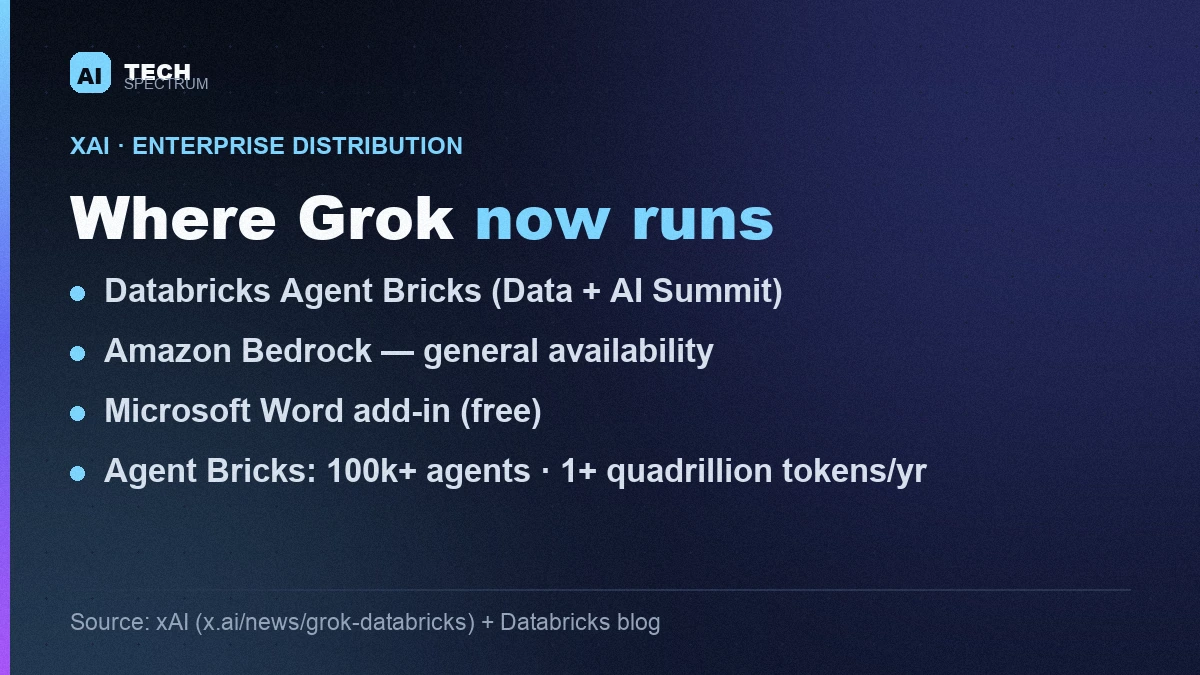
xAI spent the week pushing Grok toward enterprises where their data already lives. At the Databricks 2026 Data + AI Summit, the companies announced that Grok models are now available inside Databricks Agent Bricks, letting teams build agents that reason over data governed in their own Lakehouse without routing it through outside pipelines. Databricks, which says Agent Bricks has been used to build 100,000-plus agents processing more than a quadrillion tokens a year, now offers Grok and Kimi alongside OpenAI, Anthropic and Gemini as model choices. It caps a stretch of distribution moves for xAI that also included Grok reaching general availability on Amazon Bedrock and a free Grok add-in for Microsoft Word.
Why it matters. The frontier-model fight is increasingly a distribution fight: the model that's one dropdown away from a company's governed data has a real adoption edge over one that requires a new pipeline. Meeting enterprises inside Databricks, Bedrock and Office is how xAI competes with incumbents who got there first. What to watch. Whether "available in the platform" converts to production usage and spend — model menus are long, and being listed is not the same as being chosen. Governance, latency and price per task will decide which name teams actually click.
4. Google's Gemini 3.5 Pro June window narrows
A month after Sundar Pichai unveiled Gemini 3.5 Pro at Google I/O on May 19 and asked the audience to "give us until next month," the flagship model has yet to reach general availability. As of this week it remains in limited preview for select Vertex AI enterprise customers and has not shipped to Google AI Studio, the consumer Gemini app, or Gemini Advanced; Google's Vertex AI release notes are the place a public launch would land. The model is positioned as Google's frontier tier — absorbing the reasoning, deep-multimodal and very-long-context use cases once routed to Gemini Ultra, with a 2-million-token context window and a "Deep Think" mode highlighted at I/O.
Why it matters. Google set its own deadline, in public, and the calendar is now the story — with rivals shipping weekly, a flagship that slips its self-imposed June window invites questions about readiness or capacity. What to watch. Roughly a week and a half remain in the month. Watch the Vertex release notes and the developer changelog for the model ID and pricing; a general-availability date, not another preview tier, is the signal that the I/O promise landed.
5. A benchmark for trusting drug-discovery agents
As AI agents push into the lab, researchers shipped a way to grade them. A new paper introduces TxBench-PP (TherapeuticsBench Preclinical Pharmacology), described by its authors as a verifiable benchmark for small-molecule preclinical pharmacology — the first slice of a broader effort to evaluate agents across drug-discovery stages. Rather than testing trivia, it asks whether an agent can recover accurate conclusions from realistic program decisions, with answers that can be checked. The framing is the point: AI's promise in discovery is to compress interpretation-and-decision loops, but, the authors argue, deployment requires trusted evaluation on the kinds of calls a real program actually makes.
Why it matters. "AI for drug discovery" is one of the loudest claims in the field, and benchmarks like this move the conversation from demos to measurable, reproducible decision quality — the same discipline today's other stories demand. What to watch. Whether labs and vendors actually report scores on shared, verifiable benchmarks rather than cherry-picked internal wins — and how today's agents perform once an independent yardstick exists. (Educational only — nothing here is medical advice.)
What to take from today
Put the five together and the day reads like a collective demand for receipts. A startup met its skeptics with a technical report and an outside evaluation instead of louder claims. A conglomerate replaced "sovereign AI" rhetoric with a megawatt figure and a deadline. A model maker chose to compete on distribution — being where the data already sits — rather than on benchmark bravado. A search giant let its self-imposed launch window do the talking. And a research team built a yardstick precisely because the field has too few. The throughline we keep landing on: judge AI by what can be checked — a reproduced benchmark, an energized data center, a model actually chosen in production — not by the size of the promise.
Tomorrow's brief lands by 15:00 UTC. If you'd rather read this in your inbox once a week — just the stories that actually matter — subscribe here.