Good morning. Five stories, and they tell one story from several sides: the most capable AI models are no longer released — they are issued, to approved lists, on the government's schedule. The interesting questions have moved from "how good is it?" to "who is allowed to use it, and what does everyone locked out do next?" Prefer this once a week? Subscribe to the weekly brief.
1. GPT-5.6 Sol arrives — but only for a vetted few
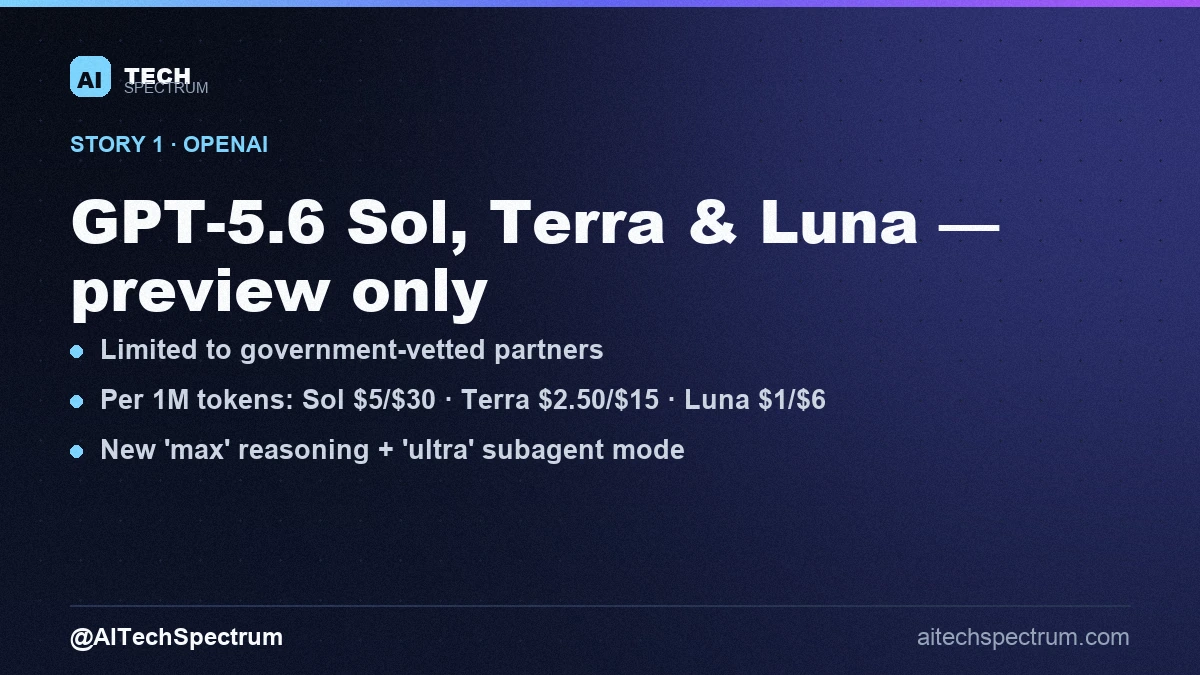
A day after reports that Washington wanted the launch staggered, OpenAI previewed the GPT-5.6 family: Sol, its flagship; Terra, a balanced tier OpenAI says matches GPT-5.5 at roughly half the cost; and Luna, its cheapest. The catch is in the rollout — the models are going first to "a small group of trusted partners whose participation has been shared with the government," and OpenAI made plain it took the step reluctantly. "We don't believe this kind of government access process should become the long-term default," the company wrote. "It keeps the best tools from users, developers, enterprises, cyber defenders, and global partners who need them." Pricing is set at $5 input / $30 output per million tokens for Sol, half that for Terra, and $1 / $6 for Luna, with a new max reasoning effort and an ultra mode that coordinates subagents.
Why it matters. The capability story is real — OpenAI claims a state-of-the-art result on Terminal-Bench 2.1 for coding and says Sol matches its banned rival Mythos Preview on the ExploitBench security benchmark using about a third of the output tokens — but the release mechanics are the actual news. A frontier model shipping to a government-shared shortlist, rather than to anyone with a credit card, is a structural change in how this industry distributes power. What to watch. OpenAI says broad availability in ChatGPT, Codex and the API is "coming weeks" away; that timeline, and whether the gate quietly becomes permanent, is the thing to track. Note too that OpenAI says Sol does not cross the "Cyber Critical" threshold in its Preparedness Framework — the restriction is precautionary, not a red line being crossed.
2. Washington frees Mythos 5 for 100+ organizations
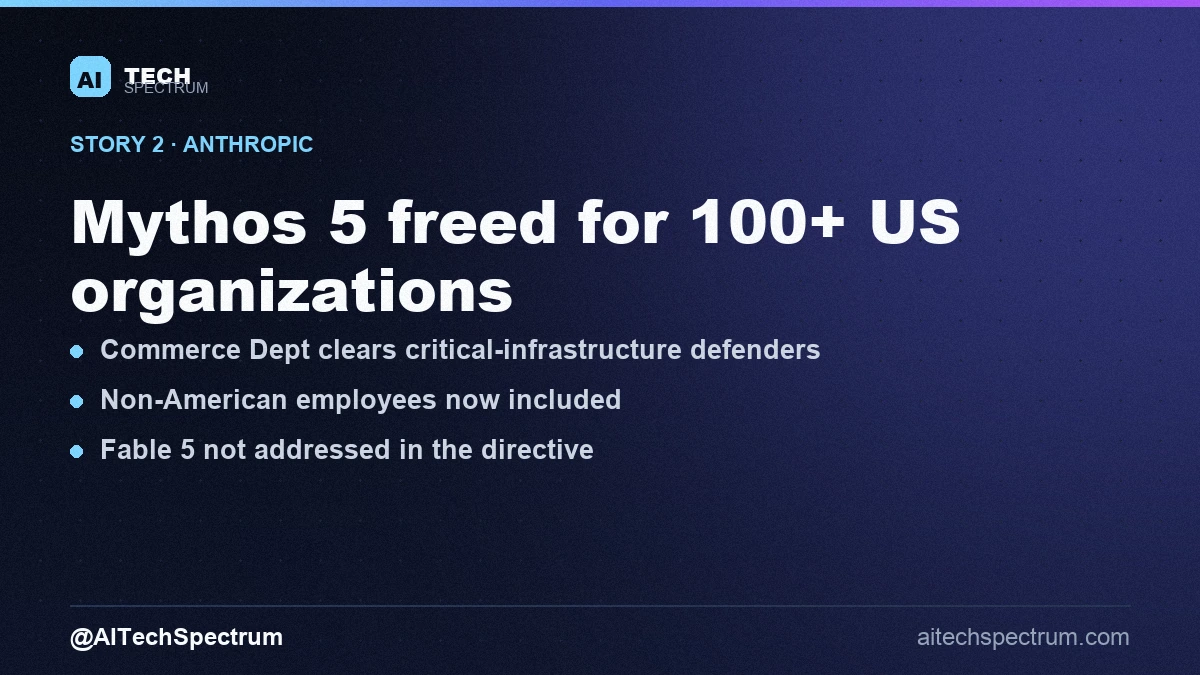
The mirror image of the OpenAI story played out at Anthropic. Two weeks after the export order that forced Anthropic to pull its cybersecurity models Mythos 5 and Fable 5, the Commerce Department is letting Mythos 5 back out — to more than 100 specific US agencies and companies, and notably to the non-American employees at those organizations, per Reuters and Semafor. Commerce Secretary Howard Lutnick wrote to Anthropic that he had "determined that appropriate safeguards are in place to permit certain trusted partners to access the Claude Mythos 5 Model." Anthropic confirmed on X that Mythos 5 — "our strongest cybersecurity model" — can be redeployed to US organizations that "operate and defend critical infrastructure," while it keeps working to widen access and bring back Fable 5.
Why it matters. Put the two lead stories side by side and the pattern is unmistakable: the same week one lab is told to hold a model back, another is told it can let one out — both decided in Washington, neither on the open market. The unit of approval is now the organization, not the product. What to watch. Fable 5, the more widely-released model, was pointedly left out of this directive, and the precise list of 100-plus organizations is not public. The signal to watch is whether "approved for critical-infrastructure defenders" hardens into a durable tiered-access system for every frontier security model.
3. Asian labs ship "Mythos-like" models into the gap
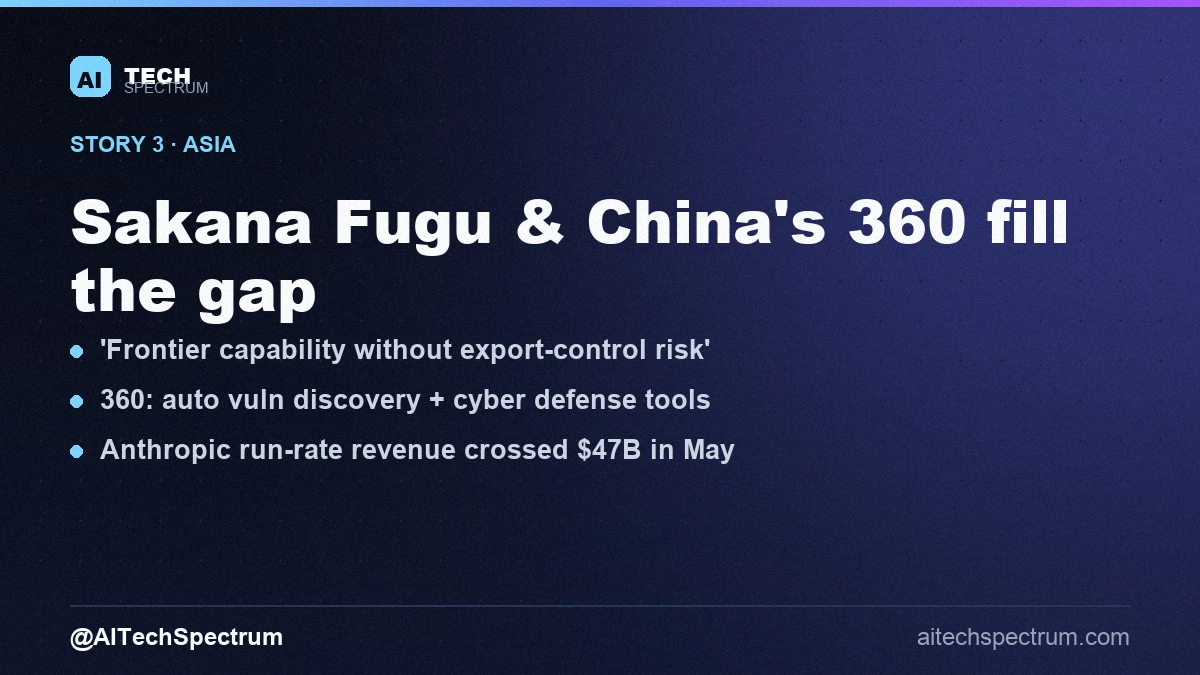
While the US sorts out who may touch its frontier models, two Asian labs moved into the opening. Tokyo's Sakana AI — founded by ex-Google researchers Ren Ito, Llion Jones and David Ha — launched Fugu, an agent-orchestration model it says "stands shoulder-to-shoulder with leading models like Anthropic's Fable 5 and Mythos Preview," with a website that advertises "delivering frontier capability without the risk of export controls." Sakana told TechCrunch the timing was "entirely coincidental" — the research was presented at ICLR this spring — but co-founder David Ha leaned into the moment on X: "Orchestration Models are the next frontier, beyond bigger models," arguing that "access to top models can disappear overnight." Days earlier, China's 360 unveiled Tulongfeng, for automated vulnerability discovery, and Yitianzhen, for automated cyber defense.
Why it matters. Export controls assume the thing controlled is scarce. The moment a capability has close substitutes abroad, a ban stops protecting a lead and starts handing the market away — and Anthropic, whose run-rate revenue crossed $47 billion in May, has real Asian enterprise revenue to lose. What to watch. Sakana frames Fugu as a hedge ("US models remain important to Asia"), while 360's founder framed vulnerability-finding AI as a national strategic asset — two very different theories of why the gap matters. The question is whether customers who switch for continuity ever switch back.
4. The quiet shift: a de facto licensing regime
Step back from the individual launches and a bigger change is visible. Dean Ball, a former White House AI adviser and soon-to-be OpenAI employee, argues — per TechCrunch — that President Trump's recent executive order, which asks certain AI companies to voluntarily submit their most advanced models for government review up to 30 days before release, has created a "de facto involuntary licensing regime" for frontier AI. The GPT-5.6 gate and the Mythos release are the first two outputs of that machinery operating in real time.
Why it matters. "Voluntary" review that determines whether you can ship is licensing by another name, and it concentrates a new kind of leverage in the executive branch — without, critics note, a published, predictable safety standard to meet. The risk Ball flags is not regulation per se but ambiguity: undefined criteria invite open-ended delay. What to watch. Two tells will show whether this is a precedent or a one-off — whether the administration publishes clear, repeatable release criteria, and whether labs without government relationships get the same treatment as those with them. (We're reporting the framing of a named analyst here, not endorsing a policy position.)
5. A founder runs his cancer data through Claude
For the human beat: a widely-shared TechCrunch profile follows Connor Christou, a 35-year-old founder diagnosed with an aggressive non-Hodgkin's lymphoma — a roughly one-in-420,000 cancer found incidentally. Facing two world-class oncologists with opposite recommendations, he gathered 12 opinions (11 favored the harder regimen, which raised his odds from about 60% to 85% for his presentation) and fed his blood work, scans, wearable data and a symptom journal into Claude. He credits the model with flagging a known false-positive pattern — thymus rebound after chemotherapy in patients under 40 — on an ambiguous end-of-treatment PET scan, an explanation later confirmed by a fourth doctor, sparing him radiotherapy. He's careful about what that means: "It didn't replace the doctors," he says; it "helped me ask the right questions."
Why it matters. A KFF poll in March found roughly a third of US adults now use chatbots for health information — this is the lived version of that statistic, and it shows AI's most valuable role may be helping patients interrogate their own care rather than diagnosing it. What to watch. The story includes the necessary counterweight: Mass General Brigham's Danielle Bitterman told the New York Times that general-purpose chatbots are frequently wrong and "have not been thoroughly evaluated" for personalized diagnoses. The honest read is that AI is a powerful preparation-and-second-opinion tool, not a clinician — useful for the questions, not the verdict. (Educational only; this is not medical advice — consult a licensed professional.)
What to take from today
One idea runs under all five stories: for the most capable models, distribution is now the battleground, not benchmarks. GPT-5.6 Sol is gated, Mythos 5 is selectively un-gated, Asian labs are racing to sell the capability the gates exclude, and the whole apparatus is being run through a review process that looks a lot like licensing. The decision framework that keeps paying off: when the headlines are about who is allowed to use a model rather than how good it is, the moat to watch isn't quality — it's access, trust, and who holds the gate. And as the founder story shows, the people getting the most out of AI right now aren't waiting for any of that to settle.
Tomorrow's brief lands by 15:00 UTC. If you'd rather read this in your inbox once a week — just the stories that actually matter — subscribe here.