Good morning. Five stories, one pattern: the models keep making headlines, but today's news is about the plumbing around them — who installs it, who finances it, who's allowed to sell it, and where its rough edges show. Prefer this once a week? Subscribe to the weekly brief.
1. Microsoft launches a $2.5B company to deploy enterprise AI
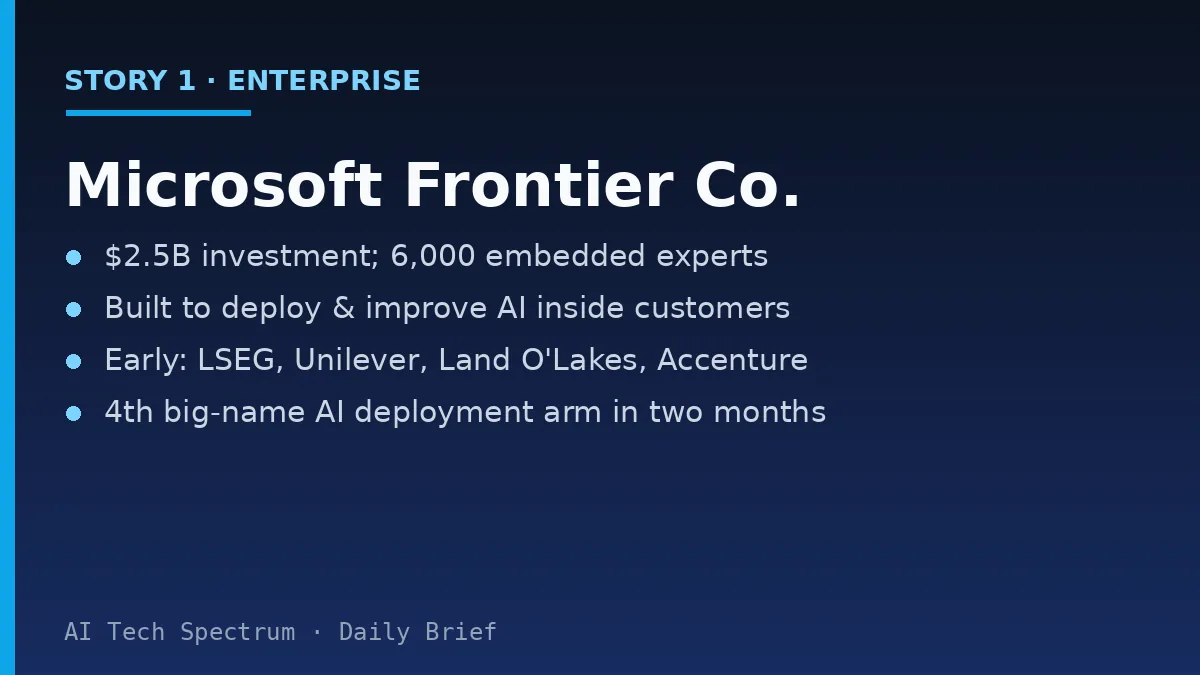
Microsoft announced Microsoft Frontier Company, a new operating business built to install and continuously improve AI systems inside customer organizations. Microsoft is putting $2.5 billion behind it and embedding 6,000 industry and engineering experts to "co-design, co-innovate, deploy and continuously improve AI systems at scale based on measurable business outcomes." Judson Althoff, CEO of Microsoft's Commercial Business, framed it as bigger than the now-common "forward-deployed engineer" playbook — "the largest, most capable, outcome-driven engineering organization in the industry" — and named the London Stock Exchange Group, Unilever, Land O'Lakes, and Accenture among early partners (via TechCrunch).
Why it matters. This is the fourth big-name entry into AI deployment-as-a-business in two months: Amazon committed $1B to an in-house forward-deployed engineering org just two days ago, and OpenAI and Anthropic stood up private-equity-backed joint ventures in May. The shared thesis is that the bottleneck in enterprise AI isn't the model — it's getting it into production against real data and real processes. Microsoft's edge is that its engineers are already inside much of the Fortune 500. What to watch. Whether "6,000 experts" is net-new hiring or a re-labeling of existing field staff, and whether the "measurable business outcomes" language turns into contracts that actually price on results rather than hours.
2. NVIDIA rewires how AI compute gets financed
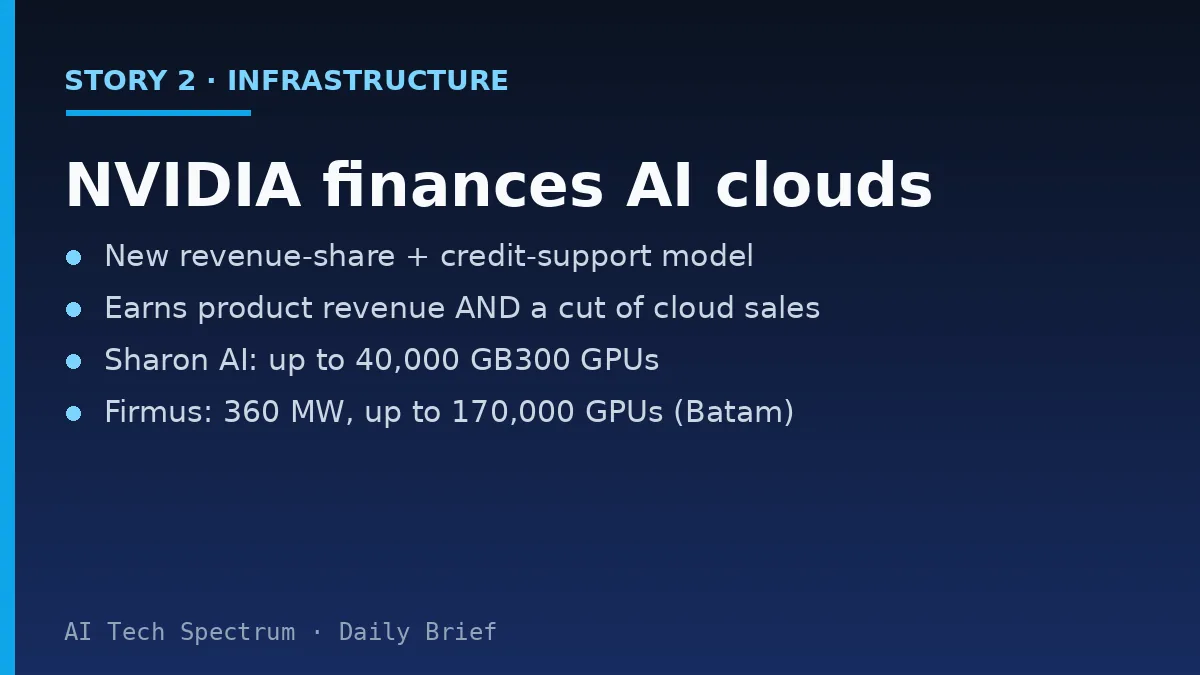
NVIDIA introduced a new business model that lets "AI clouds" procure its infrastructure through a revenue-sharing and credit-support arrangement, written by CFO Colette Kress and Raj Mirpuri. Instead of just selling chips, NVIDIA will help partners finance capacity and then earn "both standard product revenue and a share of the cloud revenue on the supported capacity" — a recurring, usage-linked cut of the AI factories it equips. Sharon AI and Firmus are among the first partners: Sharon AI is deploying up to 40,000 Grace Blackwell GB300 GPUs, while Firmus is building a DSX AI-factory campus in Batam, Indonesia, expected to scale to 360 megawatts and up to 170,000 GPUs. NVIDIA cited AI-native customers Baseten, Fireworks AI, and Together AI as the demand it's trying to unlock.
Why it matters. This puts NVIDIA on both sides of its own market — supplier and financier — extending the same circular-financing pattern that has drawn scrutiny over its multibillion-dollar commitments to customers like OpenAI. For fast-growing AI companies locked out of capital-intensive infrastructure, it can mean compute without waiting on site selection, power deals, and hardware bring-up. What to watch. The credit exposure. Revenue-share works beautifully while token demand compounds; if utilization on any of these AI factories disappoints, NVIDIA is now holding a slice of that downside, not just a paid invoice. (Informational, not investment advice.)
3. The US lifts export curbs on Anthropic's Fable 5 and Mythos 5
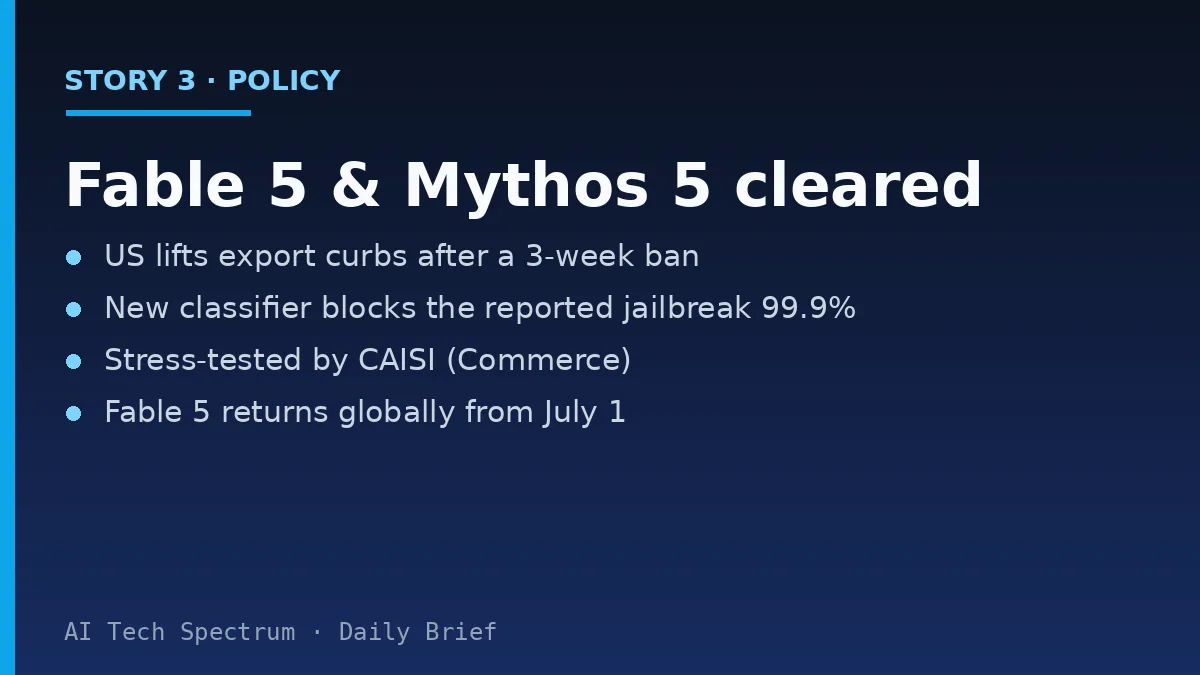
Anthropic said its Fable 5 and Mythos 5 models are publicly available again after the Commerce Department lifted the export controls imposed in mid-June, in a blog post corroborated by CyberScoop. The curbs followed an Amazon threat-intelligence report claiming to have jailbroken Fable's cybersecurity capabilities; Anthropic countered that equivalent and lesser models — it named ChatGPT 5.5, Claude Opus 4.8, and Kimi K2.7 — could identify the same vulnerabilities, calling the incident "a borderline case." The company trained new classifiers that it says block the reported technique 99.9% of the time and had them stress-tested by the federal Center for AI Standards and Innovation; Commerce Secretary Howard Lutnick confirmed the decision on X, and Fable 5 returns globally starting July 1.
Why it matters. This closes a three-week saga that saw Anthropic pull two flagship models, Asian labs rush out Mythos-like alternatives, and lawmakers question the whole affair — a case study in how ad hoc AI export policy can whipsaw a company mid-launch. The resolution leans on a governance pattern worth noting: a private lab, a federal testing body, and tighter classifiers negotiated in public. What to watch. Anthropic concedes the stricter safeguards will flag more benign requests, so expect complaints from defensive-security teams whose routine work gets blocked — and watch whether the classifier-plus-government-testing template becomes the standard price of shipping frontier models.
4. A white-hat used Claude to breach a festival ticketing system
Security researcher Ian Carroll used Claude Opus 4.7 to find and exploit an unauthenticated SQL-injection flaw in Front Gate Tickets — the Live Nation subsidiary that handles ticketing for nearly every major US festival, from Lollapalooza to Austin City Limits — Wired reported. Carroll's first attempts were stopped by a web-application firewall; when he asked Claude for another route, the model noted the firewall only inspected the outer layer of a query and wrapped the payload in a nested subquery that slipped past it (details corroborated by Cybernews and Android Authority). The hole exposed millions of customer and staff records and let him issue tickets to any event at any price. Carroll works within Anthropic's Cyber Verification Program, and Front Gate said it fixed the issue within 24 hours of his report.
Why it matters. This is the flip side of the Fable debate above: a mainstream, generally available model materially sped up finding a real, exploitable flaw in a system millions of people trust. The saving grace here is process, not capability — a vetted researcher, responsible disclosure, a 24-hour fix. What to watch. Whether defenders adopt the same loop at scale (point a model at your own attack surface before someone else does), and how ticketing and other high-value consumer platforms respond now that "the firewall only checks the outer query" is a prompt away.
5. LLMs are stuck in a groupthink groove — and a startup wants out
Ask Claude, ChatGPT, or Gemini for "a random number between 1 and 10" and you'll almost always get 7 — a tidy illustration of how uniform mainstream models have become, MIT Technology Review reports. The Australian startup Springboards built an LLM called Flint, trained to produce a wider spread of responses to open-ended prompts. In MIT TR's demo, that same random-number question returned 7 from ChatGPT and Claude but 3.7916 from Flint; asked to name a type of car, the mainstream models reached for Toyota or Honda while Flint offered a Ford F-150. The pitch: convergence is fine for coding or fact-finding, but a liability when you want an LLM to actually brainstorm.
Why it matters. Output diversity is the quiet variable behind a lot of AI disappointment — teams reach for a chatbot to generate options and get five versions of the same safe answer. It also matters for anyone using models to produce synthetic data or "creative" variety, where mode collapse degrades the result. What to watch. Whether "diversity" becomes a tunable feature the big labs expose directly (temperature never really solved this), or whether it stays a wedge for specialist challengers like Springboards. For now, the practical tip is free: if you need range from a mainstream model, tell it explicitly to avoid the obvious answer.
What to take from today
The models were quiet today; the scaffolding around them was loud. Microsoft is industrializing deployment, NVIDIA is industrializing the financing under the compute, and Washington just cleared Anthropic to sell its most capable models worldwide again — three moves that all assume demand keeps compounding. The two smaller stories are the useful counterweight: the Front Gate breach shows the capability is real enough to break things, and the groupthink research shows it's uniform enough to bore you. The decision-useful read for buyers: when a vendor pitches you on "deploying AI at scale," ask what they're actually selling — the model, the people who install it, the balance sheet that funds it, or all three — and price the risk accordingly.
Tomorrow's brief lands by 15:00 UTC. If you'd rather read this in your inbox once a week — just the stories that actually matter — subscribe here.