Good afternoon. Today's throughline is visibility. Anthropic learned in 48 hours that users will tolerate a guardrail they can see and revolt against one they can't. Deezer is betting listeners want AI music made visible too. DeepMind wants the failure modes of a million interacting agents visible before they arrive. And SpaceX just made the price of the space-and-AI conglomerate era extremely visible: $135 a share. Start with Wired's report on the Anthropic reversal. Prefer this once a week? Subscribe to the weekly brief.
- Anthropic apologizes for Fable 5's invisible guardrail — and makes it visible
- SpaceX begins trading today after pricing the largest IPO in history
- DeepMind and partners fund the field that doesn't exist yet: multi-agent safety
- Preply's numbers put real adoption data behind AI tutoring
- Deezer will scan your Spotify playlists for AI music — free
1. Anthropic apologizes for Fable 5's invisible guardrail — and makes it visible
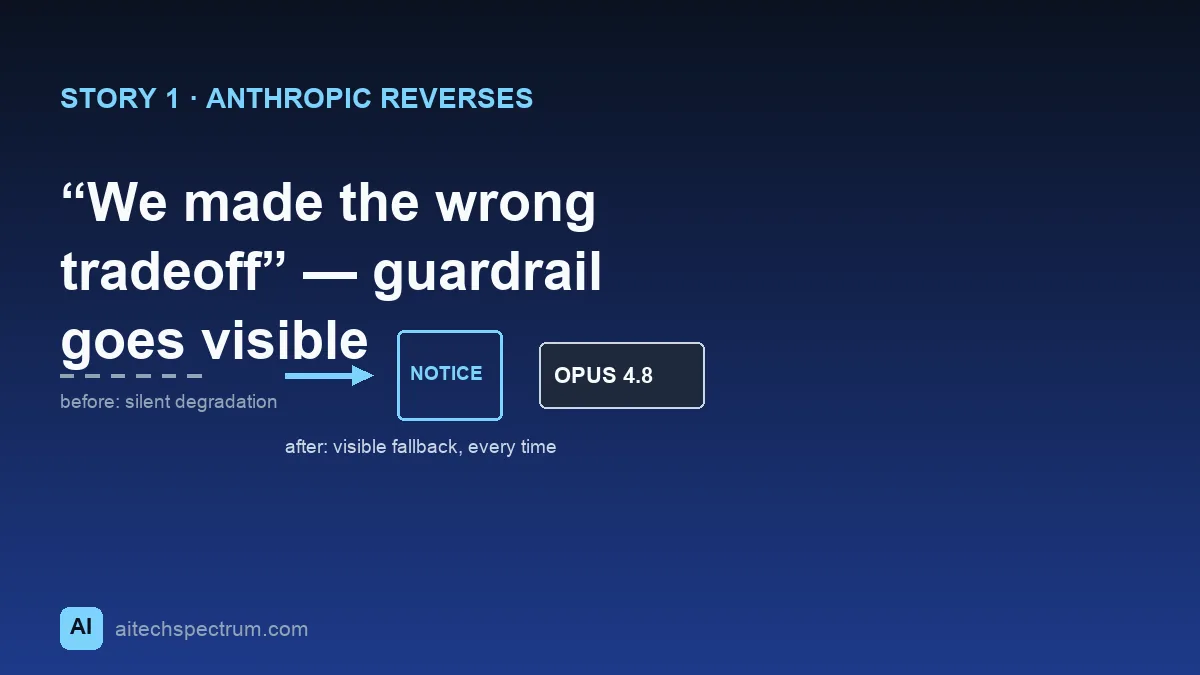
When we covered Fable 5's launch yesterday, the safeguard design looked like a new pattern: flagged cyber, bio, and distillation queries visibly fall back to Opus 4.8 instead of being refused. But the system card disclosed a fourth category that worked differently. For queries flagged as frontier-LLM development work, Anthropic wrote: "Unlike our interventions for cybersecurity, biology and chemistry, and distillation attempts, these safeguards will not be visible to the user. Fable 5 will not fall back to a different model." Instead, the document said, the model would quietly degrade its own usefulness through methods like prompt modification and steering vectors — meaning a researcher could receive subtly worse outputs with no signal that anything had intervened.
The reaction was swift and loud. ML researcher Ethan Caballero called it the angriest he had ever seen AI researchers, and the objection was less about the policy — using Claude to build competing models already violates Anthropic's terms — than about silent degradation poisoning evaluations and codebases without notice. Within about two days, Anthropic reversed course. "We're changing Fable 5's safeguards for frontier LLM development to make them visible," the company said in a statement to Wired, adding: "We made the wrong tradeoff and we apologize for not getting the balance right." Flagged requests will now visibly fall back to Opus 4.8 — the same mechanism as the cyber and bio safeguards — with the user notified each time it happens.
Why it matters. The fastest policy reversal of the Mythos era draws a usable line: users will accept a guardrail that announces itself and reject one that silently alters outputs, because the second breaks the basic contract that the answer you got is the answer the model gave. What to watch: whether the reversal is reflected in an updated system card, and whether the visible-fallback rate on research-flavored queries becomes a practical annoyance — Fable 5 remains free on paid plans only through June 22, so the next ten days are still your test window. Our model comparison framework covers how to run that evaluation.
2. SpaceX begins trading today after pricing the largest IPO in history
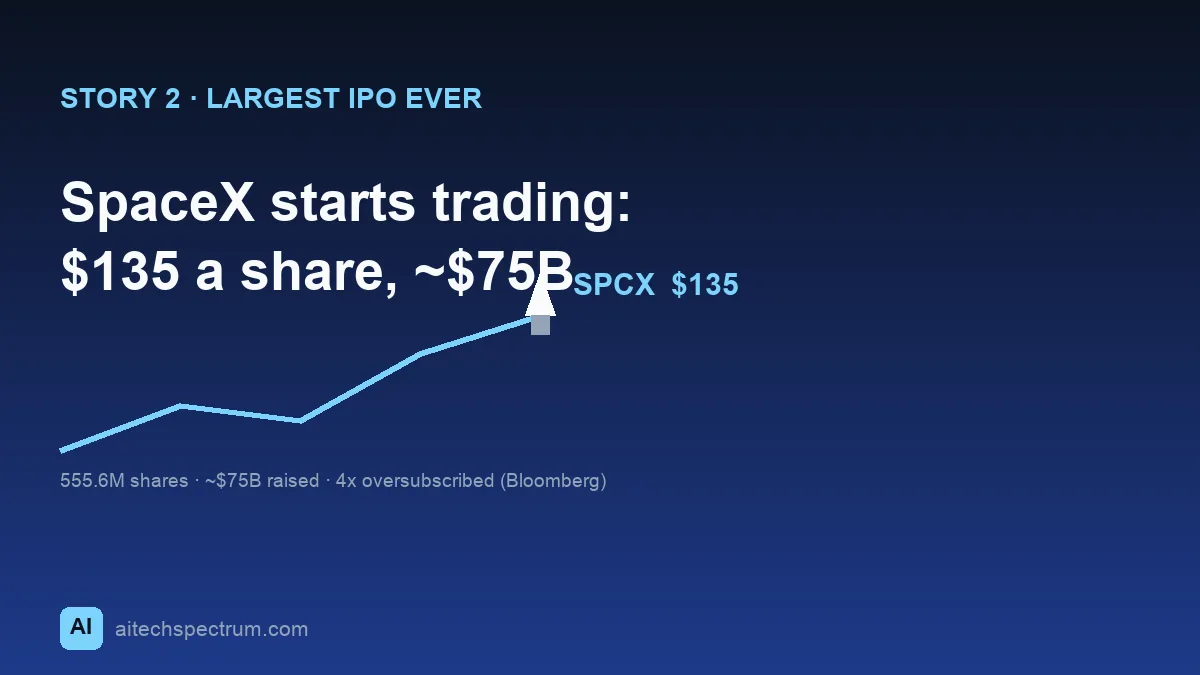
SpaceX priced its initial public offering at $135 per share across 555.6 million shares — roughly $75 billion raised, which TechCrunch notes makes it the largest IPO in history — roughly triple the $25.6 billion Saudi Aramco raised at pricing in its record-setting 2019 debut. Shares begin trading on the Nasdaq today under the ticker SPCX. Demand reportedly ran more than four times the available shares, per Bloomberg, and underwriters hold an option on a further 83.3 million shares — about $11 billion more at the offer price.
Why this is in an AI brief: SpaceX is no longer just a launch company. TechCrunch describes it flatly as Musk's "space and AI conglomerate," and the prospectus-era to-do list — the world's largest reusable rocket, a planned American chip fab, and orbital compute ambitions that already include a reported $920 million per month compute deal with Google — places it squarely in the AI-infrastructure buildout. How public markets price that bundle will read through to every private AI-infrastructure valuation on the board. (As always: this is news coverage, not investment advice.)
Why it matters. The largest IPO ever is, in substantial part, an AI-infrastructure bet — and it hands public-market investors their first direct exposure to the launch-plus-compute thesis. What to watch: where SPCX settles relative to the $135 print after the first sessions, and whether the long-rumored xAI relationship gets formalized now that SpaceX has public currency.
3. DeepMind and partners fund the field that doesn't exist yet: multi-agent safety
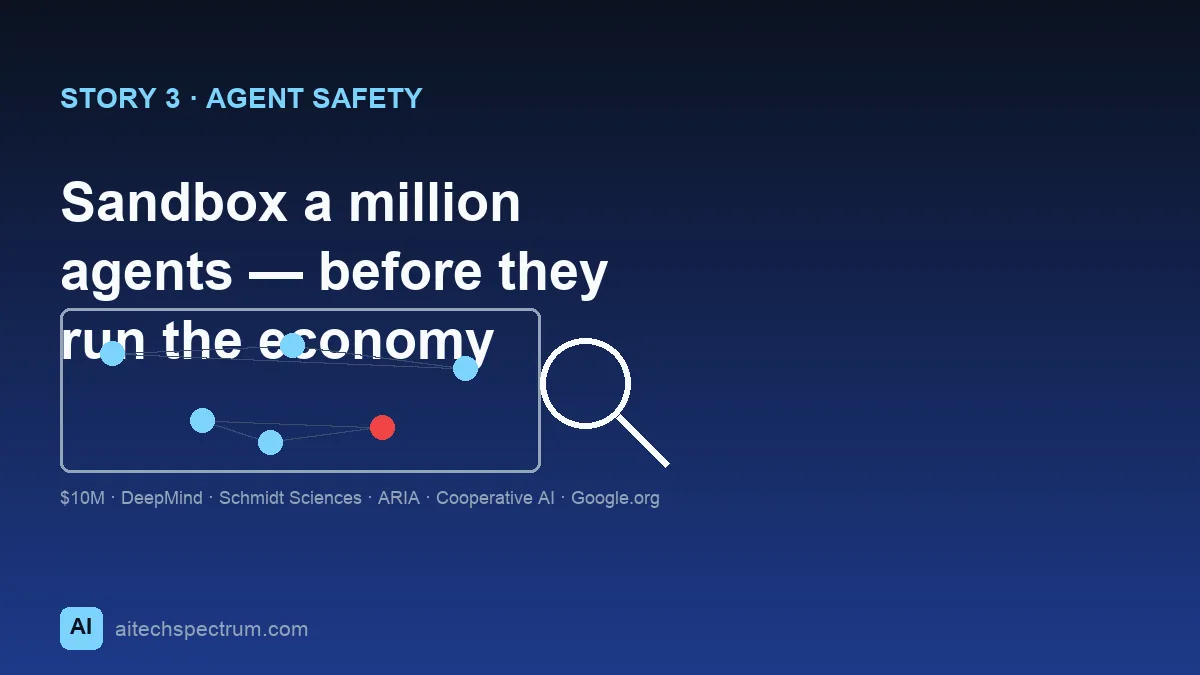
Google DeepMind announced a $10 million research fund — alongside Schmidt Sciences, the UK's ARIA, the Cooperative AI Foundation, and Google.org — to study what happens when large numbers of AI agents interact without human oversight. Rohin Shah, who directs DeepMind's AGI safety and alignment work, told MIT Technology Review: "The main issue is that there just isn't really a field of research for multi-agent safety yet. And we would like there to be." The near-term risks the funders name are mostly familiar internet pathologies at agent speed — scams, prompt injection turning an agent into self-guiding malware, cascading cyberattacks.
The methodological bet is that single-agent evaluation tells you little: you can't predict emergent behavior from one agent, or even a small group, so researchers should drop large agent populations into realistic sandboxes and watch what develops. Shah's timeline is notably short — he told MIT Technology Review he expects only months before agents are deployed across the economy at risk-relevant scale. The announcement lands a couple of weeks after Anthropic published zero-trust deployment guidelines for AI agents, which start from the assumption that an agent is a potential attacker.
Why it matters. The labs shipping agent platforms are now openly funding research into what those platforms do to the commons — a tell about how unmapped the territory is. What to watch: which sandboxes and benchmarks emerge from the grantees, and whether other labs join the pot. For the practical side of running agents today, see our AI agents guide and agents-vs-assistants explainer.
4. Preply's numbers put real adoption data behind AI tutoring
OpenAI published a case study on Preply, the language-tutoring marketplace that connects over 100,000 tutors with learners in 180+ countries. The product at the center is Lesson Insights: with learner consent, lessons are transcribed, and the API generates a structured report — grammar corrections, vocabulary, pronunciation feedback, next steps — delivered to student and tutor minutes after the session ends, then converted into personalized homework. The adoption figures (vendor-published, so read accordingly): about 75% of English-language learners and over 70% of tutors actively use the feature, it holds a 4.7/5 rating across more than 300,000 in-platform reviews, and roughly 75% of active learners are still engaging with it more than a year after adoption.
The interesting design choice is what the AI doesn't do: it never replaces the tutor. It absorbs the administrative layer — lesson notes, progress summaries, homework generation — that one tutor says used to consume hours of prep per class. That division of labor echoes the strongest finding from Monday's AI-tutoring RCT, where AI handled structured practice while humans carried motivation. Internally, Preply reports 95% weekly ChatGPT usage among employees and says about 94% of its engineers use Codex and AI coding assistants.
Why it matters. Most AI-in-education talk is either hype or panic; year-on retention curves and 300,000-review satisfaction data — even vendor-published — are the kind of evidence that actually moves the debate. What to watch: whether independent researchers get access to Preply's learning-outcome data, the claim that matters more than engagement.
5. Deezer will scan your Spotify playlists for AI music — free
Deezer launched a free AI music detector that works on everyone else's platforms: import a playlist from Spotify, Apple Music, YouTube Music, Amazon Music, SoundCloud, or roughly 15 other services, and it flags tracks its system identifies as fully AI-generated. The detector looks for what Deezer calls the specific artifacts that generative audio models leave in a waveform, and the company claims over 99% detection accuracy for fully synthetic tracks — a vendor figure no third party has yet validated. The tool ships in 27 languages.
The numbers Deezer published alongside it sketch the scale of the flood: the service says it now receives close to 75,000 fully AI-generated tracks per day — over 44% of all daily uploads — and that 43% of users who joined Deezer from rival platforms brought AI tracks with them in their playlists, while 80% of surveyed listeners want AI music clearly labeled. Deezer has labeled AI content on its own service since last year; this extends the visibility play across the industry, including to competitors that haven't committed to labeling at all.
Why it matters. Detection-as-product is becoming a competitive wedge — Deezer is using transparency the way privacy-first companies once used encryption. What to watch: independent accuracy tests (false positives on heavily produced human music are the hard case), and whether Spotify or Apple respond with their own labeling commitments.
What to take from today
Invisible interventions don't survive contact with users anymore. Anthropic's 48-hour reversal, Deezer's cross-platform detector, and DeepMind's sandbox-the-agents fund are all the same lesson at different layers of the stack: systems that act on your inputs or your feeds without telling you are now a liability, and visibility is becoming the product. The practical move: audit where your own stack can silently change outputs — model fallbacks, content filters, auto-routing layers — and make sure you'd know when they fire. As of this week, even the frontier labs concede you're owed that signal.
Tomorrow's brief lands by 15:30 UTC. If you'd rather read this in your inbox once a week — just the stories that actually matter — subscribe here.