Good morning. Five stories, and the throughline is leverage — not over the leaderboard, but over the things around the model: the people who build it, the data inside it, and the trust you place in it. Start with the one that moved two of the most decorated names in AI across enemy lines in a single week: DeepMind's brain drain. Prefer this once a week? Subscribe to the weekly brief.
1. DeepMind loses Jumper and Shazeer in a week
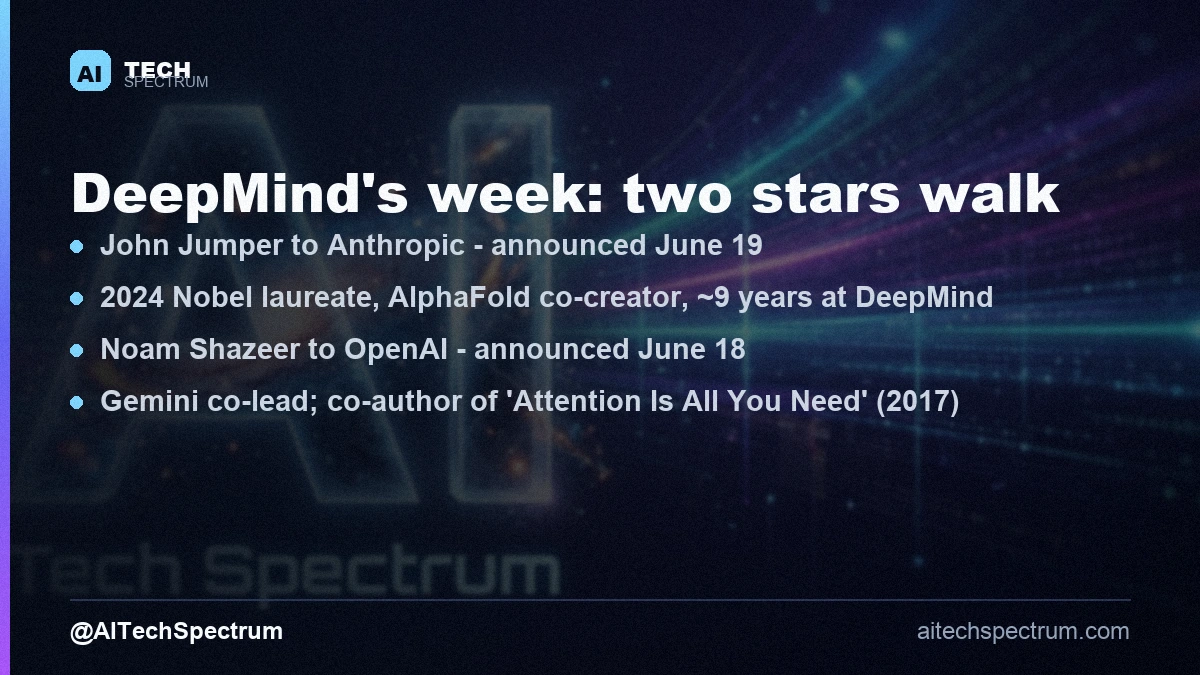
Google DeepMind lost two of its most decorated researchers in a single week. On Friday, John Jumper — who shared the 2024 Nobel Prize in Chemistry with DeepMind CEO Demis Hassabis for AlphaFold, the model that predicts a protein's 3-D structure from its amino-acid sequence — announced he is leaving for rival Anthropic after "nearly 9 years." In a post on X, Jumper wrote that Hassabis "took a real chance letting me lead the AlphaFold team just six months after finishing my PhD," and called DeepMind "a special place." Days earlier, Noam Shazeer — a Gemini co-lead and a co-author of the 2017 "Attention Is All You Need" paper that introduced the Transformer architecture under every modern model — told colleagues he is leaving for OpenAI, less than two years after Google paid to bring him back through its 2024 Character.AI deal. OpenAI's Sam Altman welcomed him publicly: "noam is one of the people I have most wanted to work with since the very beginning of openai. only took 10 years."
Why it matters. Frontier AI is a talent market as much as a model market, and DeepMind — long Google's crown jewel — is now exporting marquee names to the two rivals it competes with most directly. Jumper anchors the AI-for-science story; Shazeer helped invent the architecture the whole field runs on. Losing both in a week is a signal about where ambitious researchers believe the frontier is now being set. What to watch. Where Jumper actually lands inside Anthropic — his role hasn't been detailed — and whether this is a cluster or a trend, given that several of the original Transformer co-authors have already left Google. Watch for Google's retention response and for what AlphaFold's next chapter looks like without its co-creator.
2. Apple spreads AI through iOS 27, beyond Siri
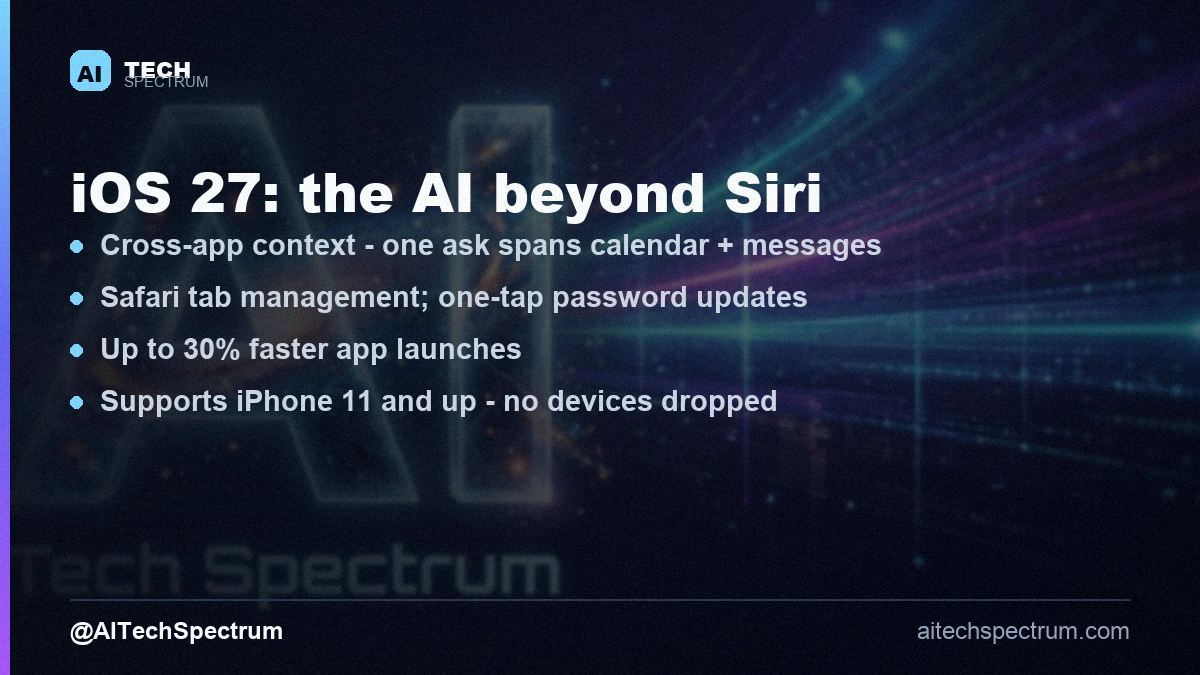
Two weeks after WWDC, the practical shape of iOS 27 is coming into focus — and the most useful AI isn't the headline Siri rebuild. The revamped Siri — reported to lean on Google's Gemini for world knowledge, housed in a standalone app with on-screen awareness — grabbed the keynote, but iOS 27 also threads Apple Intelligence through everyday apps: Safari tab management, one-tap password updates, and cross-app context so a request like "add this flight to my calendar and text mum the arrival time" runs without copy-paste. iOS 27 also claims up to 30% faster app launches and, notably, drops no devices — every iPhone that ran iOS 26 (iPhone 11 and up) is supported. It also arrives as Tim Cook prepares to hand the CEO role to hardware chief John Ternus on September 1.
Why it matters. Apple's AI rollout has been the most cautious of the megacaps, so the real story here is distribution, not a model race: putting Apple Intelligence inside the apps a billion people already open every day is how Apple catches up without out-benchmarking anyone. The reported Gemini arrangement also signals Apple is comfortable renting the frontier rather than building it. What to watch. Whether the standalone Siri app and screen-awareness actually ship on schedule — Apple has slipped Siri's AI overhaul before — and how the Gemini partnership is disclosed. For users, the no-device-cut support list is the quiet win.
3. Signal's Whittaker: chatbots 'are not your friends'
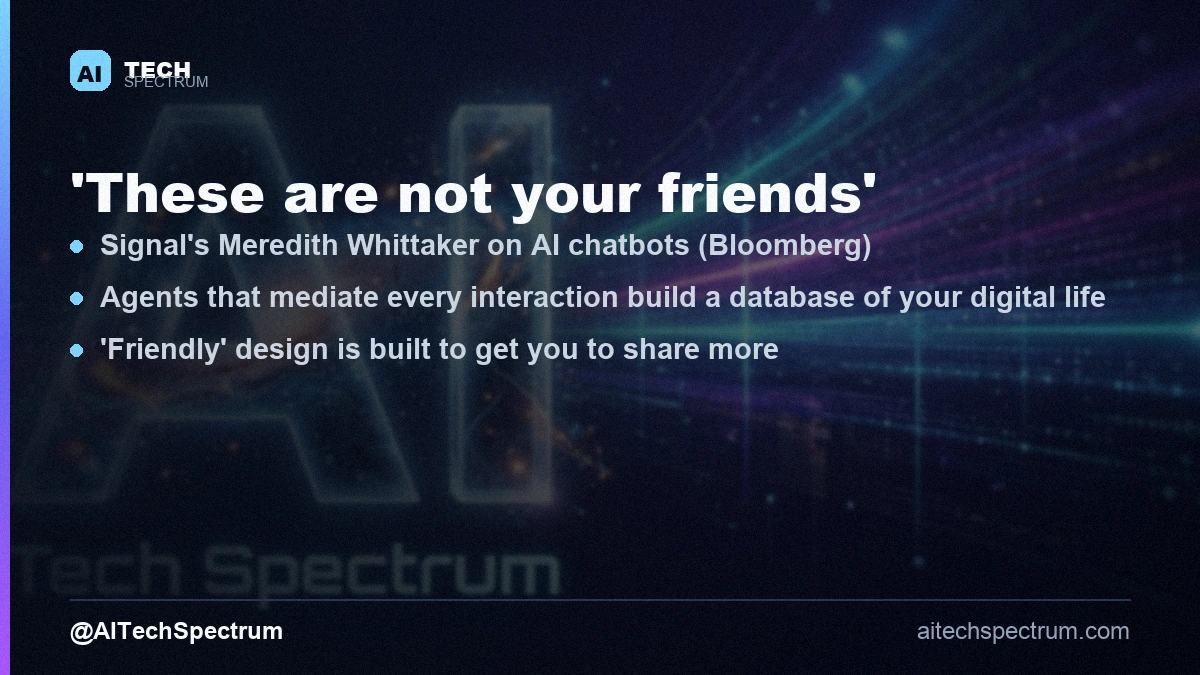
Signal president Meredith Whittaker used a Bloomberg interview to push back on the industry's friendliest framing of AI. "These are not your friends," she said of chatbots like ChatGPT and Claude. "These are not conscious beings" — nor, she added, "sentient interlocutors." Whittaker, who said she uses AI "to format a document here and there" but doesn't "ask them questions," argued the deeper risk is architectural: as AI agents are given access to mediate every interaction on your device, they assemble databases of your entire digital life that become prime targets for hackers and governments. The emotional pull of a "friendly" assistant, she argued, is a design choice — one that gets people to lower their guard and share more than they otherwise would.
Why it matters. As the industry races to slot agents between users and their data — see Apple's cross-app Siri, above — Whittaker is the most prominent privacy voice arguing the trade-off is being undersold. For anyone weighing an AI assistant with deep device access, "what does it collect, and who can reach it?" is exactly the question her warning sharpens. What to watch. Whether "agentic" privacy concerns translate into real product friction or regulation, and how vendors respond on data retention and on-device processing. Signal's stance is a useful counterweight to keep in view as agents get more access, not less.
4. The Atlantic makes AI music-training data searchable
The Atlantic turned the black box of AI training data into something you can search. Reporter Alex Reisner built a public, searchable database of four datasets of music used to train AI models — two of them enormous, at roughly 12 million and 9 million tracks. Until now, a musician who suspected their work had been swept into a training set had little practical way to check; the tool lowers that cost to a search box. The Atlantic reports that both Google and Stability AI have acknowledged using some of this material in research papers, and follow-up coverage flagged artists from Drake to Titus Andronicus turning up in the datasets.
Why it matters. Training-data provenance is the legal and ethical fault line of generative AI, and most of that fight has played out in sealed discovery documents and lawsuits. A public, searchable index shifts leverage toward creators and could feed the next wave of licensing demands and litigation. What to watch. Whether labels and individual artists use the tool to support claims, and how model makers respond on disclosure and licensing. "Was my work in here?" is on its way to becoming a standard question.
5. In the Weights scores what models know about you
For the weekend, a tool that turns "what does the AI know about you?" into a leaderboard. In the Weights, built by ex-OpenAI designers Thomas Dimson and Joey Flynn, queries a roster of models — Grok, Gemini, multiple versions of GPT, Claude, Llama — with a prompt like "Who is [name]?", clusters the answers, and assigns a "strength score" for how well models recall someone without using web search. (At launch, "Home Alone" star Macaulay Culkin topped the leaderboard with a score of 988.) It's a novelty, but it sits on a real shift: Dimson told TechCrunch that "Google vanity searches are the wrong objective in 2026 as more traffic moves to LLMs." The site also surfaces — and flags — how often the models simply make things up about a given name.
Why it matters. Beneath the gimmick is a genuine measurement question. As people increasingly ask a chatbot rather than a search engine "who is this person or company?", what a model has encoded about you starts to matter the way a Google first page used to. For brands and professionals, "what do the models say about me?" is quietly becoming a real reputation surface. What to watch. Whether tools like this mature from toy into genuine AI-reputation monitoring — and how widely the answers (and hallucinations) vary across models, which In the Weights itself puts on display.
What to take from today
Five stories, one undercurrent: the contest is moving off the leaderboard. DeepMind didn't lose a benchmark this week — it lost two of the people who set them. Apple isn't trying to win a model race; it's spreading AI through apps people already open. The Atlantic didn't argue about copyright in the abstract; it made the training data searchable. Whittaker didn't review a chatbot; she questioned whether you should befriend one. And In the Weights measured not a model's IQ but its memory of you. The decision framework that keeps paying off: judge AI by its second-order effects — who holds the talent, who controls the data, and who you're actually trusting — not by the size of the demo.
Tomorrow's brief lands by 15:00 UTC. If you'd rather read this in your inbox once a week — just the stories that actually matter — subscribe here.