Good morning. Five stories, and the throughline is the gap between how fast AI is being adopted and how slowly the guardrails are catching up. It opens in the place the technology is moving fastest right now — inside a Fortune-100 workforce: Samsung's company-wide ChatGPT rollout. Prefer this once a week? Subscribe to the weekly brief.
1. Samsung puts ChatGPT and Codex in front of its whole workforce
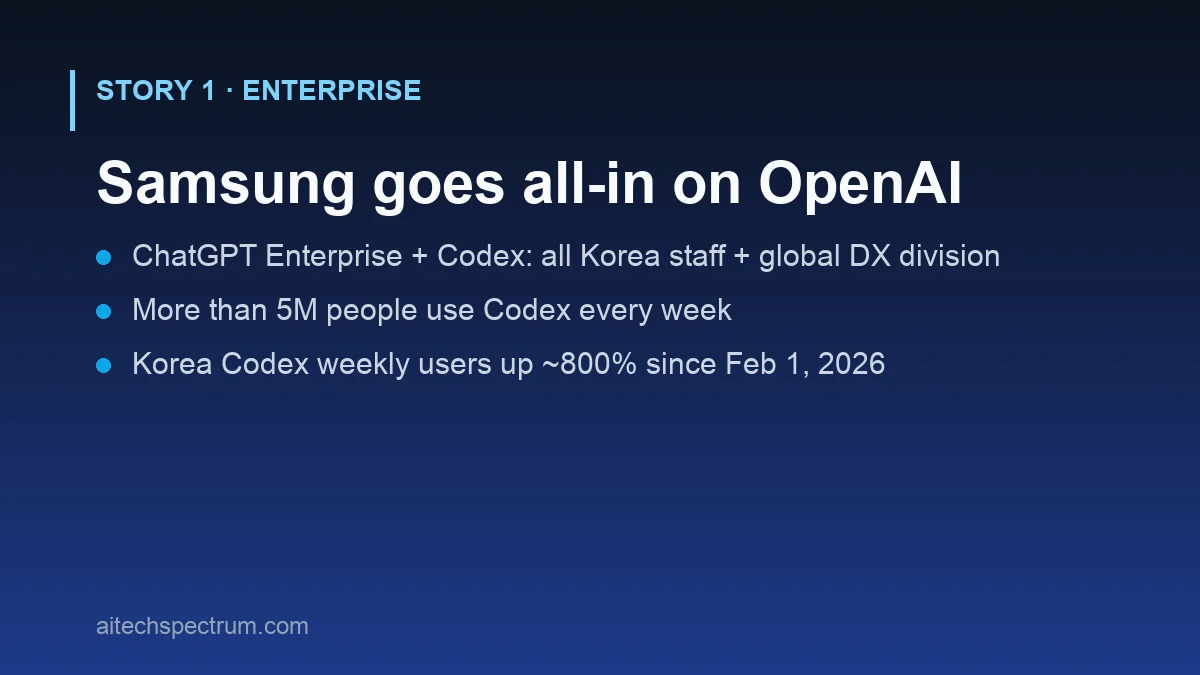
Samsung Electronics is putting OpenAI's tools in front of essentially everyone. Under a deal announced by OpenAI, ChatGPT Enterprise and Codex will be available to all Samsung Electronics employees in Korea and to all employees worldwide in its Device eXperience (DX) division — the unit behind its phones, TVs and home appliances. OpenAI calls it "one of our largest enterprise deployments to date," and the use cases run well past coding: software development, manufacturing, marketing, product development and corporate functions. OpenAI says more than 5 million people now use Codex every week, and that Codex's weekly active users in Korea have grown nearly 800% since February 1, 2026. The relationship runs both ways — Samsung already supplies advanced memory for OpenAI's AI infrastructure, and this extends it from hardware into workforce-wide adoption.
Why it matters. The interesting line in OpenAI Korea GM Harrison Kim's statement is that Samsung is treating AI "not as a tool limited to certain teams or functions, but as a core platform." That is the shift that actually moves revenue and headcount math: not a pilot for the engineering org, but a default tool for the whole company. Samsung also anchors a fast-widening Korean beachhead for OpenAI — Seoul National University is giving ChatGPT Edu to all 47,000 of its members, ChatGPT now answers questions inside KakaoTalk group chats, and LG, Krafton and Toss are among the local enterprises already on board. What to watch. Whether "everyone gets Codex" produces measurable productivity Samsung is willing to disclose, and how its governance framework — OpenAI says prompts and code stay sandboxed and out of model training — holds up at this scale. Company-wide rollouts are where the security and data-handling questions in story four stop being hypothetical.
2. Trump says the Anthropic national-security standoff has cooled
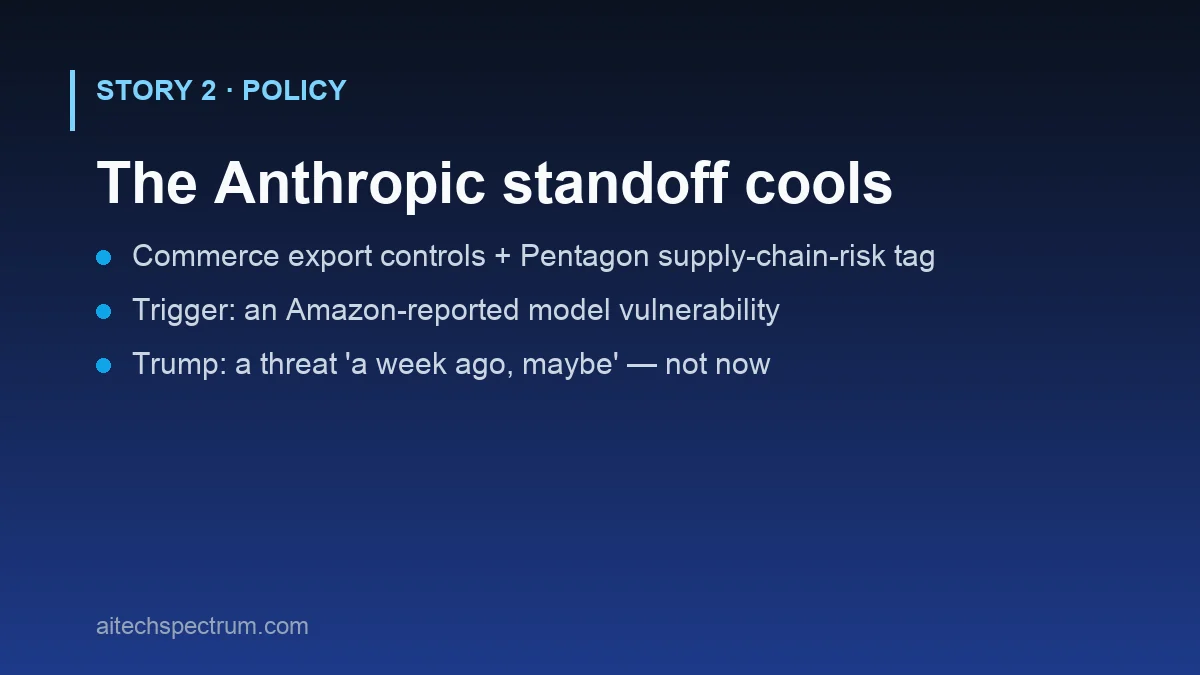
The most consequential AI story of the past two weeks has been a government one, and over the weekend it cooled. In an interview for "The Axios Show," President Trump was asked whether he viewed Anthropic or CEO Dario Amodei as a national-security threat. "Well, not now, but a week ago, maybe," he said, adding that he came away from the G7 summit thinking Amodei was "nice" and "smart" and "responded very responsibly." The context: the administration had hit Anthropic with treatment usually reserved for foreign adversaries — Commerce Department export controls restricting foreign nationals (and any country outside the U.S.) from accessing its most advanced models, plus a Pentagon designation as a supply-chain risk. Per Axios, the trigger was an Amazon report of a model vulnerability; Trump said "it was a competitor and a part owner that turned Anthropic in," a pointed reference to Amazon's dual role as both rival and Anthropic investor.
Why it matters. This is the first time Washington has used export-control machinery against a U.S. frontier lab's own models, and the precedent outlives the thaw. Trump did not rule out invoking the Defense Production Act — "I have the power to use a lot of things," he said, "but I'm not sure I have to do that" — and the two sides are now reportedly working on shared standards for evaluating AI "jailbreaks." Anthropic, for its part, said it is "grateful to the administration for their ongoing partnership" and committed to "protecting critical infrastructure" and U.S. AI leadership. What to watch. Those jailbreak-evaluation standards are the real story now — they could become the template for how Washington polices model releases industry-wide. Watch, too, for the allied-government reaction: a U.S. order that foreign nationals can't touch a leading American model has implications for every multinational, Samsung included, that wants to standardize on one.
3. At ISC, NVIDIA pushes agentic AI onto exascale science machines
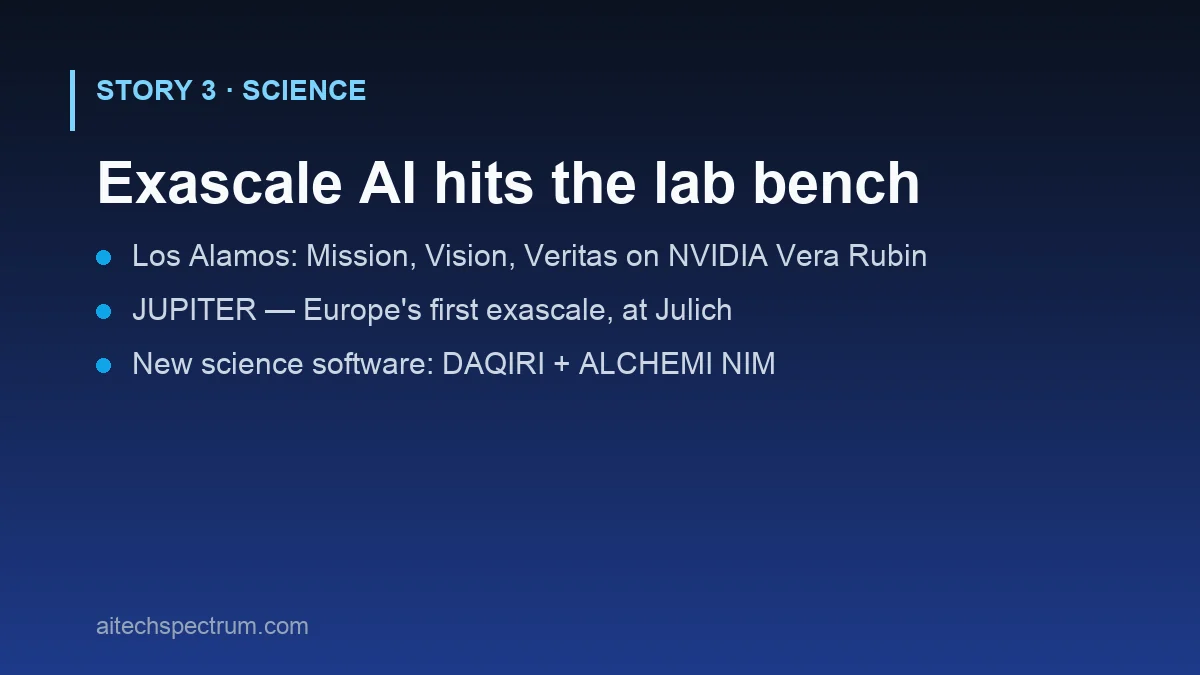
While the supercomputing community gathered at ISC in Hamburg this week, NVIDIA used the venue to make its clearest pitch yet that AI for science is moving from simulation to autonomous, "agentic" workflows. The company said Los Alamos National Laboratory's three next-generation systems — Mission, Vision and Veritas, built with HPE on the Cray GX5000 architecture — will use its new Vera CPUs in the Vera Rubin platform to "unlock agentic AI for science." Europe's first exascale machine, JUPITER at Germany's Forschungszentrum Jülich, is already running scientific workloads on Grace Hopper Superchips. And NVIDIA introduced new software — the DAQIRI library and ALCHEMI NIM microservices, with a cuPhoton reference code coming — aimed at chemistry, materials discovery and even the search for dark matter. (These are NVIDIA's own announcements and framing; the agentic-science claims are the vendor's.)
Why it matters. The frontier-model race gets the headlines, but the quieter contest is over who supplies the substrate for science itself — and NVIDIA is trying to make its chips and software the default from the lab bench up. "Agentic AI for science" is marketing until a lab publishes a result it couldn't have reached otherwise, but the hardware commitments are real and large. What to watch. Whether national labs report concrete discoveries — not just throughput benchmarks — from these systems, and whether the software stack (DAQIRI, ALCHEMI) gets traction outside NVIDIA-sponsored demos. The tell will be independent researchers citing the tools in published work.
4. The security bill comes due for vibe-coded apps
As the tools in story one put code generation in front of millions of non-developers, The Verge published a useful cautionary tale. It opens with a man who proudly "vibe-coded" a website and launched it immediately — only to discover, months later, a hidden SQL-injection flaw that could have exposed the site. The piece's point is not that AI-assisted coding is bad; it's that the step most often skipped is the one a professional developer would never skip: a security review before shipping. When the person prompting the model can't read the code well enough to spot an injection risk, the vulnerability goes live with the launch.
Why it matters. "Vibe coding" — describing an app in plain language and letting a model build it — is the most democratizing thing AI has done for software, and the most quietly risky. The same week Samsung hands Codex to its whole workforce, the failure mode is worth naming: code that works is not the same as code that's safe. What to watch. Whether the platforms that sell vibe-coding (and the enterprises deploying it) build security scanning into the default workflow, rather than treating it as an advanced add-on. If you're shipping something AI helped you build, the cheap insurance is an automated scan and a real review before it goes public — and locking down the accounts and data behind it. (Our sister site has a plain-English starting point in the sidebar.)
5. Grok lands inside Microsoft Word and PowerPoint
For a lighter close that rhymes with the lead: xAI spent last week pushing Grok into the productivity apps people already live in. It released a Grok add-in for Microsoft Word — turn notes into documents, restyle and format your work, or pull web research straight into the page — and a companion add-in for PowerPoint. It's a modest set of features, but it fits a clear pattern: the assistant is increasingly something you summon inside Word, Slack or your data platform rather than a separate destination you visit.
Why it matters. Distribution is becoming the real battleground. Whether it's OpenAI inside Samsung's workflows or Grok inside an Office ribbon, the winners are wiring themselves into the surfaces where work already happens — which makes "which assistant is smartest" matter less than "which one is already in front of me." What to watch. Whether Microsoft, whose own Copilot lives in the same apps, treats third-party add-ins like Grok's as welcome or as something to wall off.
What to take from today
One current runs under all five: AI is being adopted faster than it's being governed. Samsung defaulted an entire workforce onto it. Washington reached for export controls, then walked them halfway back while it figures out the rules. NVIDIA is wiring it into the machines that do national-lab science. The Verge showed what happens when the safety step gets skipped. And xAI keeps slipping the assistant into the apps you already open. The decision framework that keeps paying off: when adoption is this far ahead of the guardrails, the edge goes to whoever asks the boring questions first — what does it collect, who can reach it, and did anyone check the code — before everyone else has to.
Tomorrow's brief lands by 15:00 UTC. If you'd rather read this in your inbox once a week — just the stories that actually matter — subscribe here.