Good morning. Five stories, and the throughline is scale — of capability, of compute, of reach, and of how much we're now willing to let AI do on its own. It opens where the stakes are highest: the race to turn frontier models loose on the world's unpatched software. Prefer this once a week? Subscribe to the weekly brief.
1. OpenAI sets out to patch the world's open-source bugs
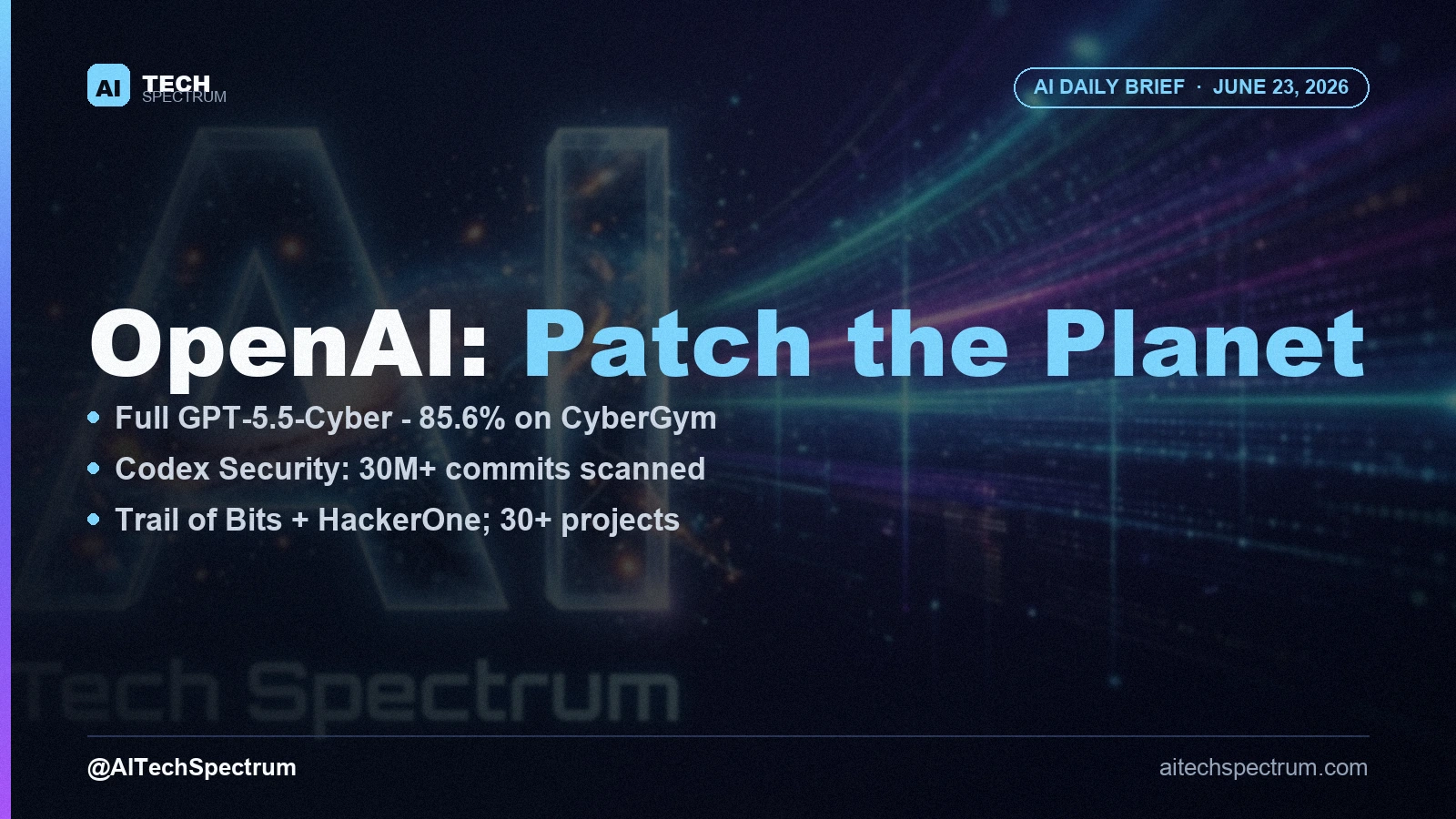
OpenAI used a major expansion of its Daybreak program to make a blunt argument: AI has flipped the bottleneck in cybersecurity from finding vulnerabilities to fixing them. It shipped the full version of GPT-5.5-Cyber — which it says reached 85.6% on the CyberGym benchmark versus 81.8% for GPT-5.5 — alongside an updated Codex Security plugin that, since March, has scanned more than 30 million commits across over 30,000 codebases. The headline initiative is "Patch the Planet," founded with Trail of Bits and in collaboration with HackerOne: more than 30 open-source projects (cURL, Go, Python, Sigstore and pyca/cryptography among them) have committed, and an initial five-day sprint surfaced hundreds of issues and merged dozens of patches.
Why it matters. This is explicitly a race. Anthropic's competing Project Glasswing reported that roughly 50 partners had used its Claude Mythos Preview model to find more than 10,000 high- or critical-severity flaws, and expanded to about 150 organizations on June 2. Both labs now make the same case — and OpenAI cites Linux Foundation and Harvard research that 94% of widely used open-source projects rely on fewer than ten developers for over 90% of their code. What to watch. Patches landing, not bugs found, is the metric that protects anyone — and the dual-use tension underneath it: the same models that close holes can open them, which is why OpenAI is gating GPT-5.5-Cyber to vetted defenders and brokering "Trusted Access for Cyber" deals with the US and allied governments.
2. SpaceX rents Reflection AI up to $6.3 billion in compute
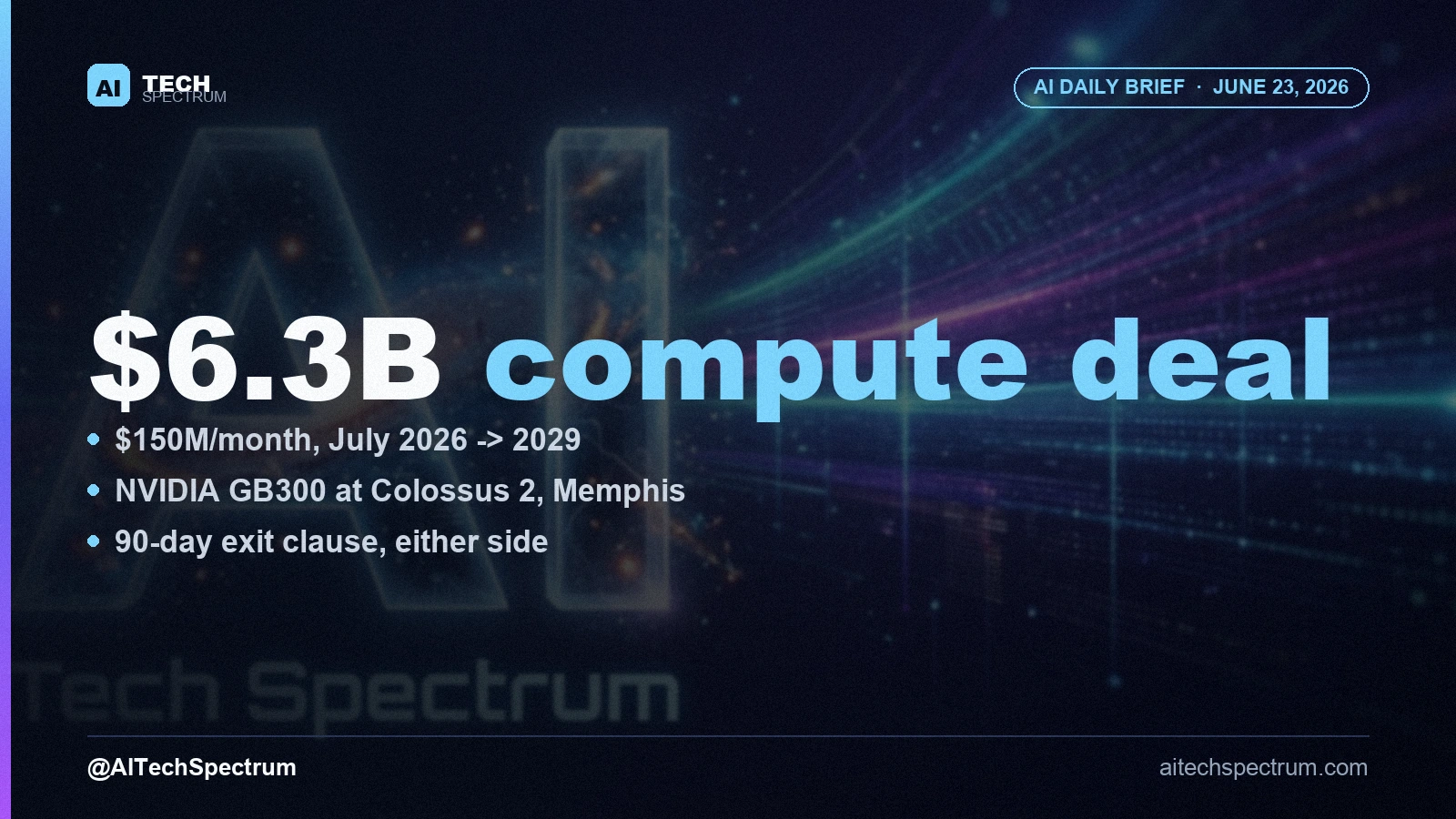
Underneath the model news sits the bill for the compute that makes it possible — and it just got a striking number. SpaceX agreed to rent the open-source lab Reflection AI capacity worth up to $6.3 billion, with Reflection paying about $150 million a month from July 1, 2026 through 2029 for immediate access to NVIDIA's latest GB300 chips at the Colossus 2 data center near Memphis. Colossus was built by Elon Musk's xAI — now part of SpaceX — to train Grok; the company is turning spare hardware into recurring revenue. Per TechCrunch, the contract carries a 90-day exit clause either side can pull after the first three months. Reflection, founded by former Google DeepMind researchers and recently valued near $25 billion, counts NVIDIA among its backers.
Why it matters. A $150-million monthly compute bill is an extraordinary operating commitment for a startup, and it shows how vertically integrated the buildout has become: Musk's empire now trains its own models and rents the surrounding capacity to rivals. The same chips powering one lab's frontier run are a landlord business for another. What to watch. Whether other labs sign onto Colossus capacity the same way, and whether that exit clause gets exercised — a tell for how durable these eye-watering compute contracts really are when model roadmaps shift.
3. NVIDIA puts always-on agents into telecom operations
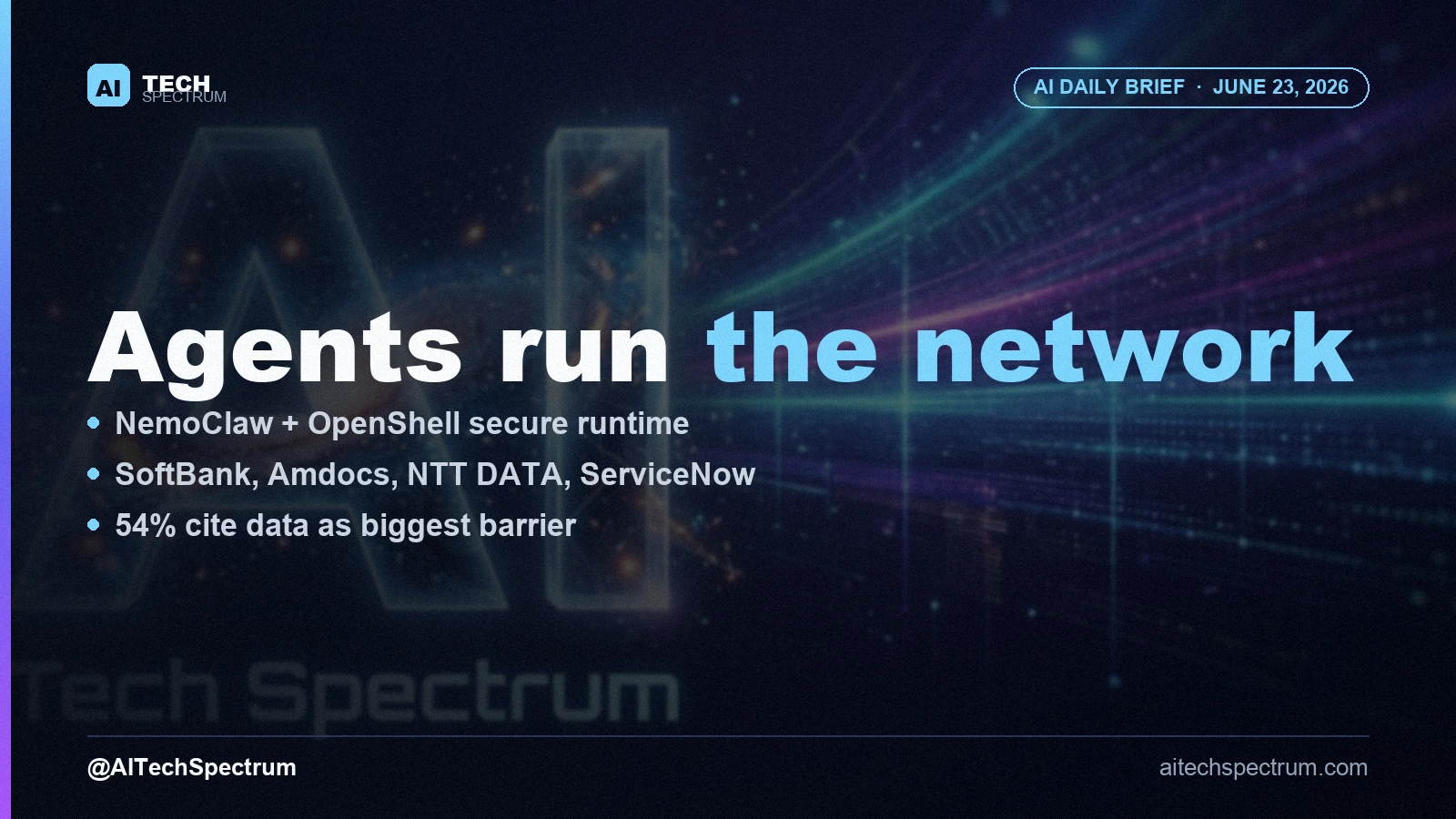
At TM Forum's DTW Ignite 2026 in Copenhagen, NVIDIA and its partners pitched the stack for "autonomous" telecom networks — long-running agents that proactively watch for problems and coordinate changes across network, IT and business systems while humans keep control of policy. The key pieces are NVIDIA's NemoClaw blueprints and OpenShell secure runtime, which give those agents policy-based guardrails and sandboxed, auditable access to live systems. SoftBank is using NVIDIA's NeMo Safe Synthesizer and Anonymizer to generate privacy-preserving synthetic data for fine-tuning its large telecom model; Amdocs, NTT DATA, ServiceNow and Tata Consultancy Services showed agents for customer care, network-degradation detection and incident response. NVIDIA notes that 54% of operators cite data-related issues as their biggest barrier to building these models.
Why it matters. "Automation is no longer the finish line — it's the launchpad to autonomy," as NVIDIA framed it. Moving from task-based automation to agents that run end-to-end inside regulated, SLA-bound infrastructure is a real escalation of trust, and the news here is the plumbing built to contain it: sandboxes, audit trails and human-in-the-loop policy. What to watch. Whether these agents run in production beyond curated demos — and how the "keep humans on policy" promise holds the first time an autonomous fix touches a live network at 3 a.m.
4. Meta launches $299 glasses — and drops the Ray-Ban name
For a more consumer-facing turn: Meta and EssilorLuxottica launched a new line called simply "Meta Glasses," starting at $299 — and notably without the Ray-Ban or Oakley branding that has defined the category for three years. Two styles, the Adventurer and the Fury, sit at $299 (about $80 less than last year's second-generation Ray-Ban Meta Wayfarer), while a top-of-range model designed with Kylie Jenner runs $399. The glasses keep the same core kit as their branded siblings — Meta AI, live translation, a camera for photos and video, and open-ear audio — and go on sale at Meta.com, LensCrafters, Sunglass Hut, Best Buy and Amazon.
Why it matters. Dropping the fashion badge and the price is a mass-market move; Meta CTO Andrew Bosworth said the goal is to "reach every corner of the market." Cheaper, AI-equipped glasses are how the camera-on-your-face form factor goes from early-adopter gadget to default — and the timing reads as a pre-emptive strike ahead of Apple's long-rumored entry. What to watch. Whether a lower price actually expands the category, and how the privacy conversation around always-on cameras evolves once the glasses are no longer a $379 novelty.
5. The AI world goes "loopy" over self-running agents
To close on where all of this is heading: TechCrunch reports the industry is getting "loopy" — authorizing swarms of agents to work continuously in the background, endlessly, rather than answering one prompt at a time. One popular trick is the "Ralph Loop" (named, yes, for Ralph Wiggum), which keeps summing up what the model has done and asking whether the goal is met, bouncing it back and forth until the task is finished. As the piece notes, it's another face of the test-time-compute push — OpenAI's Noam Brown has observed that today's models can solve almost any problem if you throw enough compute at it, so one strategy is simply to keep the compute running until the job is done.
Why it matters. Loops are the connective tissue under today's other four stories: OpenAI's security agents, NVIDIA's telecom agents and the compute Reflection is renting all assume models that run themselves for hours. What to watch. The next battleground is bounding the loop — budgets, stop conditions and oversight — because "keep throwing compute until it's done" is also how a runaway agent quietly burns a fortune or wanders off-task. Endless autonomy and endless bills are the same coin.
What to take from today
One current runs under all five: AI scaled on every axis today — capability (OpenAI and Anthropic racing to patch faster than models can break things), compute (SpaceX renting Reflection AI billions in GPUs), reach into critical infrastructure (NVIDIA's agents inside telecom networks), reach into consumers' lives (Meta's $299 glasses), and autonomy itself (the "loopy" turn toward agents that never stop). The decision framework that keeps paying off is unchanged by the scale: when the systems get this capable and this independent, the edge goes to whoever asks the boring questions first — what does it touch, who can stop it, and did anyone check the work — before everyone else has to.
Tomorrow's brief lands by 15:00 UTC. If you'd rather read this in your inbox once a week — just the stories that actually matter — subscribe here.