Good morning. Five stories, and they share a thread the labs would rather you didn't dwell on: the AI build-out is starting to send its bill to the rest of us. It arrives in the price of a MacBook, in a Los Angeles courtroom, in the physics of putting a data center in orbit, in the people moving from one company to another, and in what one of the world's most decorated novelists makes of all of it. Prefer this once a week? Subscribe to the weekly brief.
1. Apple says price hikes are "unavoidable" — and points at the build-out
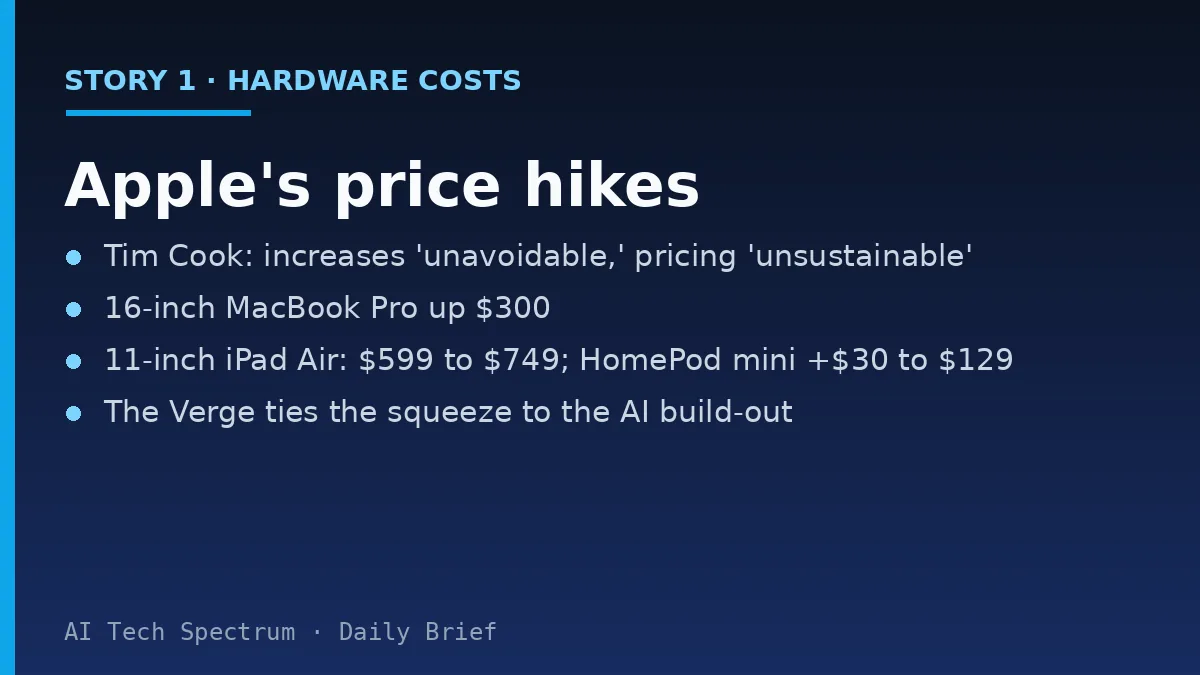
In a report from The Verge, Apple CEO Tim Cook described a wave of price increases as "unavoidable" and called the company's current pricing "unsustainable." The receipts are specific: the 16-inch MacBook Pro went up by $300, the 11-inch iPad Air jumped from $599 to $749, and even the HomePod mini took a $30 bump to $129. The Verge frames these as the consumer-facing edge of Big Tech's AI spending — the soaring cost of the advanced chips, memory, and data-center capacity that the whole industry is bidding up at once.
Why it matters. For two years, "who pays for AI?" was a question about investor capex. Apple just moved it to the checkout line. When the most disciplined margin operator in consumer hardware says hikes are unavoidable, that's a real signal that component-cost pressure from the AI build-out has broadened beyond the data center. What to watch. Whether competitors follow — price increases love company — and whether Apple ties any of the increase to opt-in AI features versus across-the-board hikes everyone pays, AI user or not. The cleanest tell that "AI tax" is real will be rivals raising prices in the same window with the same explanation.
2. Prosecutors put ChatGPT logs in front of a jury
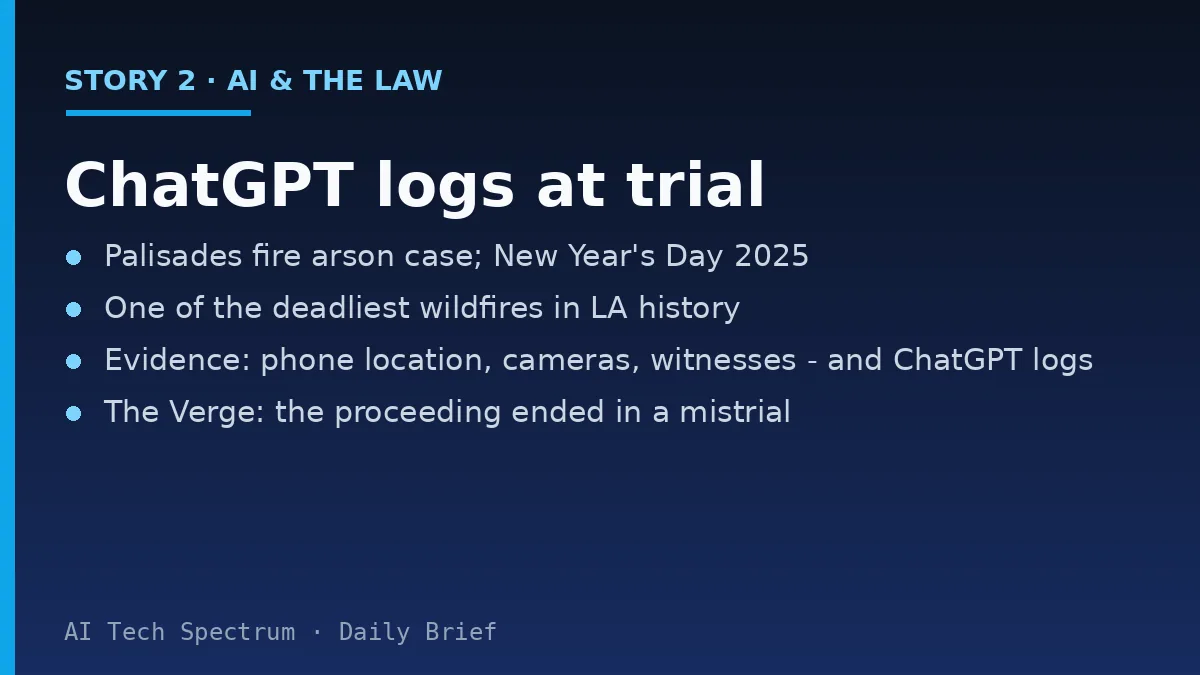
In the arson case against Jonathan Rinderknecht — charged over a New Year's Day 2025 fire that became one of the deadliest in Los Angeles history — prosecutors built their case on iPhone location data, security-camera footage, witness testimony and, notably, his ChatGPT logs, according to The Verge, which reports the proceeding ended in a mistrial. We're sticking to what's confirmed: a defendant's conversations with a chatbot were entered as evidence at a major criminal trial.
Why it matters. This is the AI privacy story made concrete. Chatbot transcripts are records — discoverable, subpoena-able, and, as of this trial, admissible. Most people type into ChatGPT with the candor of a search box, not the caution of a signed statement, and the gap between those two postures is exactly where this goes wrong. What to watch. How courts handle the reliability and context of AI logs — a prompt is not a confession — and whether the major chatbots respond with clearer retention and deletion controls. The practical defense is knowing what's stored and turning off what you can; we cover that side of it on our sister site, linked in the sidebar. (General information, not legal advice — consult a licensed attorney for your situation.)
3. SoftBank's CEO joins the doubters of Musk's orbital data centers
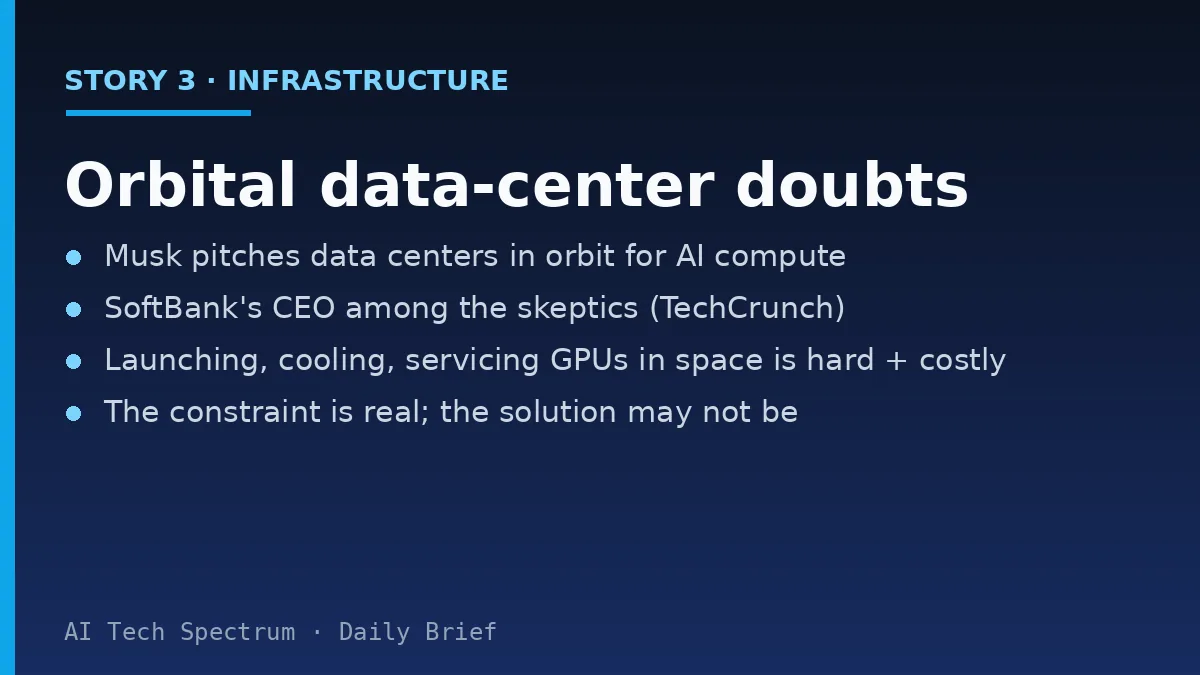
Elon Musk has been pitching data centers in orbit as an answer to AI's exploding power-and-cooling problem — and, per TechCrunch, the skeptics now include SoftBank's CEO, among others. The doubts are the obvious ones: launching, powering, cooling and servicing racks of GPUs in space is dramatically harder and costlier than building one more campus on the ground next to a substation.
Why it matters. Orbital compute is the purest example of an AI-era reflex — when demand outruns the grid, the proposals get spectacular. The useful filter is to separate the constraint, which is real (AI's appetite for power keeps growing), from the solution, which is a very long way to go for cooling. What to watch. Whether any of this moves past renderings to a funded pilot, and whether the grounded fixes — nuclear power purchase agreements, grid upgrades, efficiency gains — get the attention the orbital pitch is currently soaking up.
4. OpenAI hires away Apple's Vision Pro chief
Paul Meade, the Apple vice president who led the Vision Pro headset, is reportedly leaving to join OpenAI's hardware team, according to TechCrunch. It's another senior hardware hire for an OpenAI device effort that has spent the past year assembling engineering and design leadership as it works toward its first consumer AI hardware.
Why it matters. The model wars increasingly have a hardware front. OpenAI plainly wants a device of its own, and it's recruiting the people who have shipped ambitious — if commercially mixed — hardware at Apple. Hiring the Vision Pro lead specifically says something about the ambition level and the willingness to take on spatial-computing problems. What to watch. Whether this is the start of a broader Apple-to-OpenAI talent flow, and what the hire signals about the form factor OpenAI is chasing — a wearable or spatial device versus the pocketable gadget that earlier rumors described.
5. Margaret Atwood's four-word verdict on AI
At the Babel Literary and Cultural Festival in Porto, Portugal, Margaret Atwood — author of The Handmaid's Tale and The Blind Assassin — was asked about AI and, per Deadline's recap relayed by The Verge, didn't soften it: the problem with AI, she said, is "garbage in, garbage out."
Why it matters. It's a tidy reminder from outside the industry that a model is a mirror of its training data and its prompt. The phrase is decades older than the technology, and that's the point — many of AI's failure modes aren't new, they're old data-quality problems running at new scale. What to watch. The sharper tension underneath the quip: the writers warning about AI's inputs are the inputs. The fight over training data, consent and compensation isn't going quiet, and voices like Atwood's are why.
What to take from today
The five stories rhyme. The AI boom is no longer only a story about models and benchmarks — it is showing up in the price of your next laptop, in what a courtroom can pull from your chat history, in the fantasy infrastructure proposed to feed it, in the talent market reshuffling around it, and in the culture's running verdict. The decision-useful read: once an industry's costs and side effects start landing on people who never opened a chatbot, the smart questions shift from "what can it do?" to "what is it costing, who is accountable, and what here is load-bearing versus hype?" Keep that filter handy this week.
Tomorrow's brief lands by 15:00 UTC. If you'd rather read this in your inbox once a week — just the stories that actually matter — subscribe here.