Good morning. Three of today's stories point at the same fault line: the human side of the AI economy. Microsoft trimmed thousands of roles while its AI build-out accelerates; Amazon is quietly retiring the crowd-work marketplace that trained a generation of models; and a financial regulator admitted, out loud, that it can't keep pace. Then two builder stories about where the work goes next — nations standing up their own AI, and robots learning to picture the future before they move. Prefer this once a week? Subscribe to the weekly brief.
1. Microsoft cuts ~4,800 jobs as the AI build-out accelerates
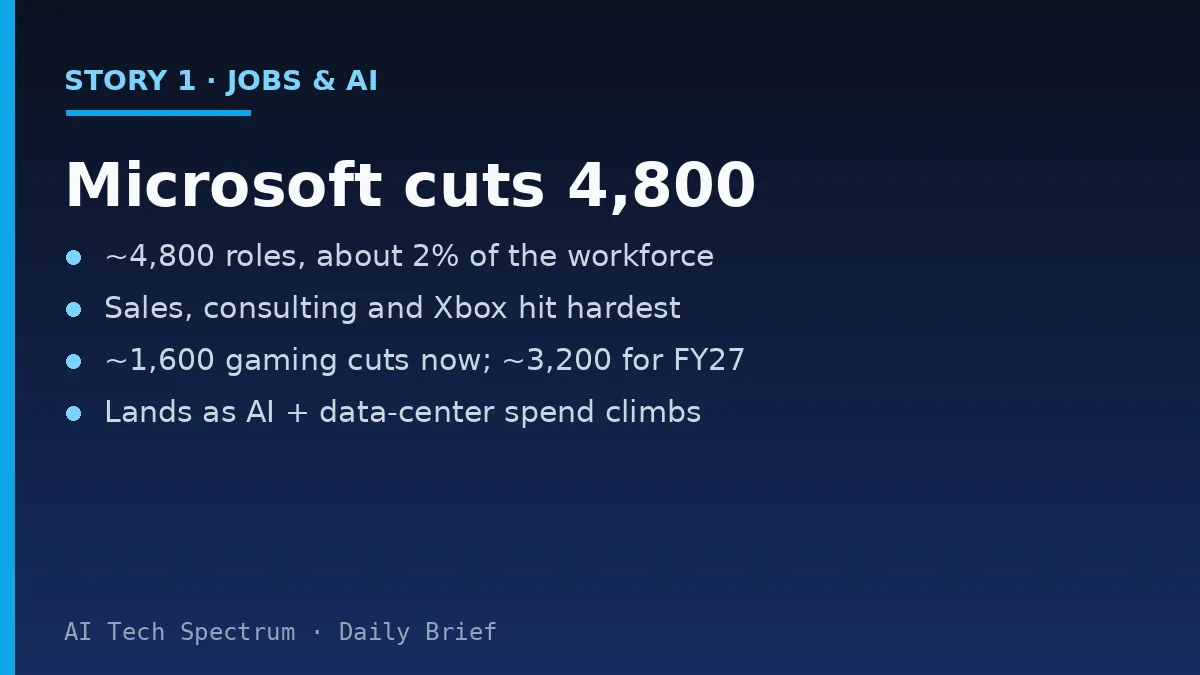
Microsoft cut roughly 4,800 jobs on Monday — about 2% of its global workforce — in a round concentrated in sales, consulting, and its Xbox gaming division, per an internal memo obtained by GeekWire. On the gaming side, Deadline reports about 1,600 roles go immediately, with total Xbox reductions expected to reach roughly 3,200 — around a fifth of the division — across fiscal 2027. It's the latest in a run of tech layoffs that, as TechCrunch notes, is stoking fears about AI displacing jobs — even though Microsoft frames these as a sales-model overhaul and a gaming reset, not automation.
Why it matters. The uncomfortable optics are the story: a company pouring record sums into AI data centers is shrinking headcount at the same time. Whether or not any single role was "replaced by AI," the pattern — flat-to-lower people budgets alongside soaring compute budgets — is what employees and investors are reading. For anyone running a team, the signal is that "we're investing in AI" and "we're cutting staff" are no longer opposite messages; increasingly they arrive in the same memo. What to watch. Whether Microsoft's next earnings call ties the reorg explicitly to AI-driven productivity, and how much of the remaining Xbox cuts land before fiscal year-end.
2. Amazon winds down Mechanical Turk
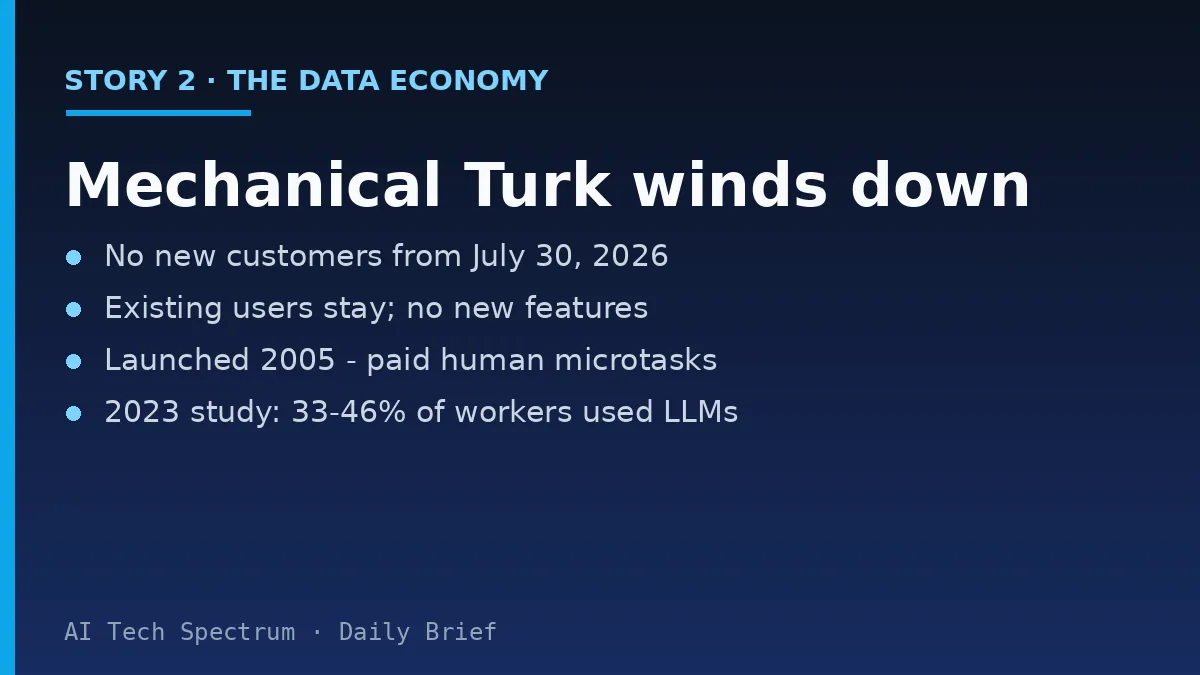
Amazon Web Services will stop accepting new Mechanical Turk customers on July 30, according to a notice reported by The Register and TechCrunch. AWS says the decision came "after careful consideration"; existing customers can keep using the service, but Amazon will invest only in security and availability, not new features. Launched in 2005, MTurk more or less invented the paid human-microtask economy — the "artificial artificial intelligence" that labeled images, moderated content, and ran surveys, and that helped assemble the training data behind today's models. Part of what unwound it is poetic: a widely cited 2023 study found that between roughly 33% and 46% of MTurk workers were using large language models to complete their tasks, undercutting the very thing buyers came for — genuine human judgment.
Why it matters. This is the clearest bookend yet for the pre-LLM data economy. The marketplace that supplied cheap human labeling is being retired just as synthetic data and services like Amazon's own SageMaker Ground Truth absorb the demand — and just as the workers themselves reach for the same chatbots. For teams that still rely on human annotation, the practical takeaway is to lock in vetted providers now and treat "is this actually a human?" as a data-quality control, not a given. What to watch. Whether existing MTurk workloads migrate to specialist labeling vendors or fold into synthetic-data pipelines — and whether Amazon ever sets a full shutdown date.
3. The FCA warns of an AI "arms race" in finance
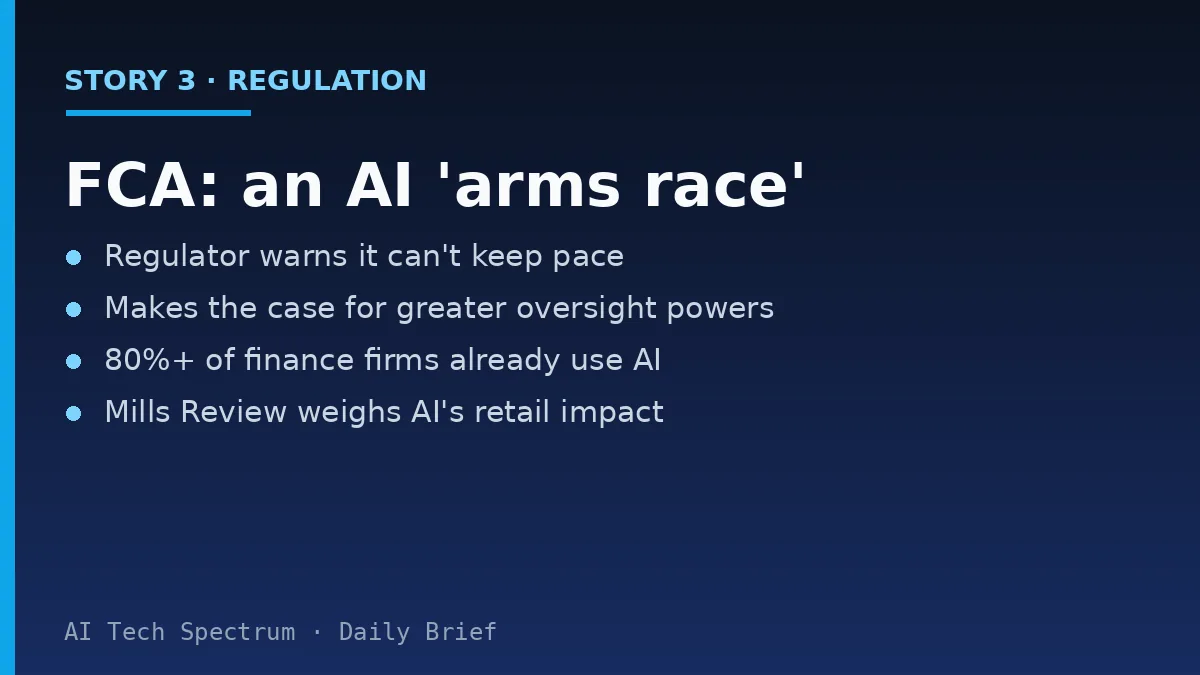
A senior official at the UK's Financial Conduct Authority warned of an "arms race" between the speed of AI adoption in financial services and the regulator's ability to keep up, making the case for greater oversight powers as growing numbers of consumers lean on AI tools for personal-finance decisions. The framing tracks the FCA's own recent work: chief executive Nikhil Rathi's June 24 speech, "Rethinking regulation for the age of AI," noted that more than 80% of financial-services firms are already deploying AI, while the regulator's Mills Review is examining AI's long-term impact on retail finance. The FCA's stated worries are familiar and concrete: opacity in AI-driven pricing and credit decisions, potential bias, and the difficulty of holding an automated system accountable when it gets something wrong.
Why it matters. Financial regulators rarely concede they're outpaced; saying so out loud is itself the news, and it usually precedes a push for new rules. If you build or buy AI for anything money-adjacent — lending, advice, fraud scoring — assume explainability and audit requirements are coming, and that "the model decided" won't be an acceptable answer to a regulator. What to watch. Whether the FCA formally seeks expanded powers and publishes a consultation this year. (Informational, not financial or legal advice — consult a licensed professional for your situation.)
4. NVIDIA's sovereign-AI playbook
NVIDIA used a July 6 explainer to lay out, in unusually plain terms, how it wants countries to think about building AI at home — and, not incidentally, why that requires a lot of NVIDIA-powered "AI factories." The post frames five ingredients of a national AI strategy — an AI imperative, an AI-ready workforce, local models and data, a domestic ecosystem, and sovereign AI factories — and points to live deployments: agents from ThinkDeep automating French public-service workflows (cutting some document searches "from two days to two minutes"), India's Sarvam platform serving models across the country's 22 official languages on domestic infrastructure, and Brazil's Widelabs modernizing legal services for a state ministry. NVIDIA says its "AI Nations" initiative has been seeding these ecosystems since 2019; the pitch lands the day before the UN's AI for Good Summit (July 7–10, Geneva).
Why it matters. "Sovereign AI" has quietly become one of NVIDIA's most durable demand stories — governments buying compute the way they once bought roads and grid. It also dovetails with this year's export-control anxiety: if you can't reliably import a frontier model, you build the capacity to run your own. Read it as a market-shaping document as much as an explainer. What to watch. Which governments announce AI-factory build-outs around the Geneva summit — and how much of the compute is NVIDIA's.
5. Also on the radar
LeRobot v0.6.0 ships robots that imagine. Hugging Face released LeRobot v0.6.0, and the theme is closing the robot-learning loop. It adds "world model" policies (VLA-JEPA, LingBot-VA, FastWAM) that learn to predict the future during training — then, cleverly, drop that machinery at inference so you get the supervision at "zero extra inference cost." It also folds in NVIDIA's newer GR00T N1.7 foundation model, a unified reward-model API for detecting success, six new simulation benchmarks under one lerobot-eval command, a lerobot-rollout deployment CLI with human-in-the-loop corrections, and up to 2x faster data loading on a leaner install. For anyone experimenting with open robot learning, it's the most complete the stack has looked. Station F doubles down on AI. Paris's Station F is expanding its F/ai accelerator, positioning the mega-incubator as a launchpad for Europe's next wave of AI startups — a small but telling data point in the same "sovereign tech" current running through today's NVIDIA and FCA stories.
What to take from today
The builder stories and the labor stories are the same story told from two ends. Nations are standing up AI factories and open-source teams are shipping robots that plan ahead — the capacity side is compounding fast. Meanwhile the human scaffolding around it is being renegotiated in real time: a hyperscaler thins its ranks, the original crowd-work marketplace switches off the lights, and a regulator concedes it's chasing the field rather than leading it. None of these is a clean "AI took the job" headline. All of them are the quieter thing underneath it — institutions rearranging themselves around a technology that's arriving faster than the org charts, the marketplaces, and the rulebooks can adapt. Build (and staff, and regulate) accordingly.
Tomorrow's brief lands by 15:00 UTC. If you'd rather read this in your inbox once a week — just the stories that actually matter — subscribe here.