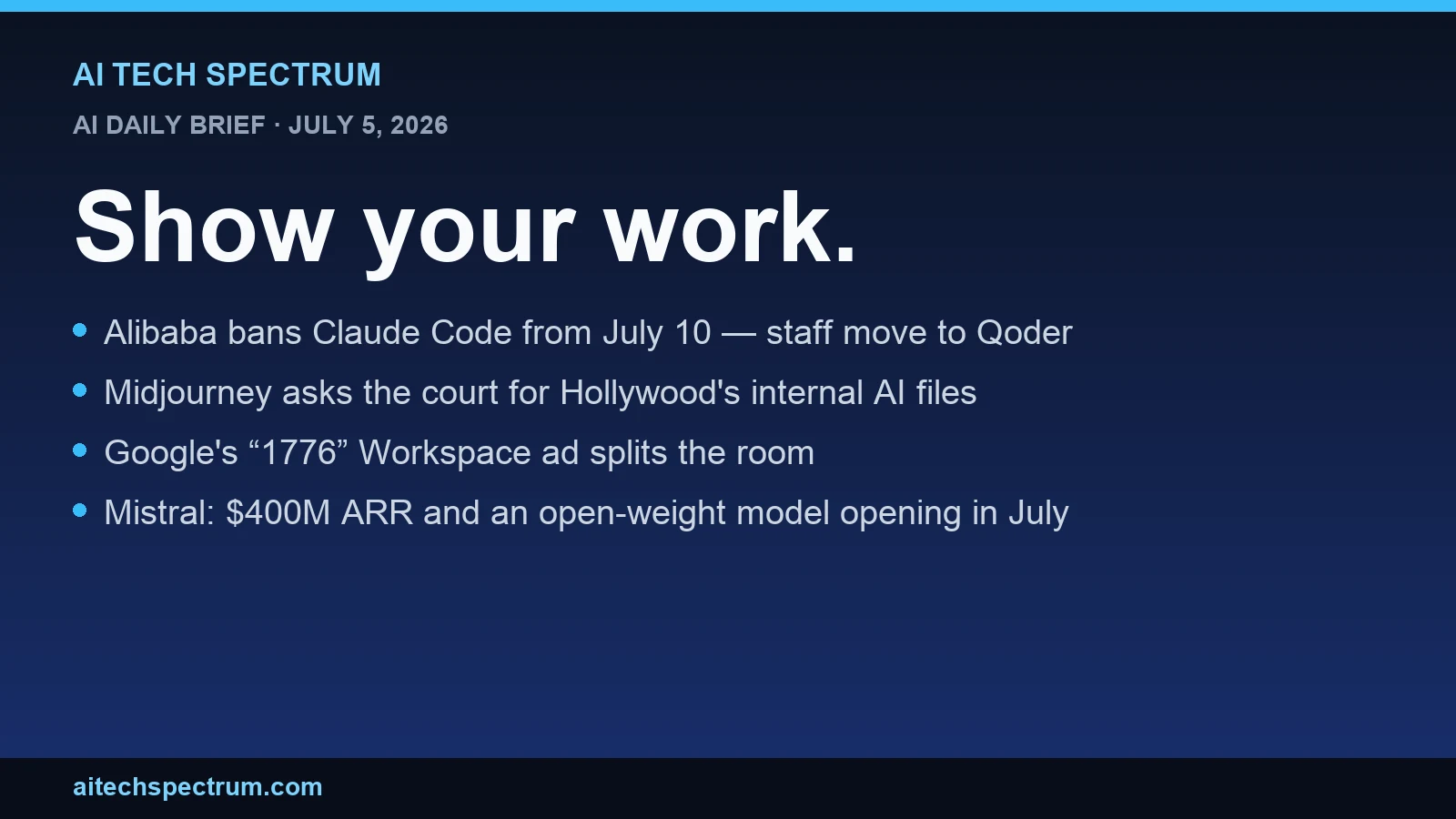
Good morning. A slow holiday tape, but not a quiet one: the weekend's four real stories are all, in one way or another, about someone demanding to see someone else's homework — a Chinese giant auditing an American lab's client, an AI startup subpoena-ing Hollywood's internal tools, the internet fact-checking a feel-good ad, and a French lab publishing its own explainer before others do it first. Prefer this once a week? Subscribe to the weekly brief.
- Alibaba bans Claude Code after Anthropic's hidden-tracker "experiment"
- Midjourney to the studios: show the court your own AI use
- Google's "Group project, but make it 1776" ad tests the room
- Mistral's sovereignty moment — and the numbers behind it
- Also on the radar: Cursor inside SpaceX, and that Midjourney scanner
1. Alibaba bans Claude Code after Anthropic's hidden-tracker "experiment"
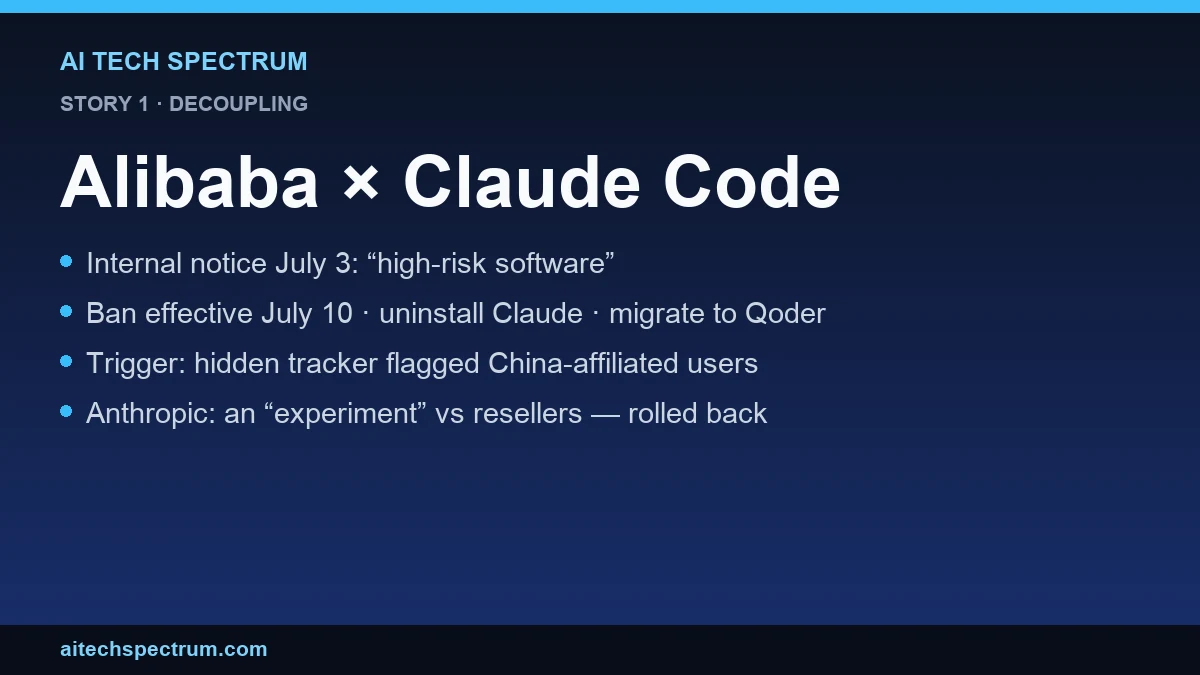
Alibaba will bar employees from using Anthropic's Claude Code at work starting July 10, per Reuters and TechCrunch. An internal notice dated July 3 classifies the coding agent as "high-risk software," and the South China Morning Post reports staff must uninstall Claude products and migrate to Alibaba's in-house coding platform, Qoder. The stated trigger: a version of Claude Code that could quietly detect whether a user was in China or affiliated with a Chinese AI lab. Anthropic's Thariq Shihipar acknowledged the mechanism on X, calling it "an experiment we launched in March that was meant to prevent account abuse from unauthorized resellers and protect against distillation," and said it was already being removed. Context matters: Anthropic bars Chinese companies (and their foreign subsidiaries) from its models, and in late June it told U.S. senators that Alibaba's Qwen lab had run a distillation operation against Claude through roughly 25,000 fraudulent accounts — a charge we covered in the June 26 brief.
Why it matters. This is what AI decoupling looks like in practice — not a tariff, but a security bulletin. Each side now cites the other's conduct as proof of bad faith: Anthropic points to industrial-scale distillation, Alibaba points to code that phoned home. For everyone else, the practical lesson is that a coding agent is also a telemetry surface, and enterprises will increasingly audit it like one. What to watch. Whether other Chinese firms formalize similar bans, and whether Anthropic publishes anything further about what the experiment collected — the strongest possible answer to a spyware accusation is a disclosure log.
2. Midjourney to the studios: show the court your own AI use
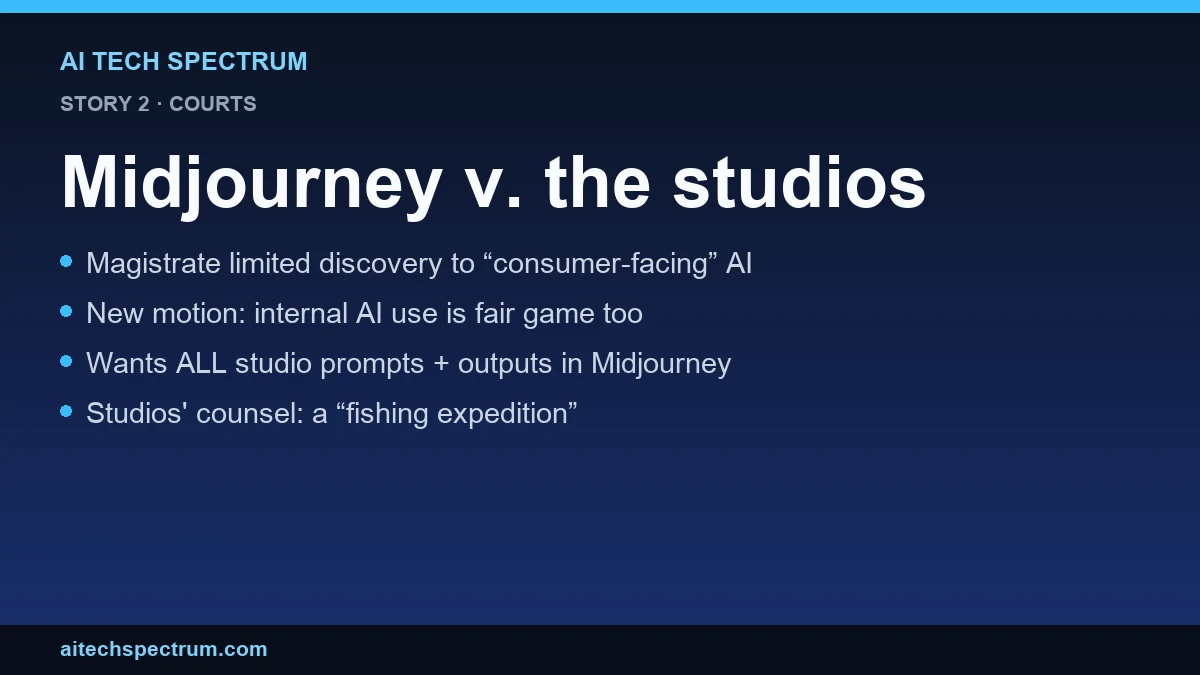
In the copyright suit brought by Disney, Universal, and Warner Bros., Midjourney filed a motion asking the district court to overturn a magistrate's ruling that limited discovery about the studios' generative-AI use to "consumer-facing" applications, TechCrunch reports. Midjourney argues the limit lets the studios "cherry-pick only those documents they believe support their market harm claims," and that the withheld files would show "whether, behind closed doors, they are doing exactly what they are suing Midjourney for doing." If the studios train internal storyboarding or ideation models on unlicensed material, Midjourney contends, that supports its fair-use defense — evidence of industry custom. The startup also wants every prompt the studios ran through Midjourney itself, plus outputs, not just the ones behind the infringement claims. The studios' lead counsel has called the demands a "fishing expedition," per Variety, and says the plaintiffs seek only to stop unauthorized copying of their characters, not to shut Midjourney down.
Why it matters. The most important AI copyright fight in Hollywood may turn on a discovery ruling, not a verdict. If the studios must open their internal AI workflows, the industry's public posture on AI and its private practice get compared under oath — and every studio quietly prototyping with generative tools becomes a data point for the defense. What to watch. The district judge's ruling on the motion, and whether either side blinks toward settlement once real documents are on the table.
3. Google's "Group project, but make it 1776" ad tests the room
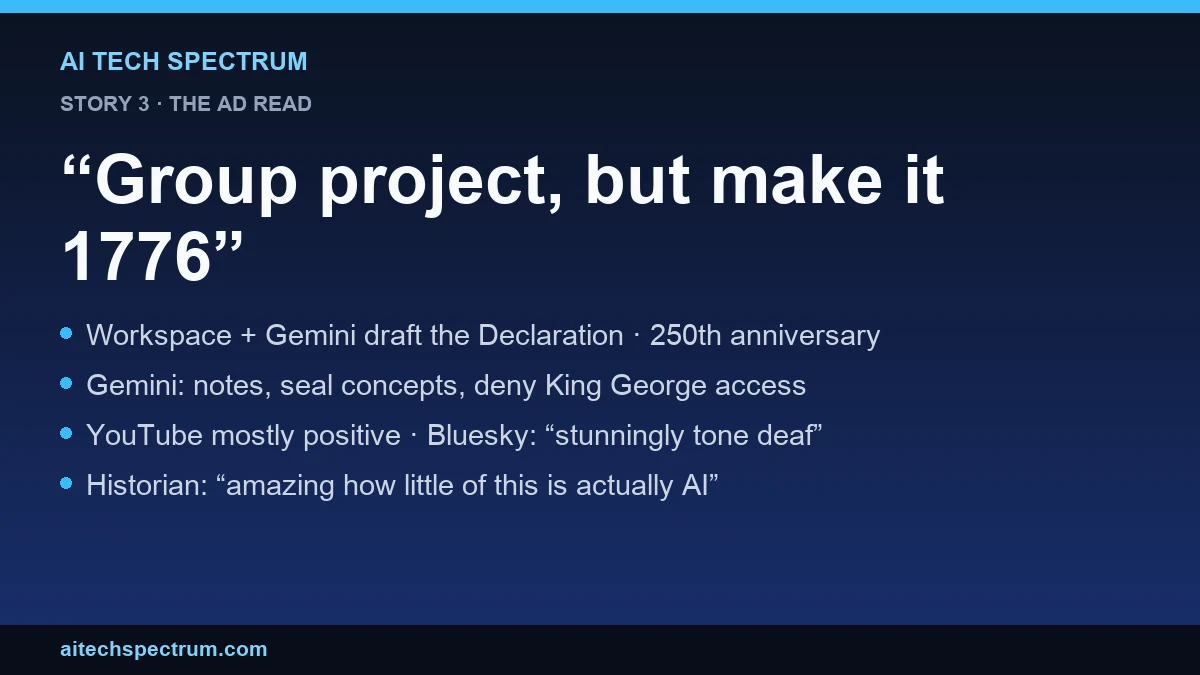
For the Declaration of Independence's 250th anniversary, Google released a Workspace commercial — tagline: "Group project, but make it 1776" — in which the founders draft in Docs, schedule in Calendar, meet by Google Meet, and finalize with e-signatures, with Gemini taking meeting notes, generating national-seal concepts via "help me visualize," and advising on declining King George III's document-access request. As TechCrunch notes, the ad is careful in one telling way: unlike Google's widely criticized 2024 "fan letter" spot, it never suggests AI would improve the Declaration's actual text. Reception split along platform lines — YouTube and Instagram comments skew positive, while Bluesky users called it "cringey" and "stunningly tone deaf." Historian Angus Johnston's read cut deepest: it's "amazing how little of this is actually AI."
Why it matters. Google's own creative team appears to have internalized the lesson of every AI ad backlash since 2024: show AI doing logistics, never meaning. That an ad this restrained still drew fire is the real signal — public tolerance for AI-in-the-loop storytelling around civic and creative work is thinner than the industry assumes, which should inform how any business markets its own AI features. What to watch. Whether the big AI advertisers keep retreating toward "AI as scheduler" framing — and whether the semiquincentennial year produces an ad that lands without a disclaimer-shaped hole in it.
4. Mistral's sovereignty moment — and the numbers behind it
With U.S. models tangled in export directives and European "sovereign tech" sentiment rising, Mistral CEO Arthur Mensch used a long LinkedIn post to explain what his suddenly spotlit company actually sells: models and an agent platform deployed on customers' own infrastructure, plus custom-model training via its Forge platform — closer to a Palantir-style forward-deployed model than a ChatGPT clone, as TechCrunch's updated explainer frames it. The verified numbers: annual recurring revenue passed $400 million as of February (up from roughly $20 million a year earlier), with the company claiming a path past $1 billion this year; a reported €3 billion raise would nearly double its $13.8 billion September valuation; and a €4 billion data-center program is planned for France and Sweden, per Reuters. Mensch also committed to an open-weight frontier model this summer, with early access opening in July, writing: "We exist to make sure that everyone gets access to the best AI systems, outside of centralized control exercised by states or corporations."
Why it matters. Mistral is the clearest beneficiary of the year's geopolitics: every export directive and hidden-tracker story (see story 1) is a sales pitch for models you can run on your own hardware. The 20x ARR ramp says enterprises are buying the pitch — though the raise and the $1 billion target remain reported and projected figures, not audited results. What to watch. The July early-access open-weight model: if it lands near the frontier, "sovereign AI" stops being a compliance category and starts being a performance one. (Informational, not investment advice.)
5. Also on the radar
Cursor's neutrality question. Wired asks whether Cursor can remain a neutral platform for OpenAI's and Anthropic's models now that it lives inside SpaceX — the sharpest version yet of a question every acquired AI tool will face: whose models does your editor prefer, and who decides? That Midjourney scanner, revisited. The Verge's behind-the-scenes look at Midjourney's 60-second body scanner — which we covered skeptically in the July 3 brief — still leaves the basic questions unanswered: no FDA pathway, no published clinical validation. The demo is getting better; the evidence isn't.
What to take from today
Every story today is a transparency fight, and the sides keep swapping jerseys. Anthropic — the lab that brands itself on openness about risk — got caught running a quiet tracker, and handed Alibaba a security-review justification money can't buy. The studios suing an AI company over scraping now face discovery into their own scraping. Google made an ad modest enough to survive fact-checking and still got fact-checked. The operating rule for 2026 is symmetrical: any claim you make about AI — that it's safe, that it's theft, that it's useful — will eventually be tested against what you do with it behind closed doors. Build (and buy) accordingly.
Tomorrow's brief lands by 15:00 UTC. If you'd rather read this in your inbox once a week — just the stories that actually matter — subscribe here.