Good morning. Two threads run through today's stories: the staggering scale of money flowing into AI infrastructure, and the growing list of places where AI's reliability is being questioned out loud. Read SoftBank's France announcement for where the capital is going; the split Gemini Spark verdicts for how hard "useful" is to pin down; the AI-code study for the quality-vs-speed tradeoff; the browser roundup for where the next interface battle is; and The Verge's SpaceX IPO take for the investor caution. Prefer this once a week? Subscribe to the weekly brief.
1. SoftBank commits up to €75B to French AI data centers
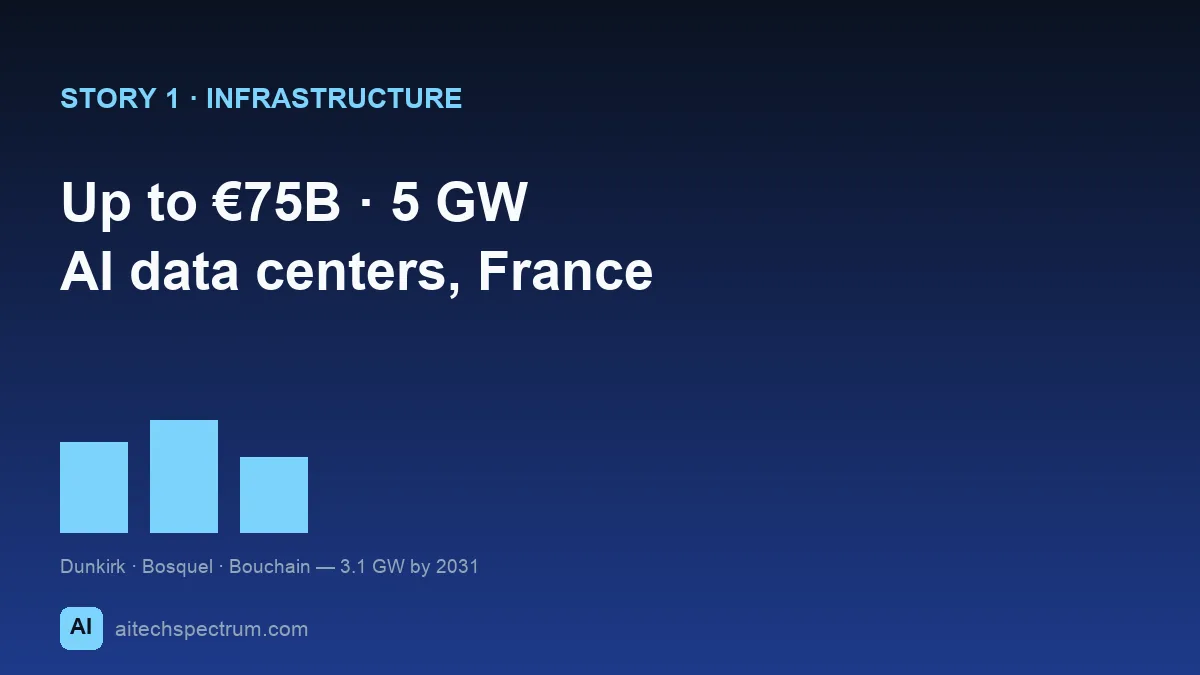
SoftBank Group announced it will invest up to €75 billion (about $87 billion) to expand data-center capacity in France, with a stated goal of developing and operating up to 5 gigawatts of additional capacity. As TechCrunch reported, the first phase covers sites in Dunkirk (Loon-Plage), Bosquel, and Bouchain to deliver 3.1 gigawatts to the Hauts-de-France region by 2031. SoftBank — both an investor in and a customer of OpenAI — says this is its largest AI infrastructure investment in Europe. French economic minister Roland Lescure called the announcement "a testament to President Emmanuel Macron's ambition to position France as a leading destination all along the AI value chain."
The substantive read is that the AI buildout has firmly entered its "sovereign infrastructure" phase, and Europe is now a contested site for it rather than a spectator. The figures are ceilings ("up to"), and a 2031 horizon leaves plenty of room for revision, so treat the €75B as a stated ambition, not booked spend. But the direction is unmistakable: the same week US opposition to data-center construction is intensifying over grid and water concerns, a Japanese conglomerate is pledging multi-gigawatt capacity in France with a cabinet minister on the podium. Where the power and the political welcome are is increasingly where the compute will be built.
Why it matters. If you run AI workloads in or for Europe, a 5GW capacity pledge concentrated in northern France signals where lower-latency, EU-data-residency compute may land over the next few years. If you follow the capital cycle, note the circularity: SoftBank funds OpenAI, buys from OpenAI, and builds the data centers the whole industry's demand depends on — a structure worth watching for concentration risk. And if you're weighing the energy story, 5 gigawatts is power-plant scale; the constraint on AI in 2026 is electricity and permits as much as chips.
2. The Gemini Spark verdict splits between two outlets
Two hands-on reviews of Google's Gemini Spark agent landed within a day of each other and reached different conclusions. TechCrunch found Spark "actually pretty useful" for everyday tasks like inbox summaries and local event planning, while questioning why Google shipped it as a separate product. Wired's reviewer, who gave Spark access to her email, documents, and calendar to plan a birthday party, came away struck that the agent did the mechanical work but missed the person most important to her. We flagged the Wired hands-on in Saturday's brief; the TechCrunch take is the counterweight.
The substantive read is that "is this agent good?" is now a question with two honest answers depending on what you ask of it. For bounded, mechanical tasks — summarize, schedule, surface — reviewers are converging on "yes, useful." For tasks that require understanding what your data means, the same agent can be confidently wrong with a clean interface. That gap isn't a bug Google will patch next sprint; it's the current frontier of consumer agents, and the split coverage is the most accurate signal you'll get this week.
Why it matters. If you're deciding whether to grant an agent your inbox and calendar, the useful answer is "yes, for chores; verify anything relational or high-stakes." If you build agents, this is a reminder that review steps and clear scoping beat raw capability for trust. For the framing of what an agent is actually taking on when it acts for you, our AI agents vs AI assistants explainer lays out the decision boundary.
3. A study questions whether AI makes code better or just faster
Many developers now decline to work without AI assistance — and TechCrunch reports researchers warning that faster code isn't automatically better code. The concern is that AI accelerates output while quietly raising the volume of code that is harder to review, maintain, or reason about — a debt that can surface later as bugs, security gaps, and brittle systems. The piece frames the risk not as "AI writes bad code" but as a culture shift in which speed becomes the default metric and quality review gets thinner.
The substantive read is that productivity gains and quality are being measured on different clocks. Lines shipped and tickets closed move immediately; the cost of weaker tests, shallow understanding, and unreviewed generated code shows up months later, when it's expensive to trace. This is the engineering-management version of the reliability theme running through today's brief: the demo (or the velocity chart) and the dependable have come apart, and the gap is where the bills accrue.
Why it matters. If you lead an engineering team, the useful question isn't whether to allow AI — that ship has sailed — but how to keep review, testing, and architectural ownership from eroding as velocity climbs. If you're a developer leaning on AI daily, your durable edge is being the person who can read, judge, and own the output, not just generate it. For the build-vs-buy comparison on the coding agents themselves, see our OpenAI Codex vs Anthropic Claude Code 2026 breakdown.
4. The 2026 browser wars reopen with AI-first challengers
TechCrunch published a roundup of the top alternatives to Chrome and Safari in 2026, capturing a market that has reopened after a decade of Chrome dominance. The renewed competition is being driven largely by AI: a wave of browsers building assistants, agents, and summarization directly into the browsing surface, betting that the address bar is the next place AI gets embedded by default.
The substantive read is that the browser is being reframed from a window onto the web into an AI runtime that acts on the web for you. That's a genuine strategic opening — Chrome's incumbency is built on speed and sync, not on agentic features — but it also raises the same permissions-and-trust questions as story 2: a browser that can read every tab and act on your behalf is a powerful agent with a powerful blast radius. The roundup is a map of who's making that bet; the open question is whether users want their browser to be an agent at all.
Why it matters. If you're evaluating tools, an AI browser is worth a trial for research-heavy or repetitive web work — but scrutinize what data it reads and where that data goes before you switch defaults. If you build for the web, assume a growing share of visits may soon be mediated by an AI agent rather than a human eye, which changes how you think about content and UX. The interface layer is back in play for the first time in years.
5. The Verge's blunt warning on the SpaceX IPO
The Verge published a sharply critical opinion piece on Elon Musk's filing to take SpaceX public, arguing the structure is built to benefit Musk far more than retail investors who buy in. The AI angle is the entanglement: Musk's ventures — SpaceX, xAI, X, Tesla — are increasingly cross-financed and cross-valued, so an offering in one is, in part, an offering on the whole Musk-AI complex. The piece reads as a caution that exuberance around an AI-adjacent megacap can paper over governance and valuation questions that matter most to small investors.
The substantive read is that this is commentary, not breaking disclosure, and a one-sided one by design — but the underlying caution is sound and generalizes beyond SpaceX. As more AI-linked companies court public and retail money in 2026 (we've tracked the OpenAI and Anthropic funding rounds in recent briefs), the gap between a compelling AI narrative and the actual terms offered to ordinary investors is where due diligence earns its keep. A great company can still be a bad deal at a given price and structure.
Why it matters. Nothing here is investment advice, and AI Tech Spectrum isn't a financial advisor — but the durable lesson is to read the terms, not the rocket. If you follow AI markets, the cross-financing among Musk's companies is a concentration pattern worth understanding before any of them goes public. Separate the technology you admire from the security you're being sold; they are not the same decision.
What to take from today
Five stories, two throughlines. First, the money: SoftBank's up-to-€75B French buildout shows AI infrastructure spending at power-plant scale, now competed for across continents. Second, the reliability reckoning: the split Gemini Spark verdicts, the code-quality study, the trust questions inside AI browsers, and the SpaceX IPO caution all point the same way: capability is racing ahead of dependability, and the smart move is to verify on your own terms. Judge AI — and the deals around it — on the evidence in front of you, not the pitch.
Tomorrow's brief lands at 15:30 UTC. If you'd rather read this in your inbox once a week — just the stories that actually matter — subscribe here.