Good afternoon. Today's throughline is governance arriving with teeth. For two years the frontier-AI conversation was mostly voluntary commitments and blog-post safety frameworks; today a US agency reached in and switched off two commercial models, a major lab took a criminal network to federal court over misuse of its own AI, and the money and the measurement kept right on accelerating underneath all of it. Start with Anthropic's own statement on the shutdown. Prefer this once a week? Subscribe to the weekly brief.
- A US directive forces Anthropic to pull Fable 5 and Mythos 5 for everyone
- NVIDIA's Blackwell tops the first benchmark built for agentic AI
- Google sues a network that turned Gemini into a phishing factory
- Mistral is reported in talks to raise about €3B at a €20B valuation
- OpenAI opens three Academy courses for "the next era of work"
1. A US directive forces Anthropic to pull Fable 5 and Mythos 5 for everyone
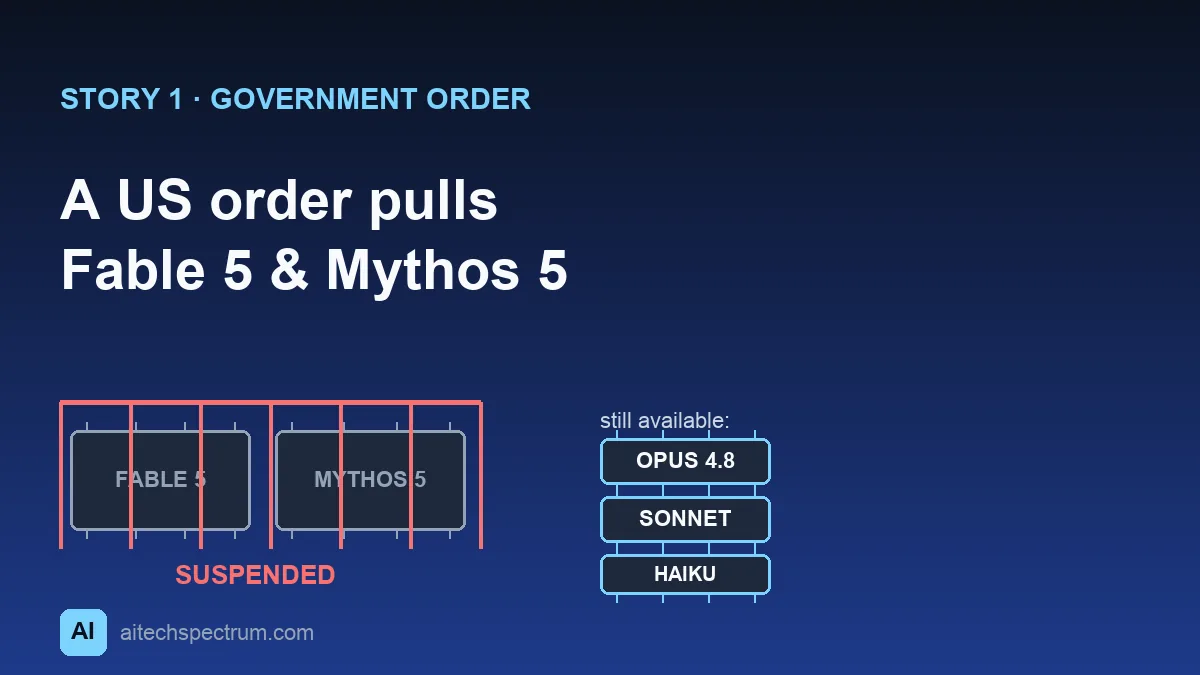
The whiplash is hard to overstate. We covered Fable 5's launch on Tuesday and its guardrail reversal on Thursday; on Friday evening Anthropic said the US government had ordered it to shut both Mythos-class models down. The company says it received an export-control directive, citing national security authorities, at 5:21pm ET that day — instructing it to suspend all access to Fable 5 and Mythos 5 by any foreign national, inside or outside the United States, including Anthropic's own foreign-national employees. Because it cannot filter users by nationality in real time, Anthropic says the only way to comply is to disable both models entirely. Access to every other Anthropic model — Opus, Sonnet, Haiku — is unaffected.
By Anthropic's account, the directive did not spell out the specific concern, but the company believes it stems from a demonstrated method of "jailbreaking" Fable 5. Anthropic says it reviewed the technique, found it surfaced only a small number of previously known, minor vulnerabilities, and validated that the same capability is "widely available from other models" — naming OpenAI's GPT-5.5. Worth stressing: the government has not published its side, so this is, for now, one party's characterization of a non-public order. Anthropic's position is unambiguous regardless: "We are complying with the government's legal directive and are removing access to Fable 5 and Mythos 5 for all users. However, we disagree that the finding of a narrow potential jailbreak should be cause for recalling a commercial model deployed to hundreds of millions of people."
Why it matters. This is the first time a US agency has reached in and switched off a generally available frontier model — a precedent that matters far more than the fate of one model family. Anthropic argues that if this standard were applied across the industry it "would essentially halt all new model deployments." What to watch: the promised next-24-hours disclosure of technical detail, whether the order is challenged or narrowed, and — practically — if you built anything on Fable 5 or Mythos 5 in the last four days, you need a fallback now. Our model comparison framework and Codex-vs-Claude Code guide cover the still-available options.
2. NVIDIA's Blackwell tops the first benchmark built for agentic AI
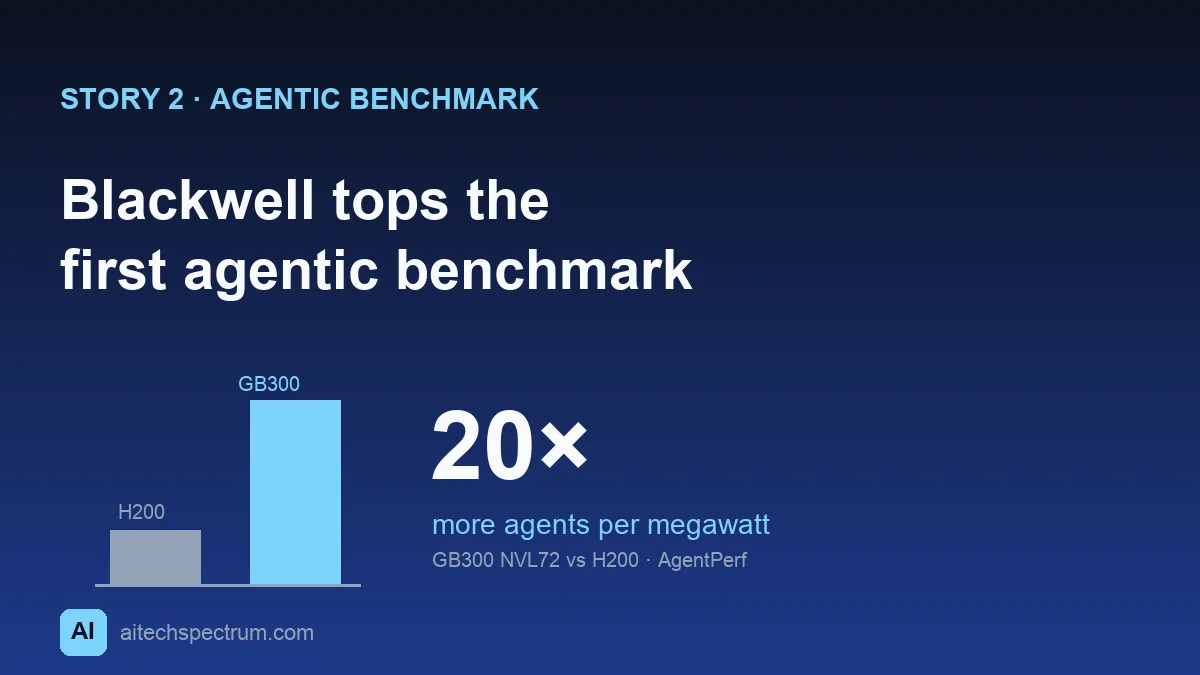
Artificial Analysis released AA-AgentPerf, which it bills as the industry's first benchmark for agentic-AI infrastructure, and NVIDIA's Blackwell led the opening round. The distinction the benchmark draws is the useful part: a chatbot reply is a sprint — one model call, one response — while an agent is a relay that chains dozens to hundreds of calls with tool use at every handoff, so existing single-call inference benchmarks don't capture how systems behave under real agent load. AgentPerf instead replays real coding-agent trajectories across 12+ programming languages and measures how many concurrent agents a platform can sustain while meeting service-level targets.
On that workload — run with the open DeepSeek V4 Pro mixture-of-experts model — NVIDIA says its GB300 NVL72, a rack that links 72 GPUs into one system, runs up to 20× more agents per megawatt than its older H200 (Hopper) generation. The headline metric, "agents per megawatt," is itself a tell about where the constraint now sits: not raw speed but how much agent work you can extract per unit of power. Inference providers including Baseten, DeepInfra and Together AI are already serving DeepSeek V4 Pro on Blackwell in production. (These are vendor and benchmark-author figures; we have not independently verified them.)
Why it matters. As teams shift budget from chat to autonomous agents, "tokens per second" stops being the number that matters and "concurrent agents per watt" starts — and that reframes every infrastructure purchase. What to watch: whether AMD and others post AgentPerf results to contest NVIDIA's lead, and how the rankings shift once tool-call latency (simulated in this first round) is modeled more fully. For the application layer, see our best AI agents guide.
3. Google sues a network that turned Gemini into a phishing factory
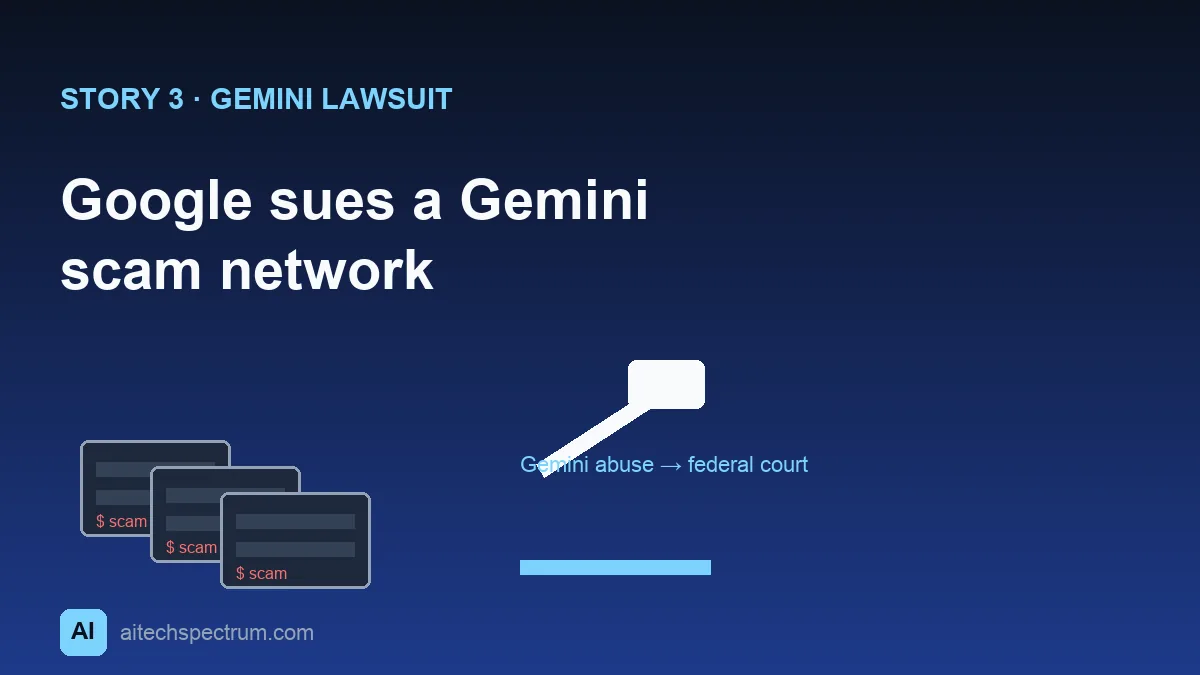
Google filed a federal lawsuit against "Outsider Enterprise," a China-based cybercrime network it says used AI tools — including Gemini — to mass-produce phishing infrastructure. Per Google's complaint, the operation has hit "hundreds of thousands of victims," with losses in the millions, and is linked to more than 9,000 fake websites and over 1 million fraudulent URLs. Over a single two-week stretch in May, Android users flagged 55,000 spam texts tied to the group, and Google connected 2.5 million messages to its infrastructure. Members allegedly prompted Gemini to generate the code for convincing fake pages — "gift redemption" and brand-impersonation sites — by framing the requests as benign. Google calls it its first lawsuit over abuse of Gemini.
The response is multi-pronged. "We're filing a lawsuit to dismantle their infrastructure, coordinating with the FBI who will be taking law enforcement actions, and will continue to work with AT&T, T-Mobile and Verizon to block these texts before they reach you," Google wrote, adding that it is also pushing for federal legislation. The FBI's framing is the part worth sitting with: "Criminals increasingly use AI to make fraud like this more convincing and harder to detect," said Brett Leatherman, assistant director of the Bureau's Cyber Division.
Why it matters. The same code-generation that makes Gemini useful to developers makes it useful to scammers, and Google is testing whether the courts — not just usage policies — can be a lever against AI-enabled fraud. What to watch: whether other labs follow with their own enforcement actions, and whether "we built it with AI" becomes an aggravating factor in cybercrime cases. If you want to harden your own accounts against exactly this kind of attack, our sister site's privacy-tool comparison is a sensible start.
4. Mistral is reported in talks to raise about €3B at a €20B valuation
French lab Mistral AI is in early discussions to raise roughly €3 billion (about $3.5 billion), Bloomberg reported, citing people familiar with the matter, in a round that would value the company at around €20 billion. That is nearly double the €11.7 billion valuation it carried after its Series C last September, and — if completed — would rank among Europe's largest private AI raises to date. The reporting is explicit that talks are early and terms could change, so treat the figures as reported, not closed; TechCrunch framed it as a rumor for the same reason. Chipmaking-equipment giant ASML, which put in €1.3 billion for an 11% stake last year, remains the largest shareholder.
Why it matters. A near-doubling in nine months is a clean read on how badly capital wants a credible non-US, non-China frontier lab — Europe's "sovereign AI" thesis priced in real time. What to watch: whether the round closes at or above €20B, who leads it, and whether ASML follows on. (This is news coverage, not investment advice.)
5. OpenAI opens three Academy courses for "the next era of work"
OpenAI launched three new OpenAI Academy courses — AI Foundations, Applied AI Foundations, and Agents and Workflows — meant to move a worker from improving a single task, to building a repeatable workflow, to directing an agent-assisted one. The framing is notably un-flashy: prompting, giving context, output review, and knowing where human judgment is still required. OpenAI says it is working with BCG, Accenture and BBVA to bring the courses into enterprises, and completers get a shareable certificate. "Scaling AI adoption is not just about giving people access to technology," said Accenture's chief AI and data officer Dr. Lan Guan; "it requires the learning systems, confidence, and new ways of working that help people apply AI every day."
Why it matters. The bottleneck on enterprise AI value has shifted from model capability to whether employees can actually fold these tools into daily work — and the labs are now treating training as part of the product. What to watch: whether vendor-run curricula become a standard enterprise procurement line item, and whether independent training providers can compete with courses built by the model makers themselves.
What to take from today
The center of gravity in AI is shifting from "what can the model do" to "who gets to decide, and who's accountable when it's misused." A government can now pull a live model; a lab can drag a misuse network into federal court; the hardware race is being scored on power efficiency, not just speed; and the capital and the upskilling keep compounding regardless. The practical move for operators: don't single-thread on any one model — today proved access can vanish in an afternoon — and assume the tools you build with can be abused, because the people suing over that abuse now assume it too. We'll keep tracing each of these to the primary source as they develop.
Tomorrow's brief lands by 15:30 UTC. If you'd rather read this in your inbox once a week — just the stories that actually matter — subscribe here.