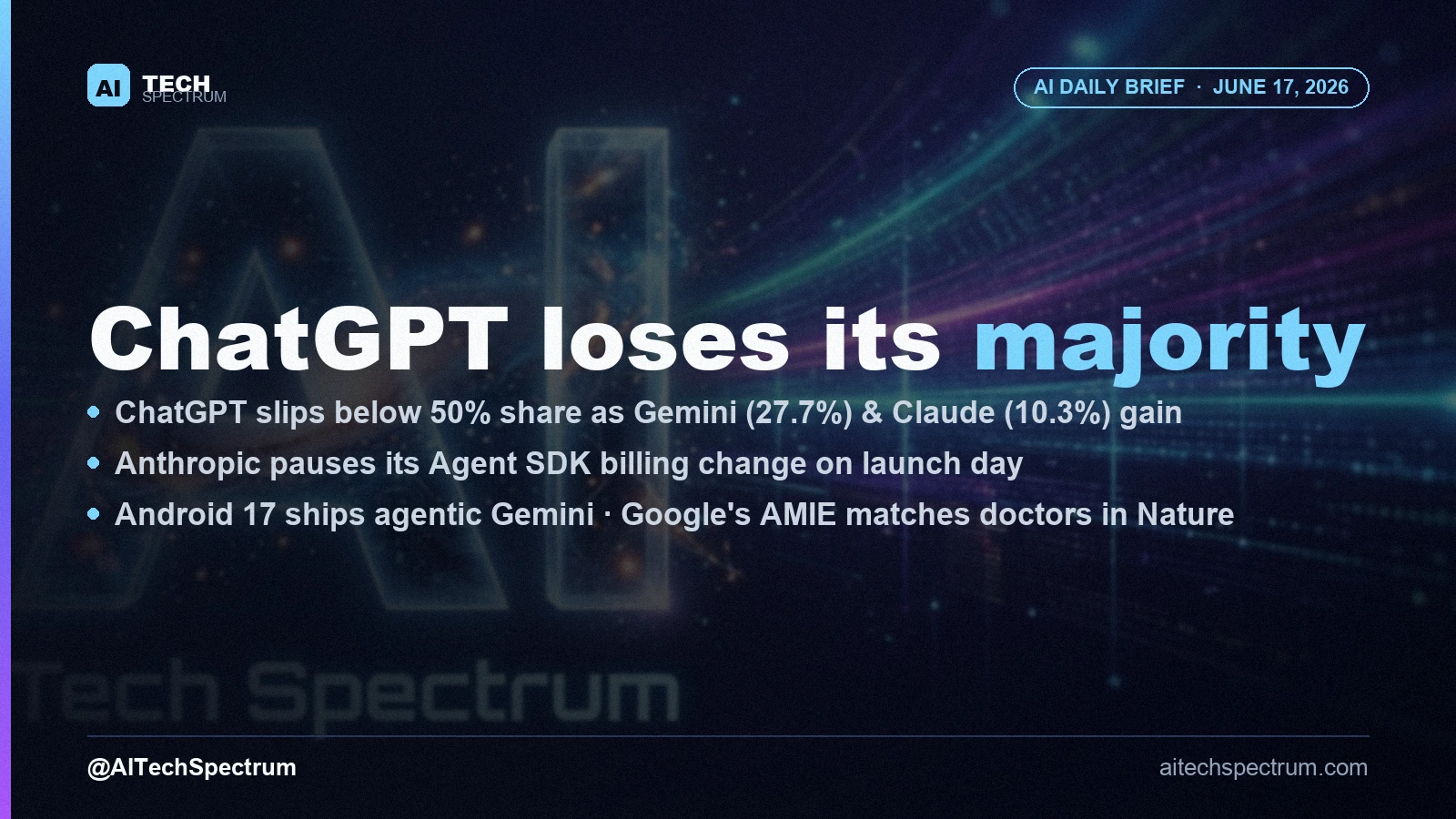
Good afternoon. Five stories, and the throughline is that the AI market no longer has a single center of gravity. The most-used assistant just lost its majority; the company with the strongest coding tools just blinked on how it charges developers; and the technology itself is leaving the chat box — onto phones, into the clinic, and onto your face. Start with the number that reframes the whole competitive map: ChatGPT below 50%. Prefer this once a week? Subscribe to the weekly brief.
1. ChatGPT's market share slips below 50% for the first time
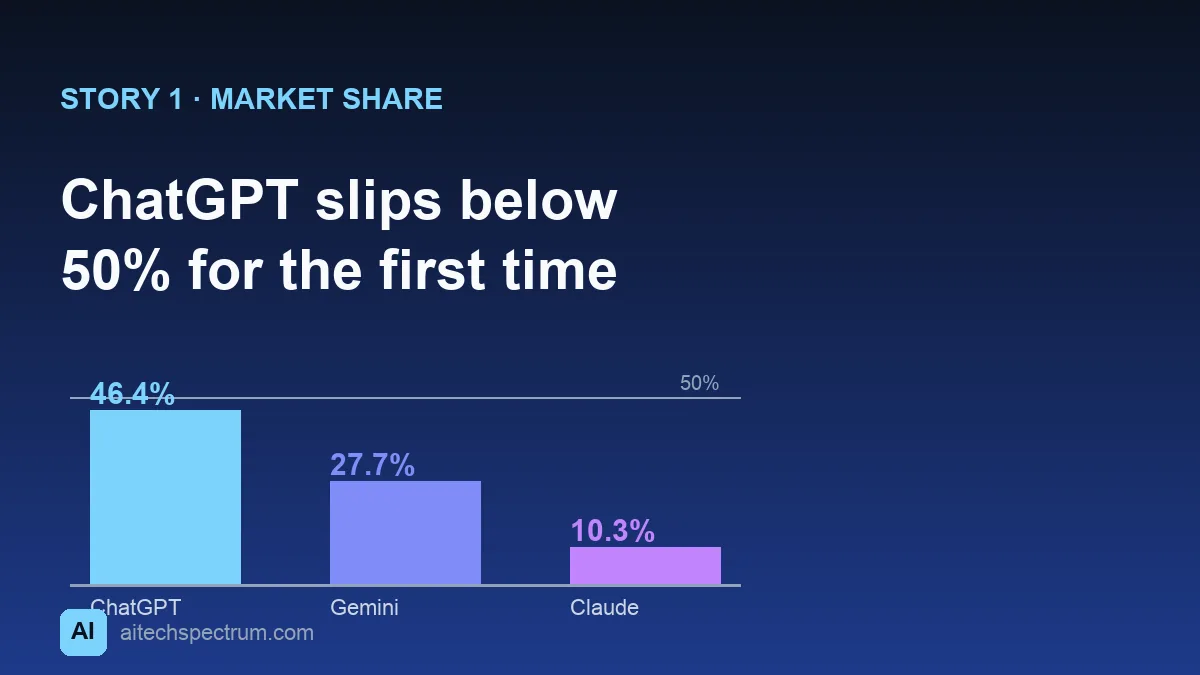
ChatGPT is still the most popular AI assistant in the world — but for the first time, it no longer holds a majority of the market. According to analytics firm Sensor Tower's State of AI 2026 report (as reported by TechCrunch), ChatGPT commanded over 50% share until January, but by the end of May it had fallen to 46.4% as Google's Gemini rose to 27.7% and Anthropic's Claude reached 10.3%; Grok, Perplexity, DeepSeek, and Meta AI each sit below 5%. In raw users the gap is still wide — ChatGPT has more than 1.1 billion monthly users, ahead of Gemini's 662 million and Claude's 245 million — but Sensor Tower's data shows users increasingly willing to switch apps, and notes that OpenAI's February defense deal triggered a measurable spike in uninstalls. One efficiency stat worth flagging for businesses: Anthropic leads on conversion, with 13% of Claude's users on a paid plan.
Why it matters. "Which AI should we standardize on?" used to have an obvious default answer. It no longer does — the top three now split the market, and switching costs are falling, which strengthens every buyer's negotiating position. What to watch: whether Gemini's ecosystem bundling keeps compounding, whether Claude's category-leading 13% paid conversion turns into durable revenue, and whether OpenAI's move into ads (Sensor Tower says ~17% of daily ChatGPT users now see them) trades share for monetization.
2. Anthropic pauses its Agent SDK billing change on launch day
Anthropic pulled back a billing overhaul on the very day it was scheduled to take effect. The change, set for June 15, would have moved Agent SDK calls, the headless claude -p command, Claude Code GitHub Actions, and third-party apps off of subscription limits and onto a separate monthly credit pool, with usage-based API pricing after the credits ran out. Anthropic confirmed in its Help Center that the move is paused: those surfaces keep drawing from Pro, Max, Team, and Enterprise subscription limits exactly as before, there is no credit to claim, and the company says it will give advance notice before any future change. Coverage from The Decoder ties the reversal to a sharpening subscription price war with OpenAI and Google.
Why it matters. For anyone who automates with Claude Code or the Agent SDK, this is a direct reprieve — the cost model you built around still holds for now. It's also a tell: competitive pressure is strong enough to make a frontier lab reverse a planned price increase at the deadline. What to watch: the eventual replacement plan (Anthropic says one is coming), and whether rivals use the moment to court developers worried about agent-usage costs. Pricing the trade-off across vendors is exactly what we built our for.
3. Android 17 ships agentic Gemini features to phones
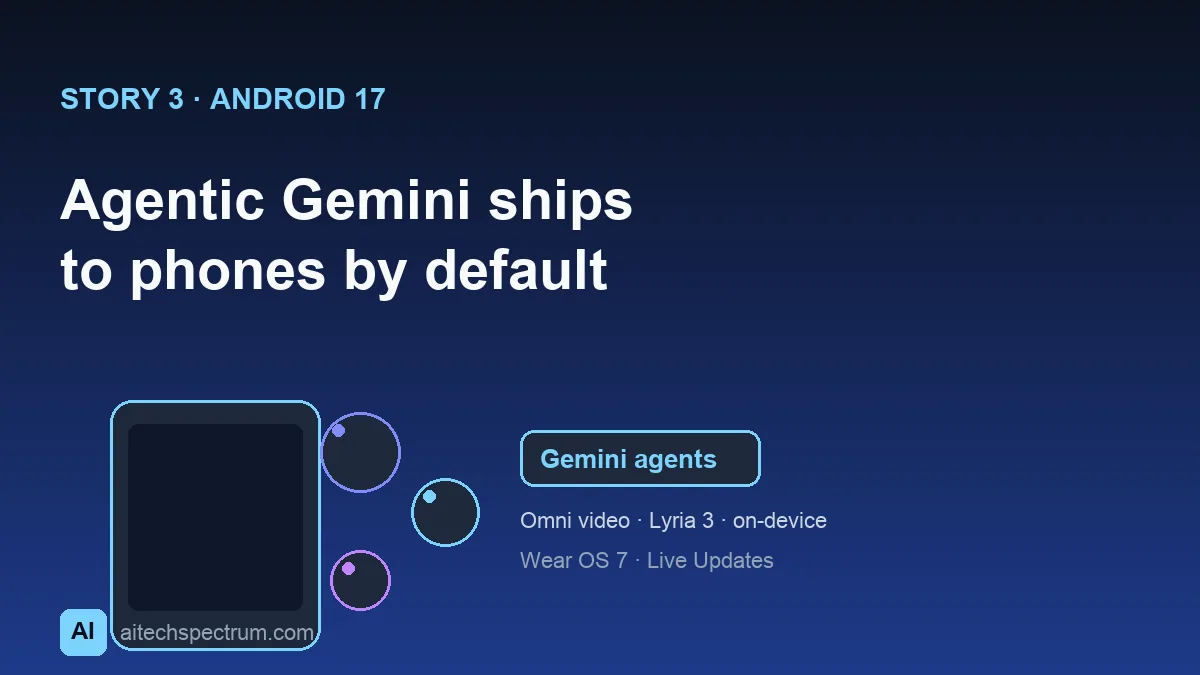
Google released Android 17 alongside Wear OS 7 and a June Pixel Drop, rolling out first to compatible Pixel phones. The headline interface change is floating app Bubbles — open apps you can long-press into desktop-like windows that hover over whatever's in the background — plus Screen Reactions for recording. The AI additions are the real story: the Pixel Drop brings the multimodal Gemini Omni, which generates videos from natural-language and image prompts (and can drop you or a custom avatar into them), the Lyria 3 music-generation model, and on-device speech translation. Wear OS 7 adds Live Updates on the wrist and Gemini features like describe-to-create widgets, with Google citing up to 10% better battery life than the prior version.
Why it matters. This is agentic, generative AI shipping to hundreds of millions of phones as a default OS feature, not an app you choose to download — the fastest distribution channel Google has, and a direct answer to the share story above. What to watch: how much of this lands on non-Pixel Android hardware and on what timeline, and whether on-device generation (video, music, translation) meaningfully pulls everyday usage toward Gemini.
4. Google's AMIE matches primary-care physicians in Nature
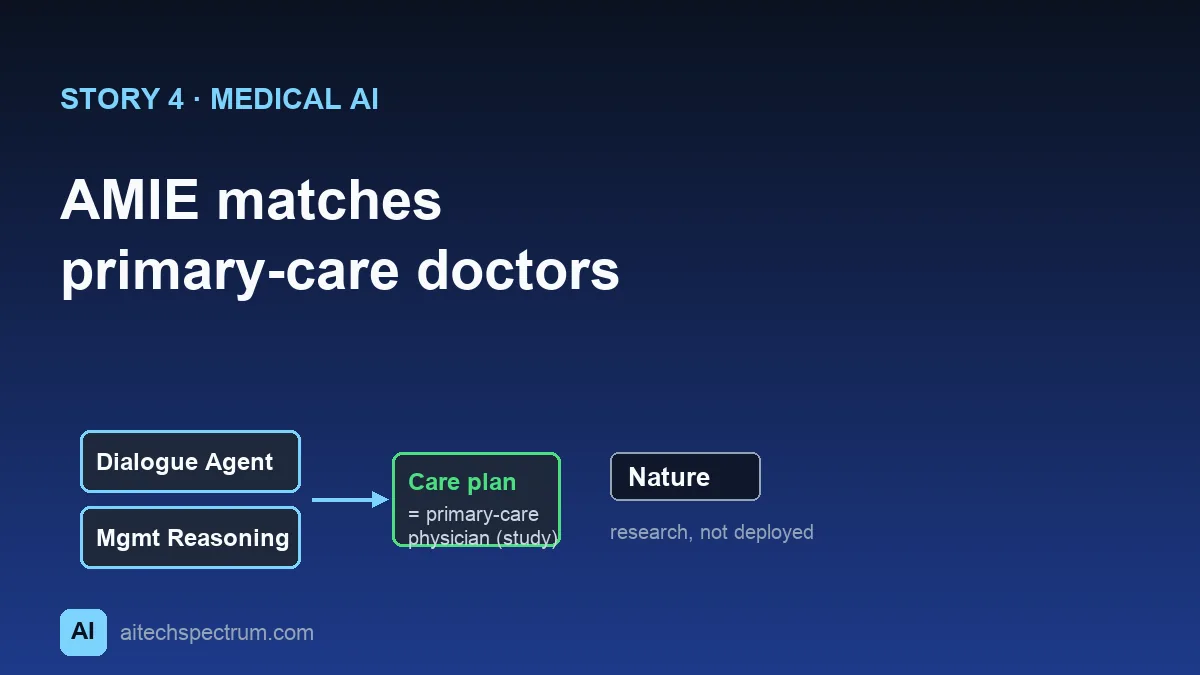
Google Research published new work showing that AMIE — its conversational diagnostic AI — can extend from one-time diagnosis into longitudinal disease management, the ongoing work of adjusting treatment over multiple visits. In a randomized, blinded virtual study modeled on a clinical exam (an OSCE) with validated patient-actors, AMIE performed on par with primary-care physicians across several dimensions of management reasoning — treatment selection, response to therapy, medication safety, and adherence to clinical guidelines. The system uses two cooperating agents: a Dialogue Agent that handles the patient conversation and a Management Reasoning Agent that synthesizes history and guidelines into a structured care plan. This is a research system evaluated in a controlled study — not a deployed product, and not a substitute for professional medical care.
Why it matters. Earlier AMIE results showed strong one-shot diagnosis; managing a condition over time is a harder, more realistic bar, and clearing it in a peer-reviewed venue (Nature) raises the credibility of AI clinical reasoning. What to watch: real-world trials with actual patients rather than actors, how regulators treat a longitudinal-management system, and whether AMIE moves toward a supervised clinical pilot. Educational only — always consult a licensed clinician for medical decisions.
5. NVIDIA opens XR AI for agents on AR glasses
NVIDIA put XR AI into public beta — a framework for building multimodal AI agents that run through AR glasses and other XR devices. The pitch is to connect lightweight glasses to an organization's full compute (cloud, data center, workstation, or edge) so a spatially aware agent can see what you see and respond in natural language. The architecture is modular, separating media transport, model services (NVIDIA's Cosmos for vision and Nemotron for language), enterprise connectivity over the Model Context Protocol, and agent orchestration via the NeMo Agent Toolkit. There's already a first product: at Augmented World Expo 2026, VITURE unveiled Helix, AI safety eyewear built on XR AI for industrial, scientific, and clinical workflows.
Why it matters. If 2025–2026 was about AI in the browser, this is the bet on the next surface — hands-free agents that perceive the physical world — and NVIDIA is positioning to own the framework layer rather than the glasses. What to watch: whether the enterprise use cases (coaching, compliance, full-provenance capture) justify the hardware, latency on real workloads over the cloud-to-edge split, and how many glasses makers standardize on XR AI versus rolling their own.
What to take from today
Read the five together and the picture is an industry that's both decentralizing and spreading out. The assistant market lost its single leader (ChatGPT under 50%), the strongest developer platform just flinched on price (Anthropic's paused billing change), and the technology is no longer confined to a chat window — it's a default Android feature, a Nature-grade clinical reasoner, and an agent that lives in a pair of glasses. The builder's takeaway is the same one we keep landing on: don't single-thread. Not on one assistant your team depends on, not on one vendor's pricing holding still, not on one surface. The leverage is in keeping your stack priced, portable, and ready to switch — because this week proved how fast the defaults can move.
Tomorrow's brief lands by 15:30 UTC. If you'd rather read this in your inbox once a week — just the stories that actually matter — subscribe here.