Good morning. Five stories, and the throughline is reach — AI pushing into the clinic, the federal tax debate, a continent's power grid, and the free tier of the world's biggest chatbot — paired with a healthy insistence on proof. Start with the clearest win: a reasoning model that helped specialists crack 18 cases they couldn't. Prefer this once a week? Subscribe to the weekly brief.
1. An AI model helps solve 18 cold rare-disease cases
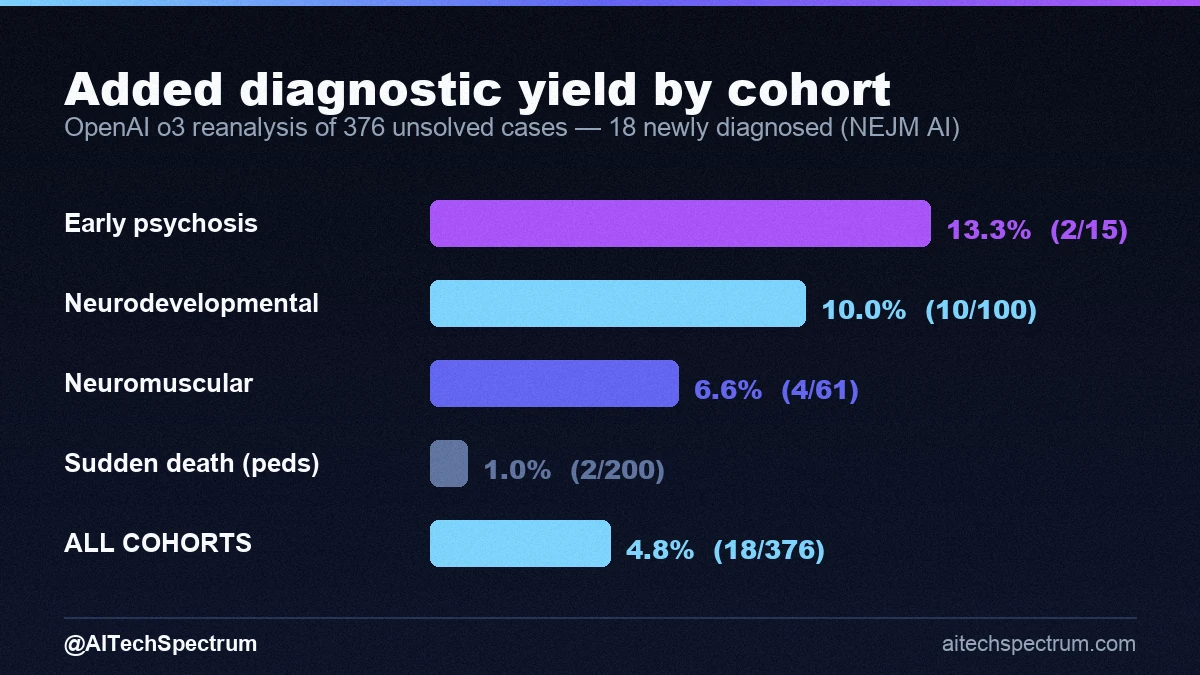
Researchers from Boston Children's Hospital's Manton Center for Orphan Disease Research, Harvard University, and OpenAI used the OpenAI o3 Deep Research reasoning model to reanalyze 376 previously unsolved rare-disease cases in children. As OpenAI describes the NEJM AI study (published June 18), the model read each de-identified case — phenotype terms, inheritance pattern, a filtered variant table, and the scientific literature — and produced evidence-linked hypotheses for experts to interrogate. After clinician review, additional testing, and lab confirmation, physicians established diagnoses in 18 cases, a 4.8% added yield on cases that had already defeated specialist analysis. The gains clustered where a single-gene answer was most likely: 10 of 100 neurodevelopmental cases, 4 of 61 neuromuscular, 2 of 15 early-psychosis, and 2 of 200 sudden-unexpected-death cases. Notably, the model diagnosed no one — in one early-psychosis case it inferred a 22q11.2 deletion (DiGeorge syndrome) from a run of low-quality sequencing calls, a hypothesis humans then confirmed.
Why it matters. Rare-disease reanalysis is as much a maintenance problem as a scientific one: the patient's genome stays fixed while the evidence around it keeps moving, so old "inconclusive" cases quietly become solvable. An explanation-first model that re-reads a backlog as knowledge advances is a concrete, human-in-the-loop use of "AI for science" — not a chatbot demo. What to watch. The authors are careful: the study was retrospective, the cohorts heterogeneous, reviewers weren't blinded to the model's confidence scores, and they didn't measure time saved or false-positive burden. The real tests are the prospective, multi-center trials OpenAI says are needed — and the Manton Center's next stage, funded by an OpenAI Foundation grant, toward a low-cost, platform-agnostic genetics "copilot."
2. Sanders proposes a $7 trillion AI sovereign wealth fund
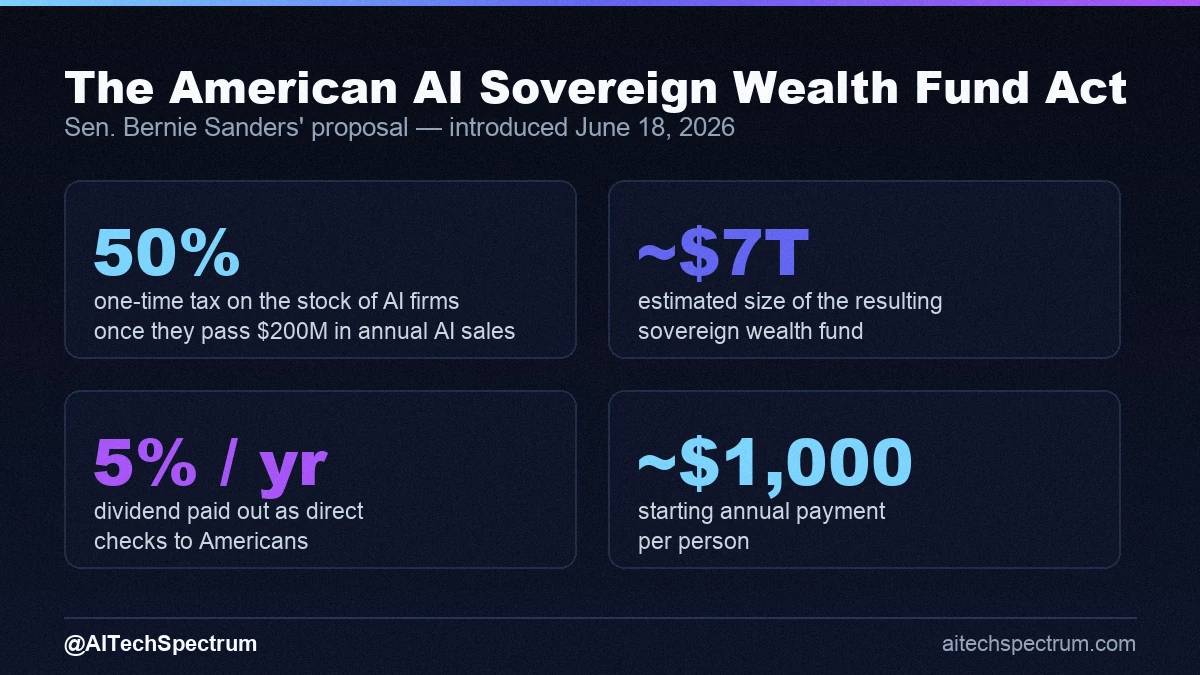
Senator Bernie Sanders introduced the American AI Sovereign Wealth Fund Act, a bill to give the public a direct ownership stake in the largest U.S. AI companies. Per his office, it would levy a one-time 50% tax on the stock of AI companies once they cross $200 million in annual AI sales, seeding a fund his office estimates at roughly $7 trillion and overseen by a new Independent Commission for Democratic AI. The fund would distribute an annual dividend of 5% of its value as direct payments to Americans — on the order of $1,000 per person to start, rising if AI's value grows. Sanders' argument is that today's models are built on the collective creative and intellectual work of generations, so the public should share in the gains rather than see them concentrate among a handful of firms and investors.
Why it matters. Whatever its legislative odds, the bill reframes the AI-windfall debate from "should we tax it" to "who owns it" — and it lands the same week the industry has been loudly counting both its breakthroughs and its costs. What to watch. A 50% equity levy is unprecedented and faces steep odds in Congress plus near-certain industry opposition, so the signal here is the Overton-window shift, not imminent passage. We're reporting the proposal and the mechanics, not endorsing it; the policy questions (valuation, constitutionality of a stock tax, dilution effects) are real and contested.
3. France's sovereign-AI infrastructure comes online
A year after France laid out its sovereign-AI plans at NVIDIA's GTC Paris, the concrete is poured. In a recap timed to VivaTech (June 17–20), NVIDIA says Mistral's new 44-megawatt data center in Bruyères-le-Châtel is operational with 18,000 NVIDIA GB200 systems — the first step toward 200 MW of European compute capacity by 2027. Mistral, French public investment bank Bpifrance, tech investor MGX, and NVIDIA are expanding "Campus AI," a network of AI factories anchored by a planned 1.4-gigawatt facility that would rank among Europe's largest. Bull and Foxconn will manufacture NVIDIA's next-generation Vera Rubin NVL72 systems in Europe, with final assembly at Bull's factory in Angers, France, while cloud provider Scaleway is already renting out Blackwell B300 instances on demand.
Why it matters. This is the "sovereign AI" thesis turning into physical capacity — Europe trying to own its compute, its models (Mistral, plus LINAGORA's French-first Luciole family), and its data under EU rules, rather than renting all of it from U.S. hyperscalers. What to watch. Whether the 1.4-GW Campus AI plan clears power and permitting at a moment of grid strain, and whether French production users — Sanofi's drug-discovery agents, Orange Business's 100,000-user internal GenAI platform, Stellantis's manufacturing digital twins — convert subsidized infrastructure into measurable output rather than another round of announcements.
4. GPT-5.5 Instant sharpens ChatGPT's health answers
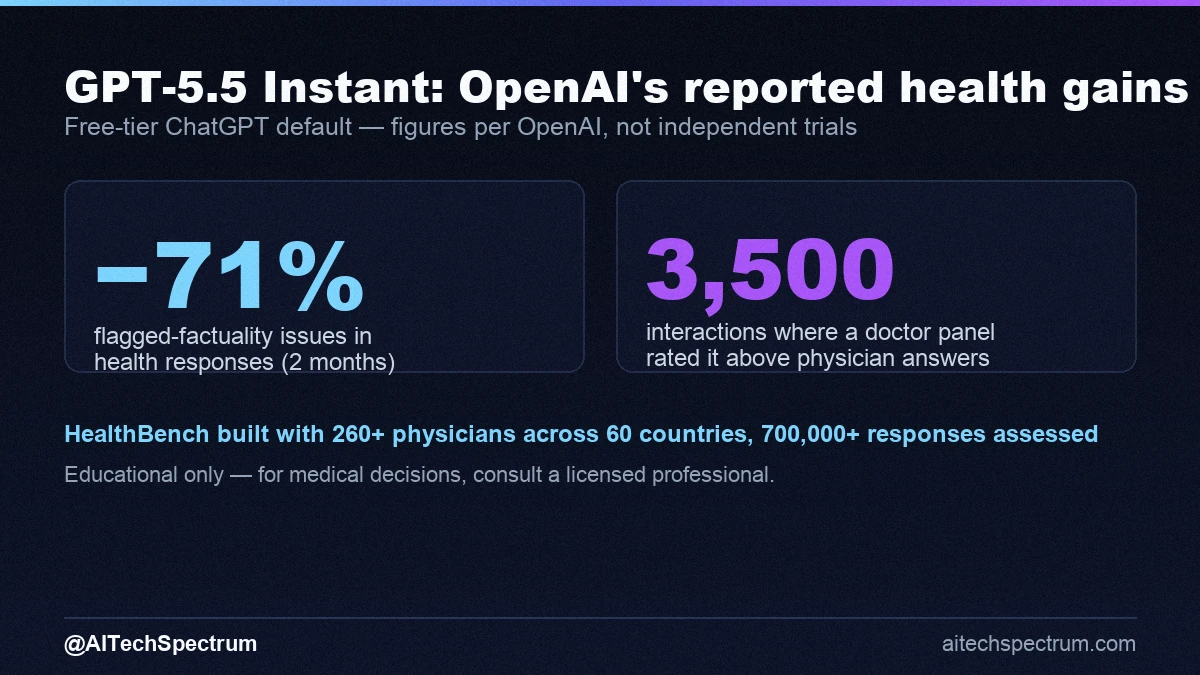
OpenAI said its GPT-5.5 Instant model — the default for free ChatGPT users — now reaches health performance comparable to its frontier models on an aggregate of evaluations, including HealthBench Professional, a substantial jump over GPT-5.3 Instant. The company reports that across recent production traffic (billions of health-related messages a week), the share of responses with at least one flagged factuality issue fell 71% over two months; in a separate review of 3,500 interactions, a panel of doctors rated GPT-5.5 Instant's answers higher than physician-written ones on accuracy, communication, and completeness. HealthBench itself was built with input from more than 260 physicians across 60 countries who assessed over 700,000 example responses. OpenAI frames the gains as better recognition of when urgent care may be needed and more consistent prompting for missing context.
Why it matters. Hundreds of millions of people already ask chatbots health questions, so moving the free-tier default toward expert-level answers carries real public-health stakes — both the upside of clearer guidance and the risk of confident errors at scale. What to watch. These are OpenAI's own measurements, not independent clinical trials, and a chatbot remains no substitute for a clinician; the open question is how the "ask for context, flag red flags" behavior holds up on the messy, high-stakes questions real users actually send. (Educational only — for any medical decision, consult a licensed professional.)
5. A startup's long-context "bottleneck" claim meets scrutiny
MIT Technology Review took a hard look at Subquadratic, a Miami startup that came out of stealth with $29 million and a bold claim: it has cracked the quadratic-attention bottleneck that makes long context so expensive in today's transformers. Its model, SubQ, advertises a 12-million-token context window built on "Subquadratic Sparse Attention," and the company says it runs roughly 52× faster than FlashAttention at one million tokens for about a fifth the cost of frontier models like Claude Opus or GPT-5.5. The catch is familiar: the full technical report isn't out, the weights are closed, and independent researchers — noting that earlier sub-quadratic architectures such as Mamba and RWKV have repeatedly underperformed transformers at frontier scale — are asking for proof before they applaud.
Why it matters. If the result holds, genuinely cheap long context would reshape pricing for the entire agent economy; if it doesn't, SubQ joins a long line of launch-day long-context promises that sounded revolutionary and looked ordinary six months later. What to watch. An independent technical report and third-party benchmarks. Until those land, treat the "52×" and "1,000× efficiency" figures as vendor claims, not results — exactly the kind of number worth waiting to see reproduced. It's the same discipline that makes the day's other stories trustworthy: a diagnosis confirmed in a lab and a yield reproduced on a bench beat any unverified benchmark.
What to take from today
Put the five together and mid-2026's AI looks less like a single trend than a system maturing in public. There are real wins you can verify — 18 cold cases reopened and solved, a measurable drop in flawed health answers for free users. There's a continent pouring concrete to own its compute and models. There's a senator arguing the public should own a slice of the upside. And there's a research culture that increasingly demands a technical report before it believes a "breakthrough." The throughline we keep landing on: judge AI by results you can check — diagnoses confirmed in a CLIA lab, yields reproduced on a bench, benchmarks anyone can run — not by the size of the claim.
Tomorrow's brief lands by 15:00 UTC. If you'd rather read this in your inbox once a week — just the stories that actually matter — subscribe here.