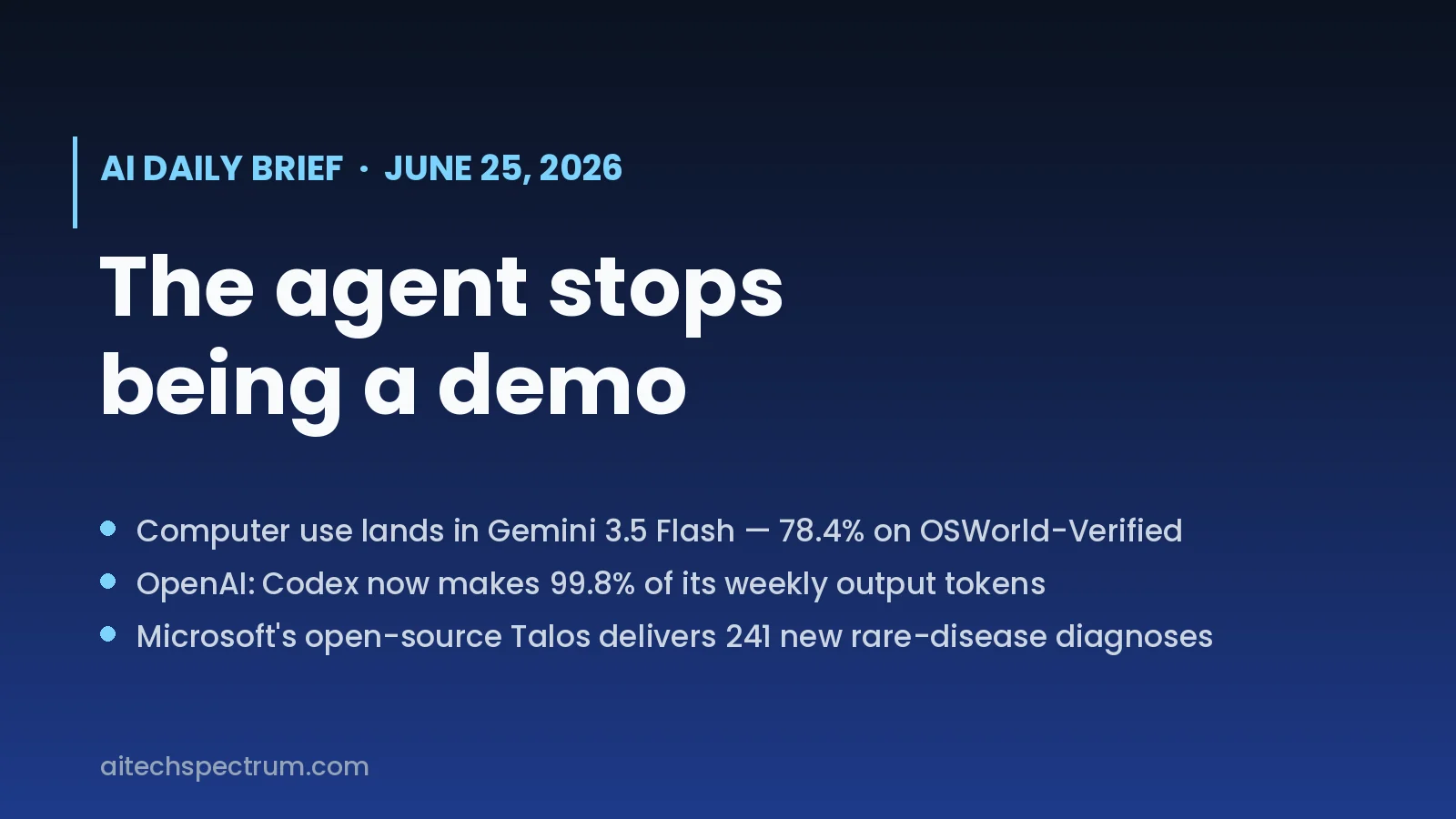
Good morning. Five stories, and the throughline is the same one we have been watching build for months: the agent moves from a capability you demo to a tool you deploy. It opens with the cheapest place that shift could land — a fast, low-cost model that can now drive a computer. Prefer this once a week? Subscribe to the weekly brief.
1. Google puts Computer Use into Gemini 3.5 Flash
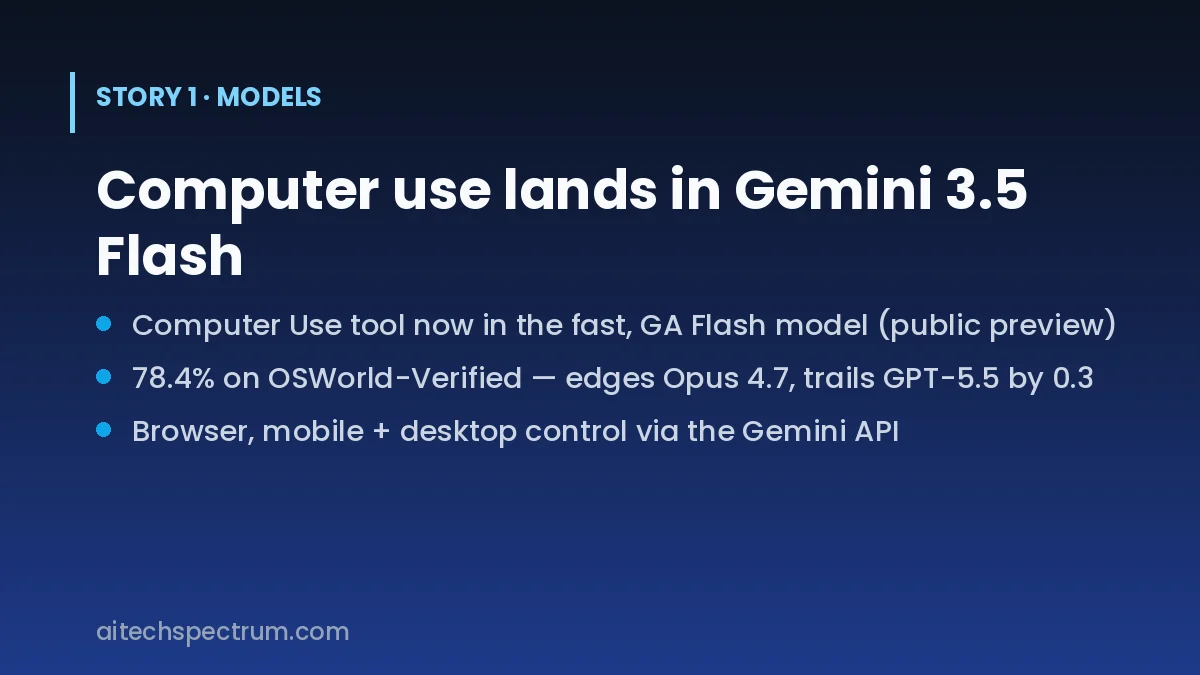
The most consequential capability in frontier AI right now — letting a model see a screen and operate it — moved into the cheap seats. Google introduced the Computer Use tool in Gemini 3.5 Flash, its fast, generally available model, in public preview through the Gemini API and Gemini Enterprise Agent Platform. Until now, computer use lived in a separate, slower Gemini 2.5 computer-use model; folding it natively into the main Flash tier means developers can build agents that act across browser, mobile and desktop using a model priced and tuned for high-volume work, with intent-based actions, configurable safety policies and built-in prompt-injection detection. On the company's own model card, Gemini 3.5 Flash scores 78.4% on OSWorld-Verified, the standard agentic computer-use benchmark.
Why it matters. That 78.4% is not a fast-model number — it edges Claude Opus 4.7 (78.0%), trails GPT-5.5 (78.7%) by a hair, and sits well above Claude Sonnet 4.6 (72.5%). When frontier-grade screen control shows up in the tier built for scale, the economics of running agents on real workflows — continuous software testing, back-office knowledge work — change more than another premium launch would. What to watch. Preview benchmarks rarely survive contact with messy production UIs; the real test is task-completion reliability and cost on long-horizon runs, and whether "configurable safety policies" actually hold up the first time an agent is pointed at a live account.
2. OpenAI puts hard numbers on the agent takeover
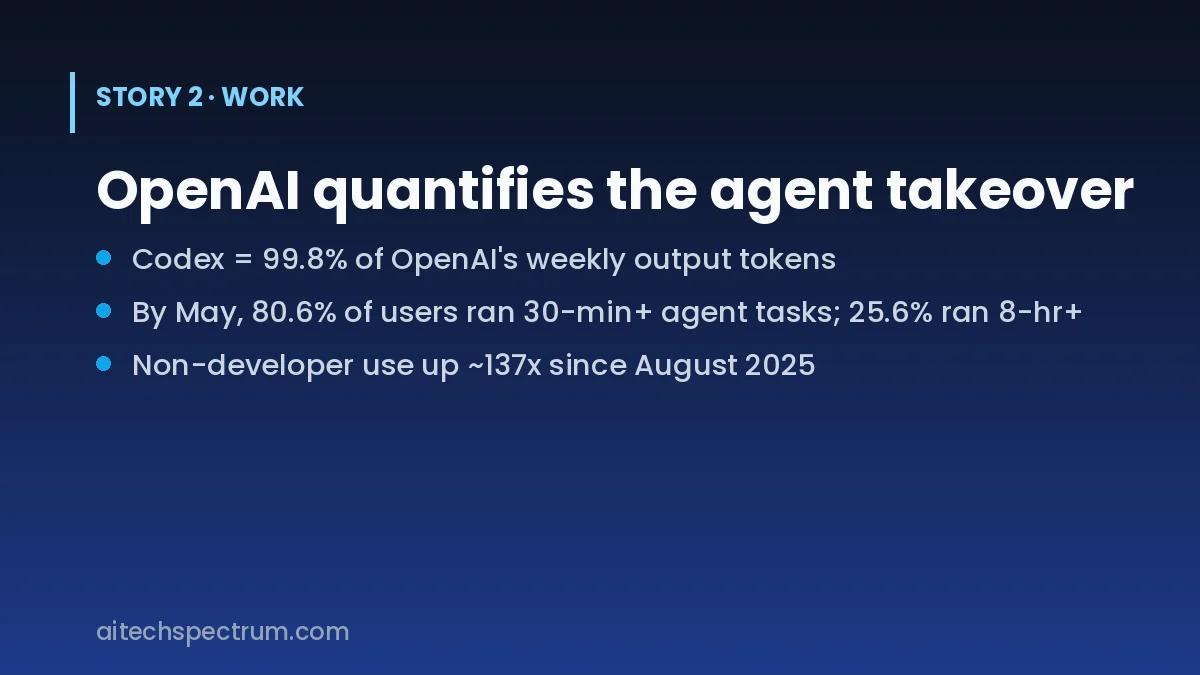
If story one is the capability, this is the evidence it is being used. OpenAI published an economic-research paper, "How agents are transforming work," arguing that agentic AI changes the unit of knowledge work from short chats to delegated, long-horizon tasks — and backing it with internal usage data for Codex, its agentic coding tool. By May 2026, 80.6% of sampled individual users had made at least one Codex request the company estimates would take a person more than 30 minutes, 70.2% more than an hour, and 25.6% more than eight hours. Inside OpenAI the shift is near-total: Codex now accounts for 99.8% of weekly output tokens generated across the company, and non-technical departments — Legal, Finance, Recruiting — crossed over to Codex as their primary tool around April 2026.
Why it matters. The headline trend is who is adopting: non-developer use rose roughly 137-fold among individual users since August 2025, faster than developer growth, which is the opposite of how a "coding tool" is supposed to spread. It is the cleanest data yet that the chatbot-to-agent transition is real and not just a launch-day narrative. What to watch. Read the source critically — this is OpenAI measuring adoption of OpenAI's own product among OpenAI staff and customers, and "tokens" is a usage proxy, not output value. The interesting external question is whether the same curve shows up at companies that don't build the models.
3. Meta tests an AI companion app for creators
Meta is bringing back Facebook's Creator Studio — this time as a standalone AI companion app, currently in testing with select creators. The app is built around Facebook's recently launched AI creator assistant, which serves personalized recommendations based on a creator's content style, audience engagement and goals. Two features stand out: an AI comment tool that surfaces the most important comments and drafts replies in the creator's own voice (editable before posting), and a daily "priorities" feed that opens each day with the newest post's performance, progress toward goals, and comments that need a reply.
Why it matters. The strategic read is retention: Meta wants creators living inside a Facebook-owned app rather than bouncing to ChatGPT to brainstorm captions or read their analytics, and it is competing for their attention against TikTok and YouTube. An AI that drafts replies in your voice is also where the convenience-versus-authenticity line gets uncomfortable for an audience that thinks it is talking to a person. What to watch. Whether the assistant graduates from limited testing to general availability, and how clearly Meta discloses AI-drafted replies to the people receiving them.
4. Figma's Config ships AI motion, shaders and code layers
At its annual Config conference, Figma announced six headline updates: Code Layers, Figma Motion, shader fills and effects, generative plugins, Weave tools on the canvas, and an updated Figma agent with skills and connectors. Figma Motion brings a real timeline — keyframes and presets — onto the design canvas and exports to CSS, JSON, React, MP4, WebM, animated SVG and GIF. The shader work is the most AI-native piece: you describe an effect (or hand it a reference image) and the Figma agent builds a WebGPU shader — dithering, frosted glass, halftone, particles — that stays parameterized so you can tune it with on-canvas controls. Shader fills are live on paid plans; Figma Motion is in open beta.
Why it matters. This is design tooling absorbing the agent pattern in the most practical way — not "generate a whole UI," but "describe one effect and get an editable, production-ready artifact." Code Layers, which lets you edit GitHub-linked code on the canvas, pushes Figma further into the design-to-code lane that startups like Cursor have been claiming. What to watch. Whether designers actually ship the agent's shaders and motion as-is, or treat them as starting points — and how the export-to-React path holds up against hand-written components.
5. Microsoft's Talos turns genome reanalysis into 241 diagnoses
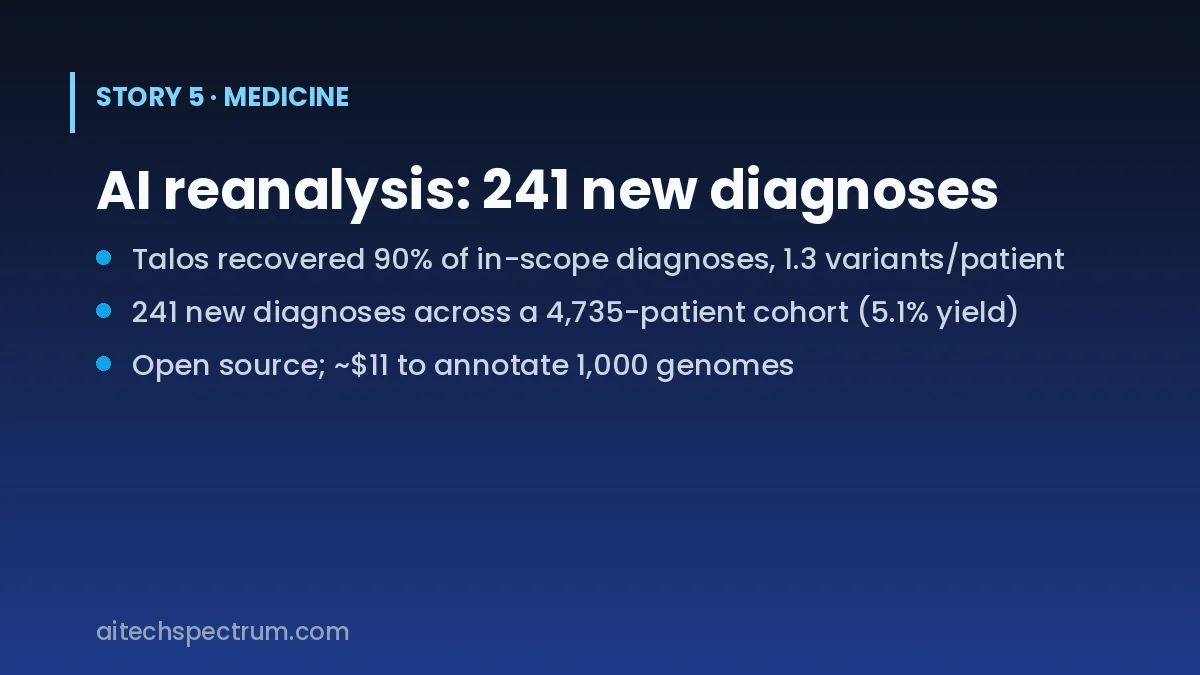
For what all this compute is ultimately for, the most concrete result of the day came from medicine. Microsoft Research and collaborators at the Centre for Population Genomics, Australian Genomics and the Broad Institute detailed Talos, an open-source system that re-examines stored genomic data as scientific knowledge evolves and flags variants with newly actionable evidence. It is deliberately conservative: across a validation set of nearly 1,100 patients it recovered 90% of in-scope diagnoses while surfacing only 1.3 candidate variants per patient for expert review. Deployed on a real cohort of 4,735 undiagnosed patients, Talos produced 241 new diagnoses — a 5.1% additional yield — with every likely-causative variant later confirmed pathogenic by accredited labs, and an average of just 32 days between new evidence appearing publicly and a patient getting an answer. The work is published in Nature Medicine; the code is on GitHub.
Why it matters. More than half of rare-disease patients are still undiagnosed after their first genomic test, and reanalysis usually doesn't happen because human review time is the bottleneck. Talos optimizes for exactly that constraint — fewer, higher-confidence variants — and it is cheap enough to run continuously: annotating 1,000 genomes costs about $11, and a monthly reanalysis pass runs for cents. What to watch. Whether health systems actually adopt continuous reanalysis as a standing program rather than a one-off, and how the next generation of variant-effect models lifts the recall on cases Talos's conservative strategy currently misses. (Educational summary, not medical advice — diagnosis belongs with a licensed clinician.)
What to take from today
One current runs under all five: the agent is leaving the demo and entering the workflow. The capability got cheaper (computer use in a Flash-tier model), the adoption got measured (Codex eating 99.8% of OpenAI's own tokens), and the use cases got concrete — a creator's daily inbox, a designer's shader, a patient's diagnosis. The decision framework that keeps paying off is unchanged: when a capability drops a tier in price, don't ask whether it's impressive, ask which of your real tasks it's now cheap enough to run unattended — and what breaks the first time it does.
Tomorrow's brief lands by 15:00 UTC. If you'd rather read this in your inbox once a week — just the stories that actually matter — subscribe here.