Good morning. Five stories, and they rhyme: AI is moving from pilot to production across the real economy — into a Fortune 100's operations, into the government's air-gapped systems, into the chips and memory powering all of it, into a factory where it fell short, and into the music business on terms worth reading twice. Prefer this once a week? Subscribe to the weekly brief.
- HP makes one of the first big enterprise bets on OpenAI's Frontier
- Palantir and NVIDIA put open models inside the government's walls
- Micron's blowout quarter makes memory the AI trade's new darling
- Ford rehires the veteran engineers AI was supposed to replace
- Suno's artist incubator comes with a non-disparagement clause
1. HP makes one of the first big enterprise bets on OpenAI's Frontier
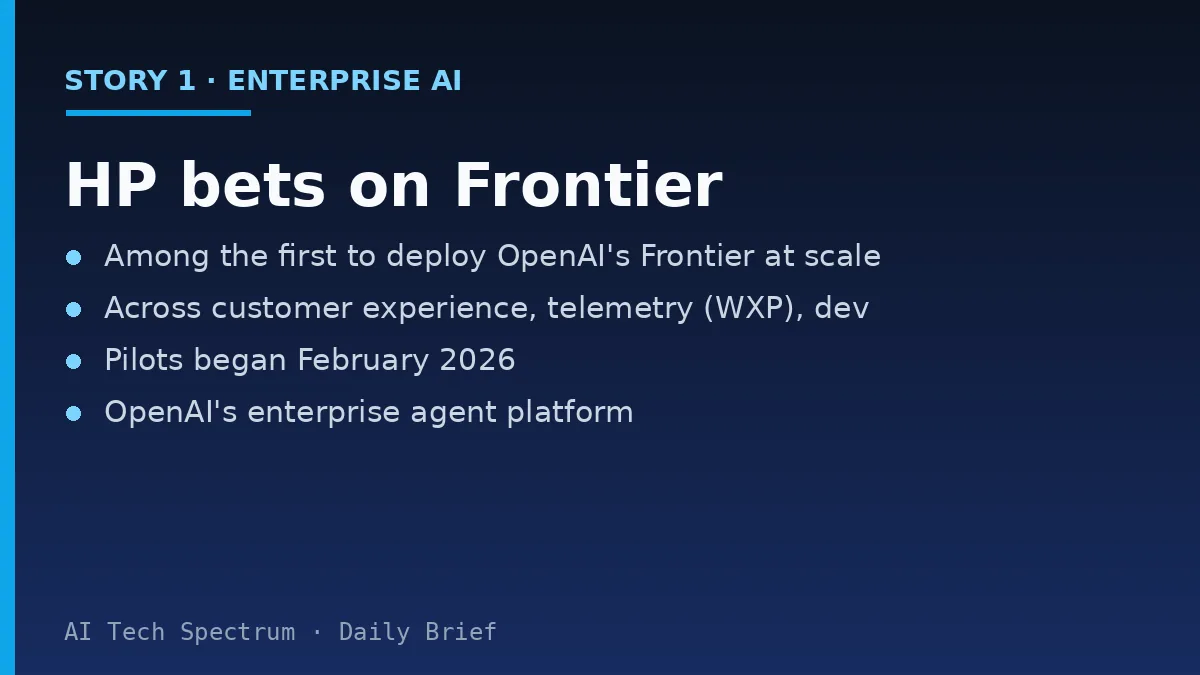
HP Inc. (NYSE: HPQ) announced a strategic partnership with OpenAI, becoming one of the first global enterprises to deploy OpenAI's Frontier platform — the enterprise agent system OpenAI released in February 2026 — at scale. HP says it will use Frontier across customer- and partner-facing experiences, customer telemetry through its Workforce Experience Platform (WXP), employee productivity, and software development. The deal follows a pilot period that began in February, testing agentic capabilities, security, and enterprise integration. HP's chief strategy and transformation officer Prakash Arunkundrum framed it as building "a more consistent experience across store, partner, chat, and voice"; OpenAI's chief revenue officer Denise Dresser said HP had moved "beyond Frontier pilots to deliver measurable business impact at scale."
Why it matters. This is what OpenAI's enterprise pivot looks like in practice — not a chatbot seat license, but a named Fortune 100 company wiring an agent platform into core operations. Frontier is OpenAI's pitch that it can own the full lifecycle of enterprise agents, from build to production, and a marquee logo like HP is exactly the proof point it needs while it fights Microsoft, Google, and Anthropic for enterprise budgets. What to watch. Whether HP later discloses concrete outcomes — cost, deflection rates, cycle-time — rather than ambitions; the announcement is long on vision and short on numbers. The cleanest signal will be whether first movers like HP become reference customers who pull other enterprises onto Frontier.
2. Palantir and NVIDIA put open models inside the government's walls
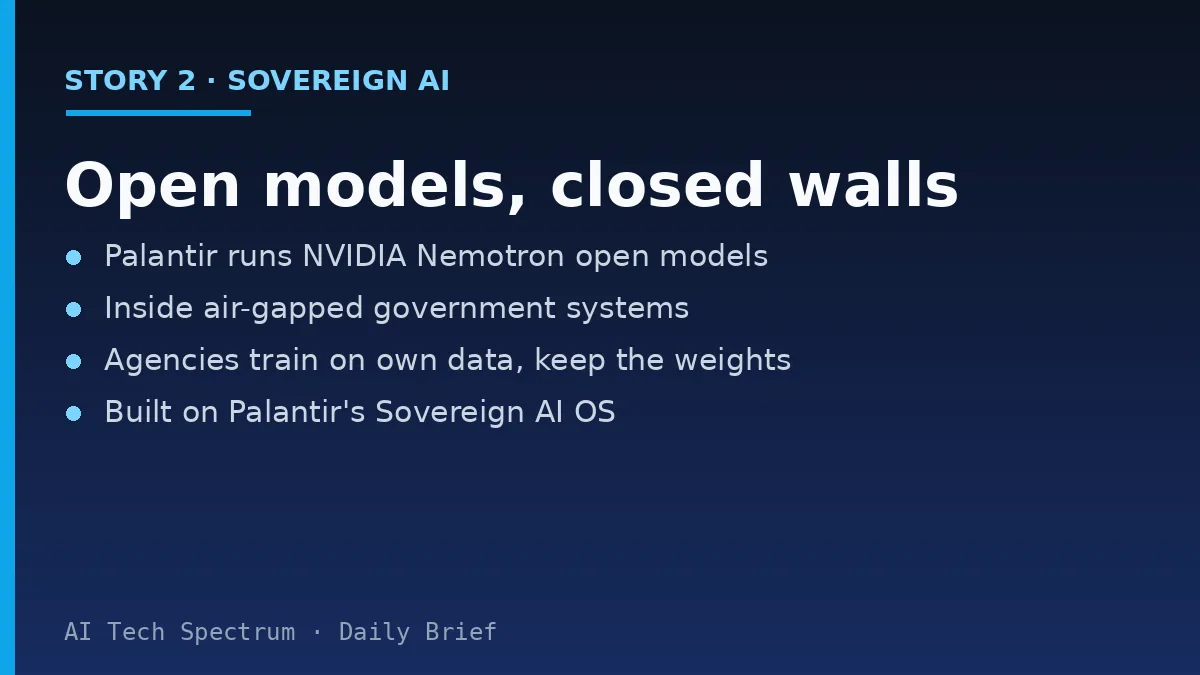
Palantir introduced an "intelligent engine" that runs NVIDIA's Nemotron open models inside air-gapped, sovereign environments for U.S. government agencies and critical-infrastructure operators, NVIDIA said, with the formal launch announced via Businesswire. The pitch: agencies can run customized Nemotron models on their own infrastructure, train on their own data, and retain full ownership of the resulting models — including the weights that encode their operational knowledge. It runs on Palantir's Sovereign AI Operating System (AIP, Ontology, Foundry, and Apollo), with explicit data authorization, architecturally enforced isolation, and full auditability. NVIDIA notes that the U.S. government, with roughly 3 million civilian employees, is effectively one of the world's largest enterprises.
Why it matters. This is the open-model thesis meeting the highest-trust buyer. Closed frontier APIs are a non-starter in air-gapped or classified settings; open weights you can inspect, fine-tune, and own are the only thing that clears the bar. It also deepens the Palantir–NVIDIA–government axis at a moment when "sovereign AI" is becoming a procurement category rather than a slogan. What to watch. Which agencies actually deploy, and whether "retain the weights" survives real security review. The model-ownership promise is the differentiator — if it holds, it's a template every regulated industry, from finance to healthcare, will want to copy.
3. Micron's blowout quarter makes memory the AI trade's new darling
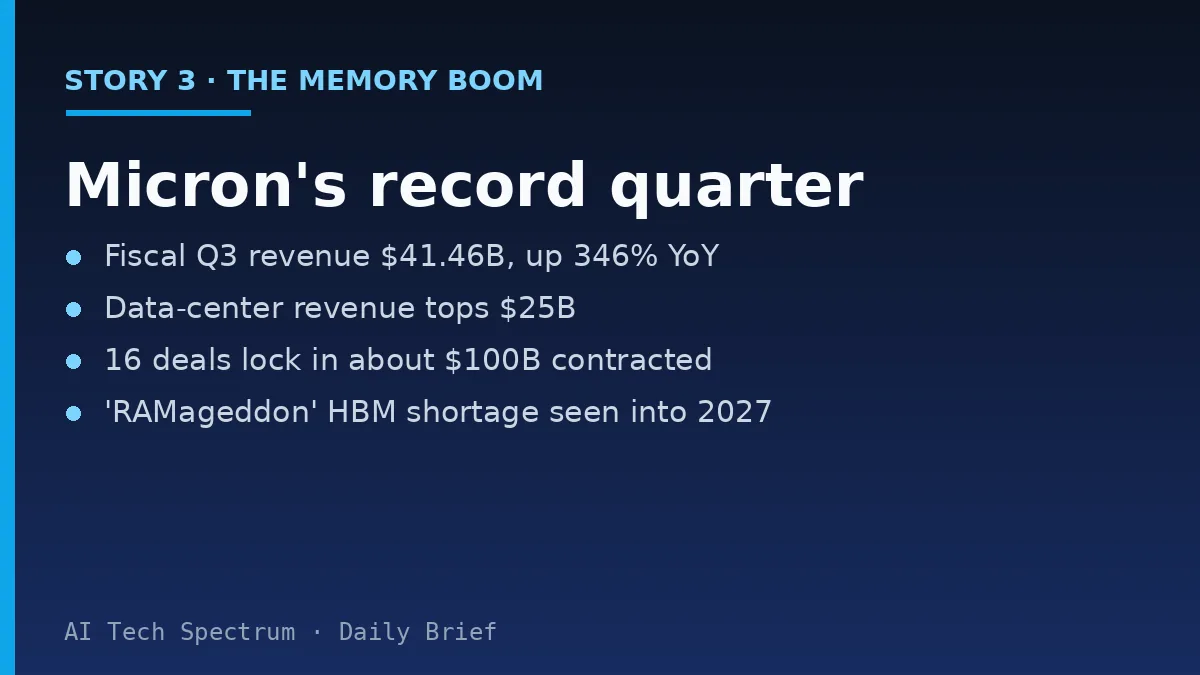
Memory maker Micron (NASDAQ: MU) reported record fiscal Q3 2026 revenue of $41.46 billion — up 346% year over year — as the AI build-out drives a shortage of high-bandwidth memory (HBM) that some are calling "RAMageddon." Data-center revenue topped $25 billion in the quarter, and Micron said 16 "Strategic Customer Agreements" have locked in roughly $100 billion in minimum contracted revenue plus $22 billion in upfront customer cash; it guided to about $50 billion in revenue for Q4. TechCrunch reports the stock has more than tripled in roughly a month, briefly pushing Micron's market value past Meta's and Tesla's.
Why it matters. Every rack of expensive AI accelerators needs even more expensive memory to feed it, and Micron controls about a third of that market. The story rhymes with yesterday's Apple-pricing piece: the same component crunch that is pushing up laptop prices is minting record profits one layer up the stack. What to watch. The cycle. Memory has always been brutally cyclical, and a 346% revenue jump alongside a market cap above Meta's is the kind of setup that historically precedes a reversion. The bull case rests on those multi-year contracts holding through 2027; the bear case is that "this time is different" remains the most expensive phrase in semiconductors. (Informational, not investment advice.)
4. Ford rehires the veteran engineers AI was supposed to replace
Ford has brought back about 350 veteran engineers — some former employees, some pulled from suppliers — after leaning on automated, AI-driven quality systems that didn't deliver, TechCrunch reports, following original reporting by Bloomberg. COO Kumar Galhotra said the company had been "relying more and more on automated quality systems" with disappointing results; VP of vehicle hardware engineering Charles Poon admitted, "Mistakenly we thought that by just introducing artificial intelligence and ingesting the design requirements that we had, that that would produce a high-quality product." The rehired "gray beard" engineers now train younger staff and reprogram the AI tools. Ford credits the move with trimming warranty and recall costs by "hundreds and hundreds of millions" of dollars and says it took the top spot among mainstream brands in this week's J.D. Power Initial Quality Study.
Why it matters. This is the year's cleanest cautionary tale about swapping tacit expertise for a model. The engineers Ford let go carried hard-won intuition for failure points — knowledge that was never written down — so the AI trained on incomplete data and amplified the gaps instead of filling them. The fix wasn't more AI; it was the humans, now pointed at making the AI better. What to watch. Whether other manufacturers quietly run the same playbook. The lesson isn't "AI doesn't work" — it's that automating a process before you've captured the expertise behind it bakes in the holes. Sequencing matters more than ambition.
5. Suno's artist incubator comes with a non-disparagement clause
AI music platform Suno launched "Spark," an incubator for unsigned artists 18 and older, offering cash grants — reported to range from the thousands into the tens of thousands of dollars — plus marketing money, songwriting camps, and a dedicated partner manager, per Variety and Billboard. Artists keep creative and commercial rights and choose their own distributor — but the fine print includes a non-disparagement clause: participants agree not to say anything negative about Suno and to avoid rival AI music tools for 60 days after their last post. It lands as Suno courts the industry it once antagonized, touting an upcoming model built with Warner Music Group and a recent $400 million raise that valued the company at $5.4 billion.
Why it matters. It's a sharp illustration of how AI platforms are trying to convert critics into participants. The grants are real and the rights terms are unusually generous for this space — but the strings (don't criticize us, don't touch competitors) are exactly the kind of clause an artist should read twice. Generosity with a loyalty rider is still a loyalty rider. What to watch. Whether artists and their advisors accept the non-disparagement terms, and whether Warner's involvement signals a broader label détente with AI music or just a hedge. Either way, "we'll fund you if you stay quiet and stay exclusive-ish" is a model worth tracking.
What to take from today
The thread is AI leaving the demo stage and meeting the real economy — with its wins and its limits in the same frame. HP and Palantir show the enterprise and the government wiring AI into how work actually gets done; Micron shows the staggering money flowing to whoever supplies the picks and shovels; Ford shows what happens when you automate ahead of your own expertise; and Suno shows the terms attached to AI's outstretched hand. The decision-useful read: once AI moves from pilot to production, the right questions turn operational, not philosophical — what does it cost, what does it own, what does it replace, and what does the fine print ask of you. Keep that filter handy this week.
Tomorrow's brief lands by 15:00 UTC. If you'd rather read this in your inbox once a week — just the stories that actually matter — subscribe here.