Good morning. Five stories, one question: as the money and the marketing around AI get bigger, who owns the upside and who gets to say "prove it"? Washington is being offered a literal cut; three products made outsized promises today; and the least-hyped use of AI turned out to be the one running the lights. Prefer this once a week? Subscribe to the weekly brief.
1. OpenAI floats a 5% stake for Washington — and a global AI referee
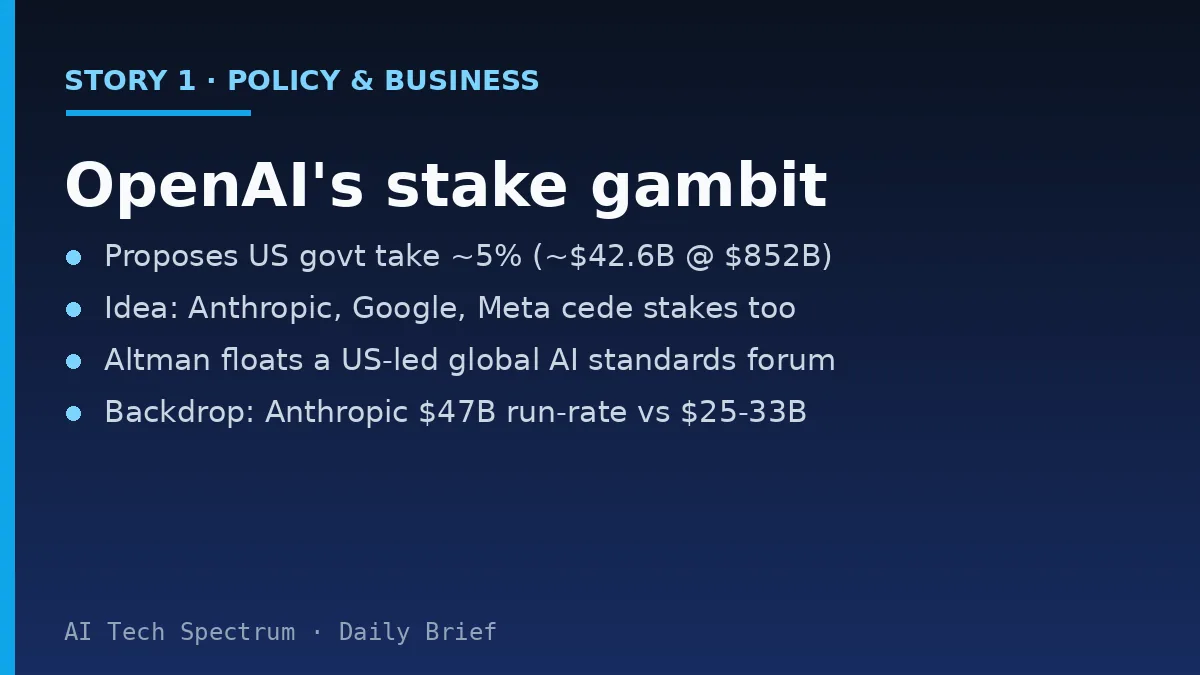
OpenAI has proposed handing the US government a roughly 5% stake in the company to defuse political pressure in Washington, according to a Financial Times report picked up by CNBC and Axios. A stake that size would be worth about $42.6 billion at OpenAI's recent $852 billion valuation. The reported vision is bigger than one company: each leading US AI developer — Anthropic, Google, and Meta among them — would cede a similar slice to a government vehicle such as a sovereign wealth fund, with Altman arguing that giving the public a direct financial interest is the fairest way to share AI's upside. Separately, in a Financial Times op-ed, Altman proposed a US-led international forum — modeled on aviation safety and the International Atomic Energy Agency — to set AI standards and "guard against the commercial pressures that can lead to unsafe racing."
Why it matters. The two proposals point in opposite directions, and that's the story: an equity stake ties the government's fortunes to OpenAI's success, while an international standards body would sit in judgment of it. The backdrop is a lead that's genuinely slipping — OpenAI has guided to $25–33 billion in annualized revenue, while Anthropic said in May it's on course for $47 billion and profitability in 2029; Ramp data shows Anthropic overtook OpenAI in business subscriptions in May, and Similarweb had ChatGPT dipping below half of generative-AI web visits for the first time. What to watch. Whether any lab actually signs over equity to the state, and how antitrust and conflict-of-interest scrutiny reacts to a regulator that's also a shareholder. (Informational, not investment advice.)
2. Meta quietly ships Pocket, an AI game-maker
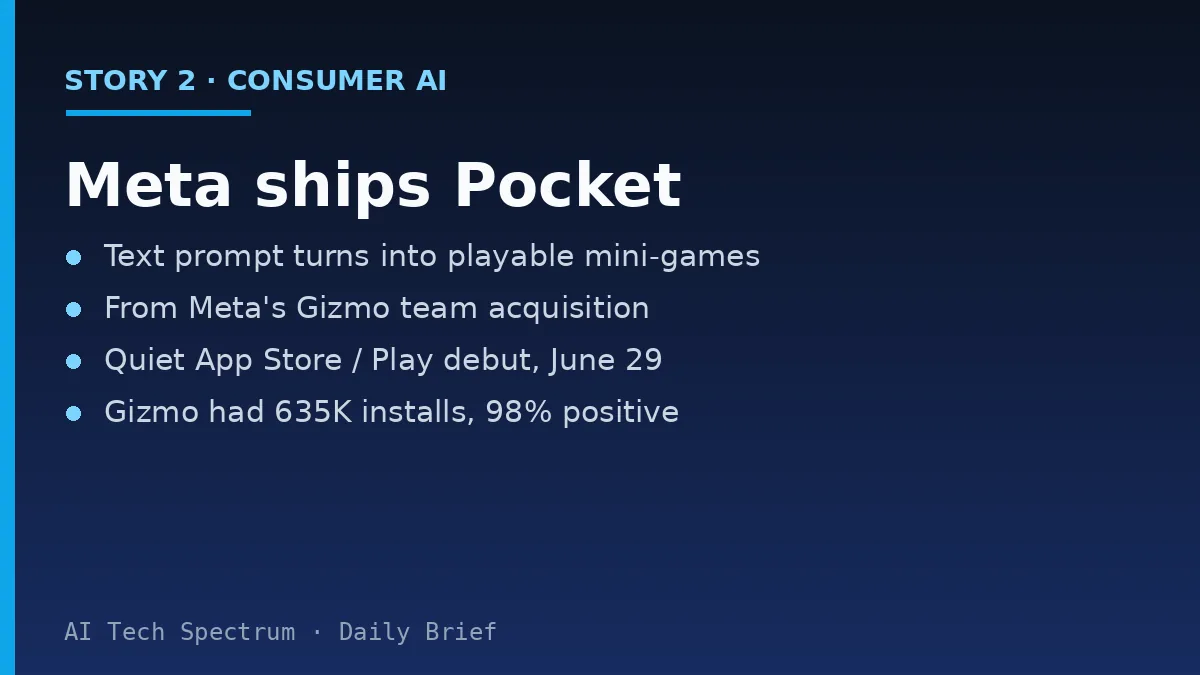
Meta quietly launched Pocket, an app that lets anyone generate small, interactive games and apps — which it calls "gizmos" — from text prompts, TechCrunch reported. The software comes out of Meta's acquisition earlier this year of the team behind Gizmo, a "vibe-coded" mini-app platform, and pairs the prompt-to-game builder with a scrollable feed of gizmos other people have made. There was no official announcement: a reverse engineer spotted the listing, and app-intelligence firm Appfigures dates the quiet App Store and Google Play debut to June 29. For scale, Gizmo's original app had logged roughly 635,000 lifetime installs with 98% positive sentiment before Meta absorbed the team.
Why it matters. Pocket extends Meta's push to make AI creation — not just AI chat — a mainstream consumer habit, alongside its Meta AI image app and the Vibes video app. The bet is that a TikTok-style feed of tiny, generated games keeps people producing and scrolling inside Meta's walls. What to watch. Whether "make a game from a sentence" produces anything people return to, or whether the feed fills with disposable one-offs — and whether Meta formally launches Pocket or lets it stay an experiment, as its unannounced debut suggests it still is.
3. Midjourney's 60-second body scanner meets its skeptics
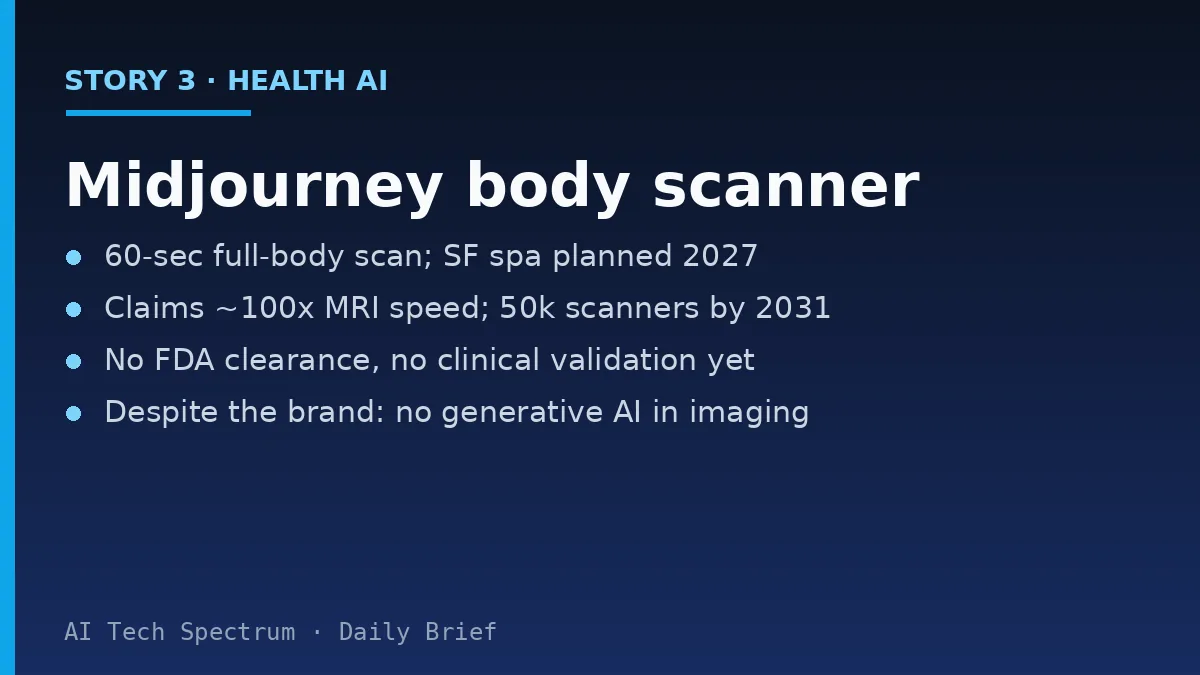
Midjourney — the image-generation lab — unveiled Midjourney Medical, a full-body "ultrasonic CT" scanner it says produces MRI-like 3D imaging in about 60 seconds, at "nearly a hundred times the speed" of an MRI, paired with a planned "Midjourney Spa" opening in San Francisco in 2027. The company's stated ambition is a fleet of more than 50,000 scanners by 2031, enough for a billion scans a month, and it claims that widespread early imaging could eventually "avoid 30% of all deaths and 50% of all healthcare costs." Reviewers were quick to add the caveats Midjourney's own post mostly defers: as The Next Web and Futurism noted, the device has no FDA clearance (Midjourney says it will start with non-diagnostic body-composition maps and submit test results over time), no published clinical-validation data, and — despite the brand — no generative AI in the imaging itself.
Why it matters. This is a clean test of a pattern worth naming: a lab famous for one kind of AI attaching that halo to a hardware moonshot in a regulated field. The engineering may be real, but "as casual as a trip to the spa" and "avoid 30% of deaths" are marketing, not findings. What to watch. The first peer-reviewed or FDA-facing data, and whether radiologists' central worry — that whole-body scans on healthy people surface ambiguous findings that trigger anxiety and unnecessary follow-ups — gets addressed rather than waved past. (Informational, not medical advice — talk to a licensed clinician about screening.)
4. OpenClaw lands on your phone — and in your dating life
OpenClaw, the open-source AI-agent "gateway" that went viral this spring, is now a mobile app on iOS and Android, TechCrunch reported: you pair your phone with the OpenClaw Gateway, a routing layer that connects your requests to AI agents and the tools they can use. The rollout was uneven — early Android reviews sat around 2.2 stars with complaints of bugs, while the iOS build drew better marks. And the use cases are getting personal: TechCrunch also profiled people using OpenClaw to run their dating logistics — one founder has his bot research neighborhoods and assemble a linked document of restaurant options before a date.
Why it matters. This is agentic AI leaving the demo and entering daily life, with the tradeoff in plain sight: the same "let it act for me" convenience means handing an autonomous agent standing access to your accounts and tools. Security advocates have warned repeatedly against giving an assistant unilateral control, and a buggy 2.2-star launch is not where you want that access to live. What to watch. Whether mainstream agent apps ship real permission scoping and audit trails before a headline breach makes the case for them — and, more practically, whether you've locked down the logins any agent could touch. (See the sidebar.)
5. The quietest AI is running the turbines
While consumer AI grabbed the headlines, MIT Technology Review looked at the less photogenic frontier: AI agents embedded in heavy industry. In an interview, Woodside Energy's VP for digital, Andrew Meleng, described an "autonomous enterprise" where agents plug into core operational workflows with outcomes framed as protecting people, protecting the environment, and delivering energy at lower cost. The piece's argument is that the most consequential deployments are unfolding where physical infrastructure, uptime, and safety are paramount — not in a chat window.
Why it matters. It's the counterweight to today's other four stories. Government stakes, game-makers, body scanners, and dating bots are loud; agents that keep a gas plant or a wind farm inside its safety envelope are quiet, boring, and — if they work — enormously valuable. The bar in these settings is also higher: a hallucination in a brainstorm is a shrug; a hallucination in a control loop is an incident. What to watch. Whether operators keep humans firmly in the loop and publish real reliability numbers, or whether "autonomous enterprise" outruns the evidence the same way the consumer pitches above do.
What to take from today
Follow the money and the marketing and you get the same instruction. OpenAI's stake proposal is a bid to align the most powerful referee — the US government — with the industry's upside, right as its own lead narrows; the three product stories (Meta, Midjourney, OpenClaw) are all big promises that invite a "prove it," and the turbine story is the reminder that the AI most worth trusting is usually the one making the least noise. The decision-useful read for buyers and citizens alike: separate the demo from the deployment, ask who benefits when the claim is repeated, and price the risk on evidence, not adjectives.
Tomorrow's brief lands by 15:00 UTC. If you'd rather read this in your inbox once a week — just the stories that actually matter — subscribe here.