Good morning. For two years the frontier race was measured in benchmark points and context windows. Today it's measured in where the agent runs and what it's allowed to touch: Anthropic and Google both moved agents off the desktop and into the background, NVIDIA started designing silicon around the pauses between an agent's steps, and two consumer stories show the same capability cutting both ways. Prefer this once a week? Subscribe to the weekly brief.
1. Claude Cowork goes mobile — and the data says most users aren't coding
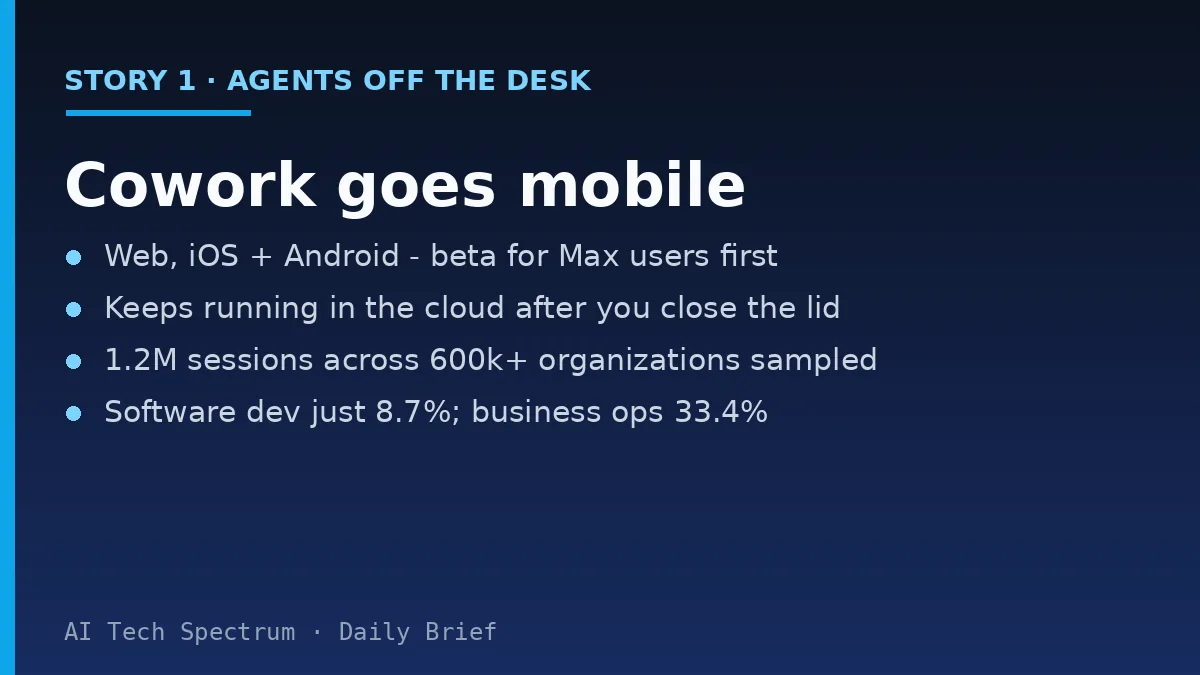
Anthropic is taking Claude Cowork — its autonomous work agent — off the desktop. It's rolling out on web, iOS and Android, in beta to Max subscribers first, with other paid plans following over the coming weeks, as TechCrunch and The Verge reported. The pitch is continuity: start a task on a laptop, let it keep running in Anthropic's cloud after you close the lid, and steer or review it from your phone — while it still pauses to ask when it needs a decision or a permission. Anthropic paired the launch with usage data that cuts against the industry's coding-agent story. Across 1.2 million anonymized Cowork sessions (sampled May 11–31) from more than 600,000 organizations, software development was just 8.7% of use. The largest category was business-process and operations work — pulling scattered updates into a report, reconciling spreadsheets — at 33.4%, followed by content creation and copywriting at 16.4% (VentureBeat, InfoWorld). Anthropic also said it plans to merge Cowork with its chatbot so you can chat and hand off computer tasks from one interface, landing first on web and desktop.
Why it matters. The mobile move quietly redefines the agent — less a coding copilot pinned to an IDE, more a background worker you delegate to and check on like a colleague. And the usage split is the strategic tell: the money question isn't "will agents replace developers" but "will knowledge workers delegate the operational busywork," which is a far bigger market than the coding tools everyone benchmarks. What to watch. The security calculus. An agent that keeps working after you close your laptop is an agent whose permissions you are no longer watching in real time — a thread that runs straight into stories 3 and 5.
2. Gemini's managed agents learn to run in the background
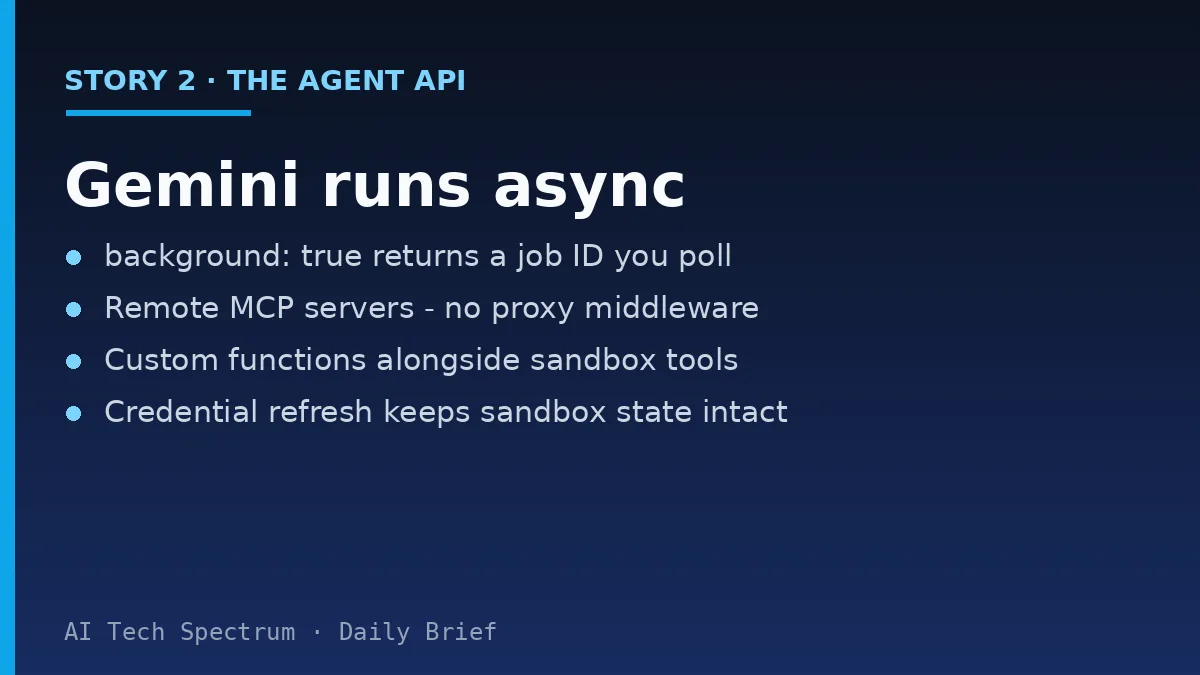
Google expanded Managed Agents in the Gemini API with four capabilities aimed squarely at production use. Background execution lets a developer pass background: true so an interaction runs asynchronously on Google's servers; the API returns an ID immediately that the app can poll, stream, or reconnect to later, instead of holding a fragile long-lived HTTP connection open. Remote MCP server integration lets managed agents connect directly to remote Model Context Protocol servers — private databases, internal APIs — without writing custom proxy middleware. There's also custom function calling alongside the built-in sandbox tools, and network credential refresh so expiring tokens and short-lived keys can be rotated mid-session while the sandbox keeps its filesystem state, installed packages and cloned repositories intact. Managed agents run inside an isolated cloud sandbox where Gemini handles reasoning, code execution, package installation, file management and web lookups behind a single endpoint.
Why it matters. This is the same "agent as a background service" thesis as story 1, but at the API layer — Google is making it boring, in the good way, to run long, tool-using agents in production. First-class remote-MCP support in particular is a bet that MCP is becoming the connective tissue of the agent era. What to watch. Whether "async by default" becomes the norm for agent APIs, and how Google's linked security best practices hold up once agents are reaching into private databases from a shared cloud sandbox.
3. NVIDIA names a CPU class for the agent loop
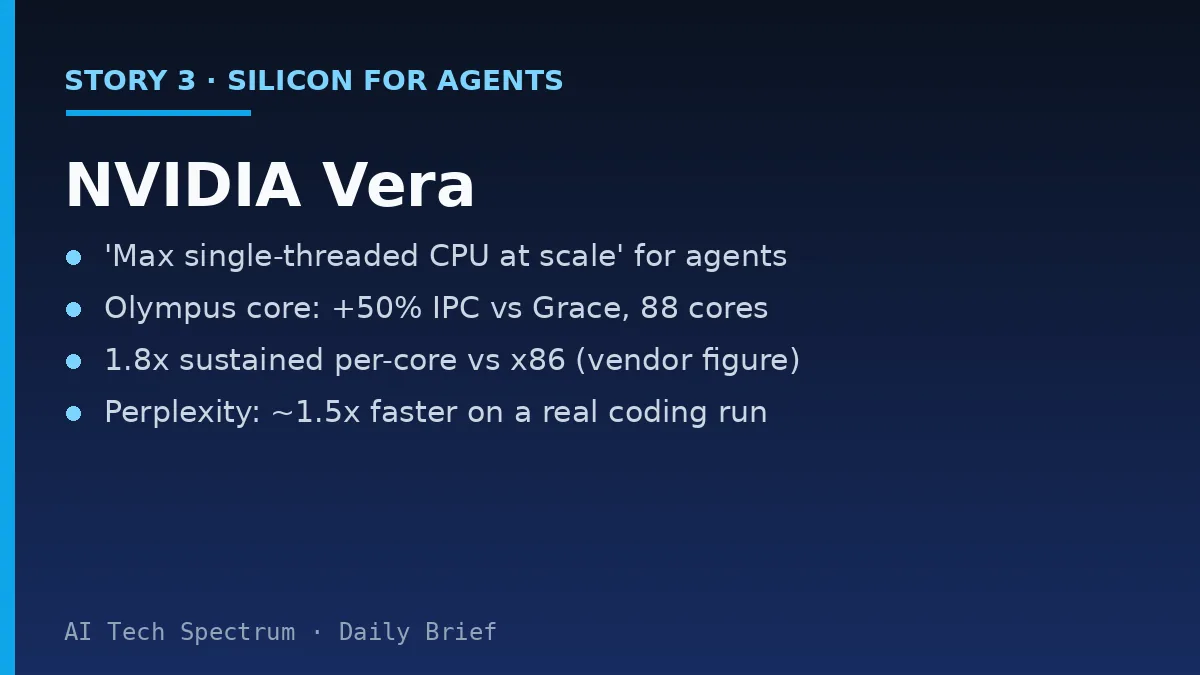
NVIDIA used a July 7 post to name a category it says it is building for: the "max single-threaded CPU at scale," a class of processor optimized not for core count but for how fast a single agent step finishes. The argument is that an agent runs in a loop — reason, call a tool, get a result, decide again — and because each step waits on the last, per-core speed sets how fast the loop advances while the expensive GPU sits idle waiting on the CPU. NVIDIA Vera is its answer. Its custom Olympus core delivers 50% higher instructions per cycle than NVIDIA Grace; the chip pairs up to 1.2 TB/s of LPDDR5X memory bandwidth (at under 40W of memory power) with 3.4 TB/s of core-to-core bandwidth — which NVIDIA says is 3x any other data-center CPU — across 88 cores. In loaded agentic workloads NVIDIA claims 1.8x the sustained per-core performance of x86. Perplexity, an early tester, said that on a real coding workflow — cloning a repo and running its test suite in sandboxes — Vera finished about 1.5x faster than x86 and started concurrent sandboxes up to 1.9x faster, and is looking to deploy it in production. NVIDIA also previewed a next-generation Rosa CPU with an Arm v9.2 "Rigel" core.
Why it matters. Vendor benchmarks flatter the vendor, so treat the multipliers as directional — Perplexity's numbers are NVIDIA-published, not independent. But the framing is the real news: NVIDIA is telling the market that the bottleneck in agentic systems is shifting from raw model FLOPs to the CPU-side "glue" work between model calls, and it is designing silicon around the agent loop specifically. What to watch. Independent benchmarks, and whether "single-threaded speed at scale" pulls the rest of the data-center CPU market off the pure core-count race.
4. Meta's Muse Image ships — with an instant consent backlash
Meta launched Muse Image, the first image-generation model from its Superintelligence Labs (MSL, led by Alexandr Wang) and the group's second release after the Muse Spark LLM in April. Meta's pitch is that Muse Image "reasons" through a prompt before drawing — planning layouts, blending multiple photos, and pulling in real-time web context — and can create from scratch, edit photos, remove objects, build infographics, and render legible text inside images. It is live now in the Meta AI app and powers new tools across Instagram (more than 30 new AI effects in Stories) and WhatsApp, with Facebook, Messenger and advertiser tools via Advantage+ creative coming later; everyday use is free, with more available through Meta's subscriptions. The rollout drew immediate pushback: because the model blends photos while "preserving the subject's likeness," early users flagged to TechCrunch and The Verge that it can pull other people — including other Instagram users — into AI-generated images, reviving the consent questions that trail every "Meta AI and your photos" feature.
Why it matters. Muse Image is Meta answering the consumer image-gen race with distribution no startup can match — billions of users across four apps in one launch. But the likeness-blending feature is the story's fault line: the same capability that makes it fun is the one that makes "someone put me in an AI photo" a default risk rather than an edge case. What to watch. Whether Meta ships granular consent controls before the feature scales, and whether "reasoning" image models meaningfully beat one-shot generators at the two things they historically botch — legible text and multi-element layout.
5. Savi raises $7M to fight the AI-scam economy
A new startup, Savi Security, launched an iOS and Android app aimed at the consumer end of the AI-scam problem, backed by a $7 million seed round led by Acrew Capital. Founded by brothers Patrick and Ryan Coughlin (Patrick was previously SVP of security products at Cisco), the company grew out of a real incident: their mother received a call that spoofed their sister's number and cloned her voice, with a man demanding $1,200 or he would harm her. The app screens texts, voicemails and incoming calls, and its standout feature is live call monitoring — during a suspicious call you can add Savi's agent as a listener to flag behavioral tells in real time. It runs $8/month, or $63/year, for a whole family with no cap on users. The backdrop is grim: the FTC says people reported losing $3.5 billion to imposter scams in 2025, triple the 2020 figure, and Malwarebytes research found Gen Z fell for text scams about 25% of the time. Savi's free precursor tool, Scam Wise, has logged 50,000 submissions and is growing by roughly 10,000 a week.
Why it matters. Stories 1–3 are agents doing legitimate work; this is the same capability turned against consumers — a voice cloned from three seconds of public audio, at a cost low enough to target ordinary families rather than just enterprises. The defensive market is now consumer-scale, and real-time "AI vs AI" screening is the emerging shape of it. What to watch. Whether always-listening scam-detection apps clear the privacy bar they implicitly ask users to accept, and whether platform-level defenses — carriers and operating systems — absorb this before standalone apps scale.
What to take from today
The through-line is delegation. Anthropic and Google are both racing to make an agent something you hand a task to and walk away from — on your phone, in the background, in the cloud — and NVIDIA is rebuilding the CPU around the millisecond gaps in that loop. Meta is doing the same handoff for images, and Savi is a reminder that the exact capability that lets an agent act on your behalf is the one a scammer rents to impersonate you. Three questions rhyme across all five stories: what is the agent allowed to touch, whose infrastructure is it running on, and can you see what it did while you weren't watching. Delegation is the product now; visibility and scope are the price.
Tomorrow's brief lands by 15:00 UTC. If you'd rather read this in your inbox once a week — just the stories that actually matter — subscribe here.