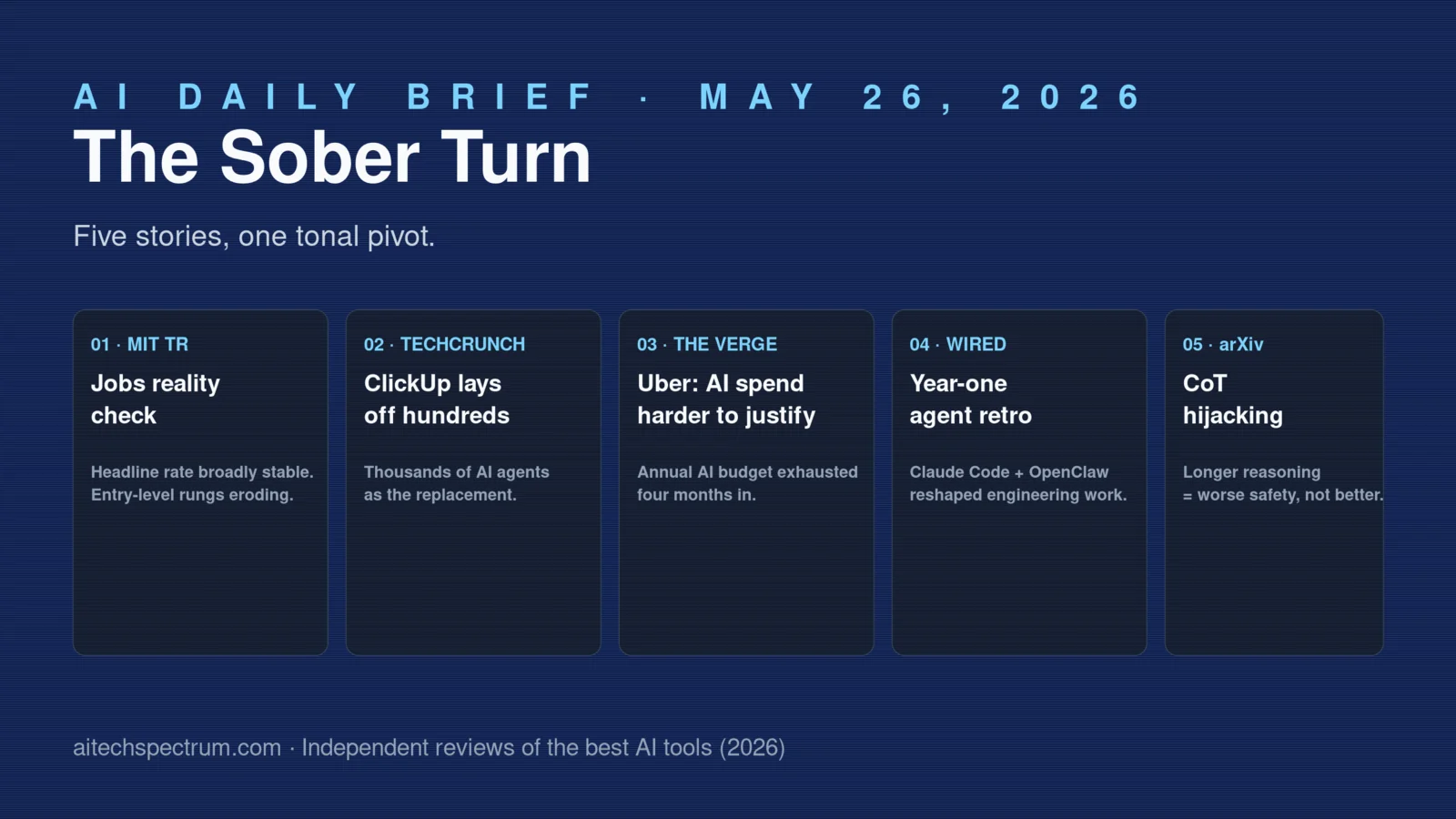
Good morning. Today's brief is a tonal pivot. The four secular outlets and one arXiv paper in this brief are not a coordinated story, but they line up the same way: the part of the AI conversation that was running on press releases and projection is starting to be replaced by the part that runs on labor statistics, P&L lines, post-mortems, and benchmark data. MIT Tech Review is the most direct example — read it back-to-back with its companion piece on entry-level work. Then ClickUp's mass layoff for the concrete operating decision; Uber's CFO-side moment for the budget reality; Wired's year-one retrospective for the sense-making; and the Chain-of-Thought Hijacking paper for the part the safety teams care about. If you'd rather read this once a week, subscribe to the weekly brief.
- MIT Tech Review's reality check on the AI jobs hysteria
- ClickUp lays off hundreds and tells TechCrunch the replacements are AI agents
- Uber's president tells Rapid Response the AI spend is "harder to justify"
- Wired's year-one retrospective on Claude Code and OpenClaw
- "Chain-of-Thought Hijacking": when longer reasoning makes models less safe
1. MIT Tech Review's reality check on the AI jobs hysteria
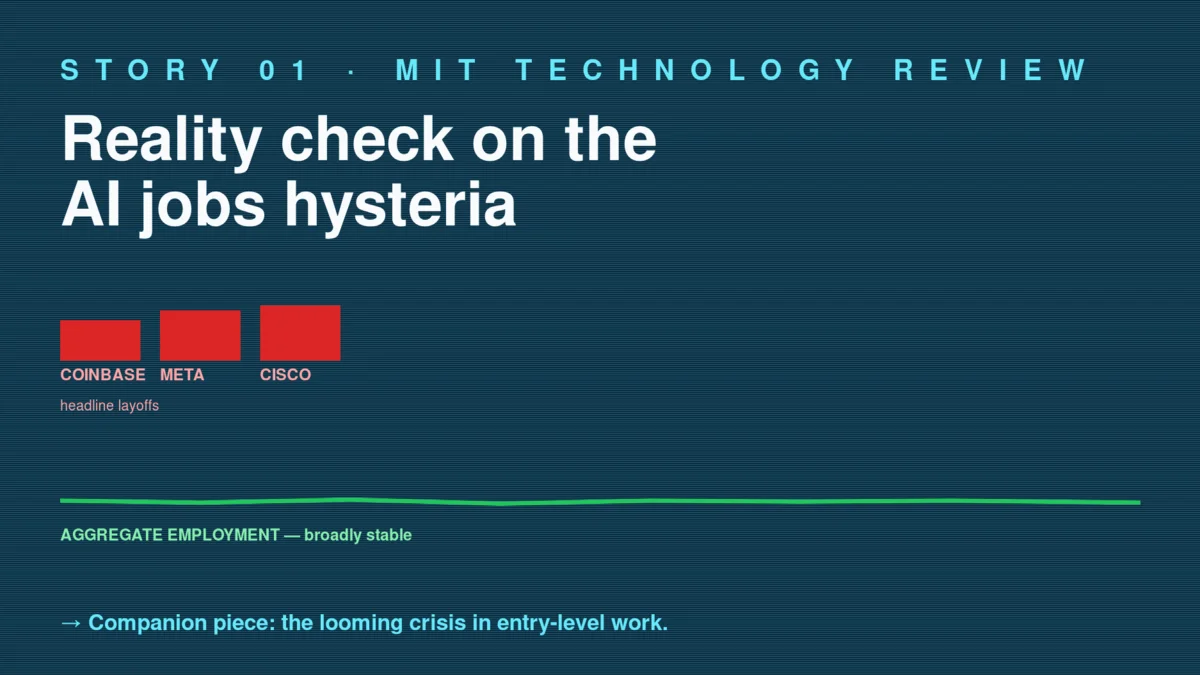
MIT Technology Review published a piece this morning arguing the white-collar collapse narrative that has dominated business coverage for the last eighteen months does not match the data. The piece walks through the eye-catching layoff round — Coinbase, Meta, Cisco — and then sets it against aggregate employment in developed countries, which remains broadly stable on the headline numbers. The author's read is that the data so far doesn't show the clean story of mass technological unemployment that the press cycle has been describing; the labor-market signal is messier, slower, and more concentrated in specific entry points than the framing suggests. Its companion piece on entry-level work, published the same morning, argues the place to look for the displacement signal is not the headline unemployment rate but the hiring rate for first-job roles — junior analysts, paralegals, copywriters, customer-support tier-one — where the elasticity of agent substitution is highest and the political response is most underweight.
The substantive contribution is the framing. The two MIT TR pieces argue that the right unit of analysis is not "did AI take the jobs" but "where in the labor pipeline is AI removing the rungs" — and that the answer concentrates in the part of the pipeline that has historically been how knowledge workers entered their careers. That reframes the policy conversation from retraining displaced mid-career workers (the 2010s model of trade-shock response) to keeping the on-ramp open for people who have not yet entered. It also reframes the corporate conversation: a company that automates the bottom rung of its analyst pipeline gets a one-quarter cost win and a five-year talent-pipeline problem. The pieces, taken together, are the cleanest counterweight in mainstream coverage to the "Coinbase, Meta, Cisco, therefore the white-collar economy is collapsing" arc.
Why it matters. If you set hiring policy, treat the entry-level rate, not the headline rate, as the early-warning signal — that's where MIT TR's data trail points. If you run people strategy at a company that's leaning on AI agents to replace tier-one work, the durable cost is the five-year pipeline gap, and the budget question is whether the agent savings outweigh the eventual cost of hiring senior talent into a thinner pool. And if you write about AI for a living, the MIT TR pair is a useful reminder that the prevailing narrative is downstream of layoff press releases, not of labor statistics. For a parallel on how the technology side of the same story has matured, see our writeup of agentic AI hitting mainstream enterprise adoption.
2. ClickUp lays off hundreds and tells TechCrunch the replacements are AI agents
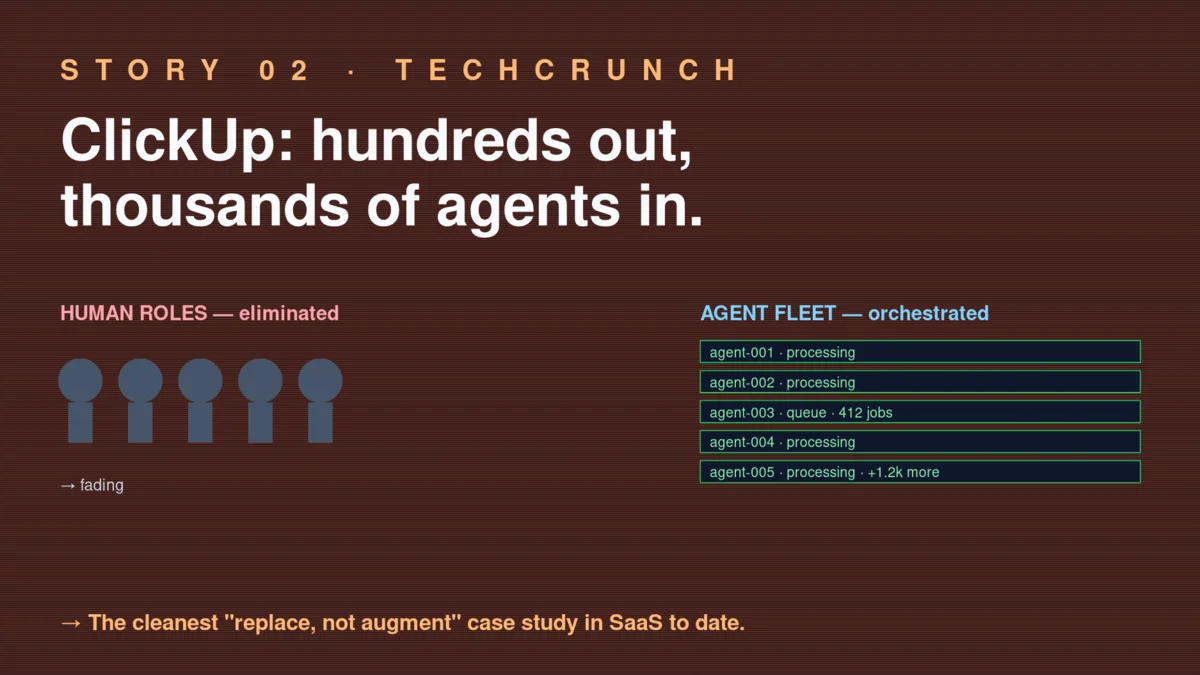
TechCrunch reports that the nine-year-old project-management SaaS company ClickUp is laying off "hundreds" of employees and replacing them with what the company describes as "thousands of AI agents." TechCrunch frames it as the cleanest "replace, not augment" case study in the SaaS sector to date — the agents are not productivity tools handed to remaining employees, they're stand-ins for the jobs that were just eliminated. The piece is one of TechCrunch's most-read of the day and is being widely shared on engineering and management Twitter as the moment when the agent-substitution argument leaves theory.
The substantive read is what makes ClickUp specifically interesting. ClickUp's own product is a project-management surface — the layer at which a lot of the knowledge-worker coordination it just laid off was happening. If a company that sells the platform on which agent-orchestrated work is run also operates as the cleanest example of it internally, the dogfooding signal is unusually strong, and the question of whether the unit economics work in production gets answered quickly. The piece treats the layoff as a leading indicator for the rest of the project-management category — and, by extension, for any horizontal-SaaS category where the customers are themselves about to make the same call. The next twelve months at ClickUp are now the most-watched controlled experiment in the SaaS sector.
Why it matters. If you run a SaaS company adjacent to ClickUp's category — Monday, Asana, Notion, Linear, Atlassian — the procurement conversation just shifted: customers will start asking what your own ratio is and what reference customer is running the agent-substituted version of your stack. If you're a buyer evaluating any horizontal-SaaS purchase in 2026, the durability question is no longer "does it work today" but "does the vendor itself dogfood the AI version of the workflow it's selling you." And if you're tracking the labor signal MIT TR just argued is concentrated in entry-level rungs (story 1 above), the ClickUp roles are exactly that part of the org chart. For the operational pattern of running large agent fleets in production, see our best AI agents 2026 roundup.
3. Uber's president tells Rapid Response the AI spend is "harder to justify"
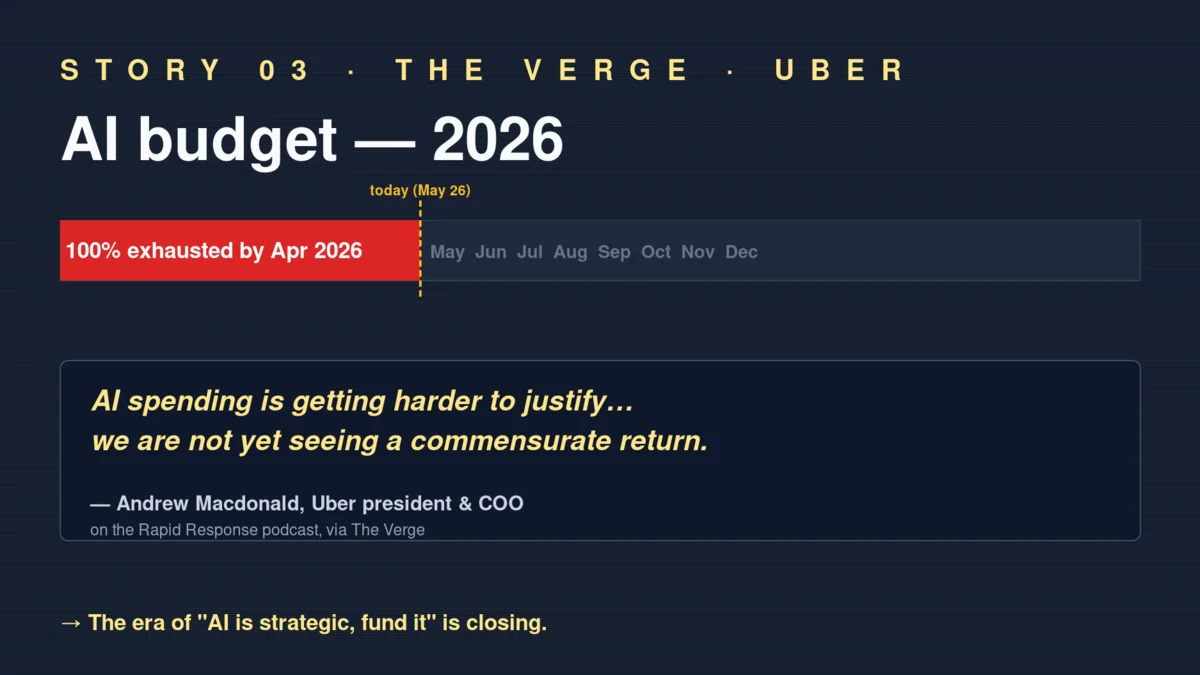
The Verge reports that Uber president and COO Andrew Macdonald told the Rapid Response podcast that the company exhausted its 2026 AI budget approximately four months into the calendar year and is now questioning whether it's seeing a commensurate return on the spend. The framing is striking less for the absolute number — Uber doesn't disclose its AI line item — than for who's saying it and how. A sitting president and COO of a public ride-share company is publicly describing AI ROI as "harder to justify" while the rest of the press cycle is talking about agentic super-cycles, and the candor is the part the market is going to remember.
The substantive read is that the corporate-spend conversation is finally arriving at the budget-committee table. The 2024–2025 pattern was that AI was a board-level priority and the budget was treated as an investment line that didn't have to clear the same ROI bar as customer acquisition or product development. The Macdonald comments are the first time in 2026 a Fortune 100 operator has on-the-record described the spend as failing that test. That doesn't mean the agentic story is wrong — it means the next quarter is the one where buyers ask vendors to prove ROI on the same axes as any other line item, and the vendors that have data win the budget cycle. Pair the Uber comment with the MIT TR reality check from story 1 — they're the same observation from opposite sides of the income statement.
Why it matters. If you sell AI tooling to enterprises, the next renewal cycle is the one where ROI gets graded; bring data, not anecdotes. If you buy AI tooling at a public company, expect your CFO to start asking what specific line the spend reduces and on what timeline — the era of "AI is strategic, fund it" is closing. And if you're a builder, the message is that the value proposition has to translate cleanly into a P&L impact your customer's finance team can defend in a budget meeting. For a deeper take on where the dollar value is actually showing up across coding tools, see our OpenAI Codex vs Anthropic Claude Code 2026 comparison.
4. Wired's year-one retrospective on Claude Code and OpenClaw
Wired publishes the definitive year-one retrospective on how Claude Code and OpenClaw — the two products the piece credits with kicking off the agent era for engineering — reshaped the software industry. The piece's argument is that the technology arrived less than eighteen months ago and that the changes already locked in — to engineering workflows, to PR review, to the structure of the developer org chart, to the speed at which features are shipped — are the biggest single-cycle shift the magazine has covered in its run. The framing is intentionally retrospective; the piece reads as a year-one annual report rather than a news story.
The substantive value of a piece like this is the consolidation. There are dozens of agent retrospectives in circulation right now from individual labs, individual outlets, and individual builder threads; Wired's is the one that's going to be cited in business books and MBA case studies for the next several years because it's narrative-first and reads as the canonical version. The two products it puts at the center — Claude Code and OpenClaw — are now the names that get repeated when the category is described in shorthand. Note that the piece is mostly a sense-making exercise; it does not contain new product news, but it does contain the version of the year-one story that policy people and non-technical executives will be exposed to first. The downstream effect is that vendor pitches will start being shaped against Wired's frame rather than the lab-blog frame they were shaped against in 2025.
Why it matters. If you write or pitch in this category, read it once for the narrative spine and a second time to mark the language Wired chose for each phase of the story — that's the vocabulary you'll see repeated in customer conversations for the rest of the year. If you sell agents, the piece is now the executive-summary version of your category that procurement committees will Google; align your collateral to its frame. And if you build agents, the implicit ask is to be ready for the second year of the cycle in which the press is less interested in the arrival of the technology and more interested in operational outcomes — exactly the ROI test stories 1 through 3 just made explicit.
5. "Chain-of-Thought Hijacking": when longer reasoning makes models less safe
A new arXiv preprint, "Chain-of-Thought Hijacking," argues that the field's working assumption about reasoning models — that longer inference-time reasoning produces more robust safety behavior — is empirically wrong. The authors find that over-extended reasoning in large reasoning models (LRMs) like the OpenAI o-series, DeepSeek-R1, and the reasoning variants of Gemini and Claude produces worse safety performance, not better. The mechanism the paper describes is that an attacker can hijack the chain itself: instead of attacking the final answer, the attacker steers the intermediate reasoning steps toward a place from which the model's safety alignment no longer holds, and the model walks itself out of its own guardrails over the course of the trace.
The substantive contribution is the inversion. Until this paper, the dominant frame in the safety community was that reasoning traces were a feature — they made the model's behavior more interpretable, easier to oversee, and harder to jailbreak in one shot. The new finding is that the same property that makes reasoning interpretable also makes it attackable: every additional reasoning step is another decision point an adversarial input can influence, and the longer the trace the more leverage the attacker has. For deployers, the implication is that the "switch to a reasoning model for harder tasks" reflex now needs to be paired with red-teaming specifically tuned to mid-trace hijacks, not just final-answer refusals. The paper pairs neatly with the multi-turn agentic-safety work we covered in yesterday's brief: the field is converging on the conclusion that single-turn, single-trace safety eval is insufficient.
Why it matters. If you ship a reasoning model into a product where safety matters — healthcare, finance, kids, critical infrastructure — add chain-of-thought hijack tests to your eval pipeline; the standard refusal-rate scorecard is no longer sufficient. If you do safety research, this is one of the cleanest negative results of the quarter and worth replicating across additional model families. And if you're a product leader, the implication is that "we use a reasoning model" is no longer a defensive answer to a security question; the defense has to describe how the trace itself is protected. For broader context on where the safety methodology is heading, pair with yesterday's writeup of the "Boiling the Frog" multi-turn agentic safety benchmark.
What to take from today
Five stories, one tonal pivot. The first three — MIT TR's jobs reality check, ClickUp's mass layoff for agents, and Uber's spend-justification moment — are the same observation from three different vantage points: the AI conversation is starting to be priced on labor statistics, on operating decisions, and on P&L impact rather than on press releases. Wired's year-one retrospective is the consolidation moment for that conversation and the version that's going to be cited going forward. And the Chain-of-Thought Hijacking paper is what happens to the safety-research community in the same week: an assumption that held for two years just got falsified, and the methodology has to follow. The connective tissue is that the field is now post-hype on a few specific axes — labor, ROI, narrative, safety — and the operators who price the moment correctly get to make better decisions than the ones who treat each story as an outlier.
Tomorrow's brief lands at 15:30 UTC. If you'd rather read this in your inbox once a week — just the five stories that actually matter — subscribe here.