Good morning. Five stories, and the throughline is the same idea from three angles: the contest between the top AI labs stopped being only about who ships the best model. It is now also about who is allowed to release one, who is accused of copying one, and who is winning the customers. Prefer this once a week? Subscribe to the weekly brief.
1. The White House asks OpenAI to hold GPT-5.6 back
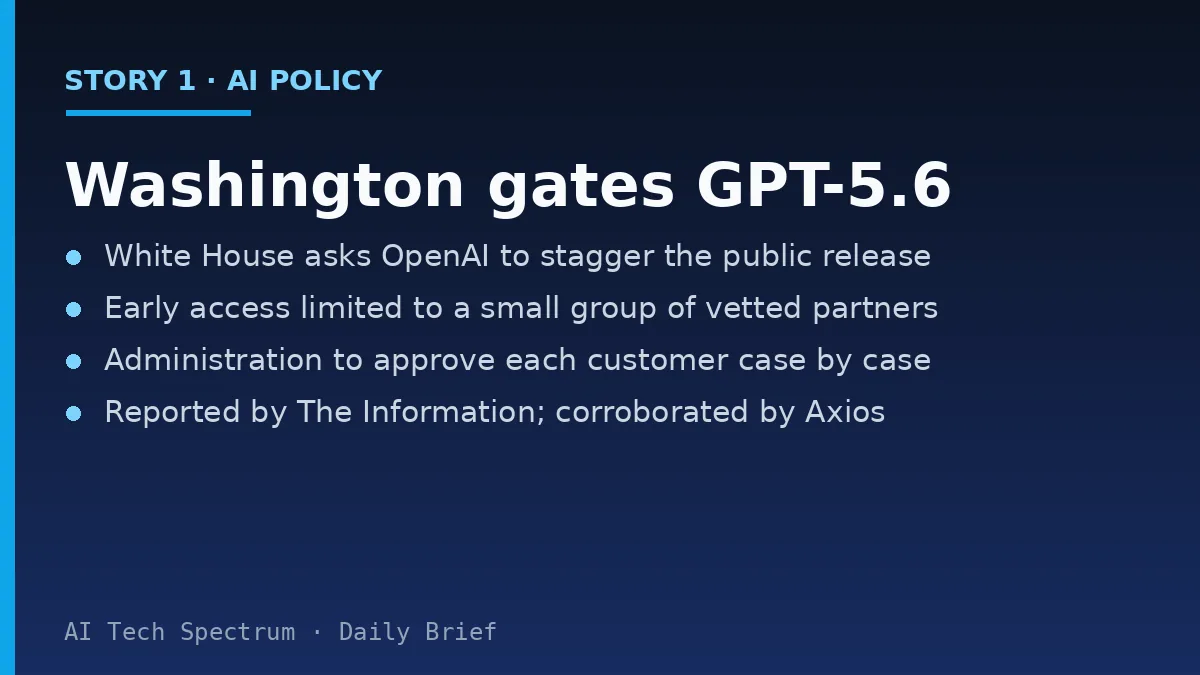
The day's biggest story is not a model launch — it is a model being held back. According to reporting from The Information, corroborated by Axios, OpenAI plans to give its next flagship, GPT-5.6, to a small group of vetted partners first, after the White House asked the company to stagger the release over national-security concerns. The request is reported to have come from the Office of the National Cyber Director and the Office of Science and Technology Policy, which are building a framework to evaluate the security of frontier models; under the arrangement, the administration would sign off on each early-access customer case by case, with a broader public rollout expected roughly a couple of weeks later.
Why it matters. If the terms hold as reported, this is the first time the U.S. government has preemptively asked an American AI company to limit a model's launch — a move from publishing safety frameworks to gating distribution. Handing the most capable systems to a government-approved shortlist first is a different posture than the release-broadly-and-patch-later default the industry has run on. What to watch. Treat the specifics as reported, not confirmed: neither OpenAI nor the White House has published the terms, and "a couple of weeks" is exactly the kind of timeline that slips. The real signal is whether case-by-case federal sign-off becomes a precedent other labs are expected to follow.
2. Anthropic names Alibaba in its largest Claude-cloning case
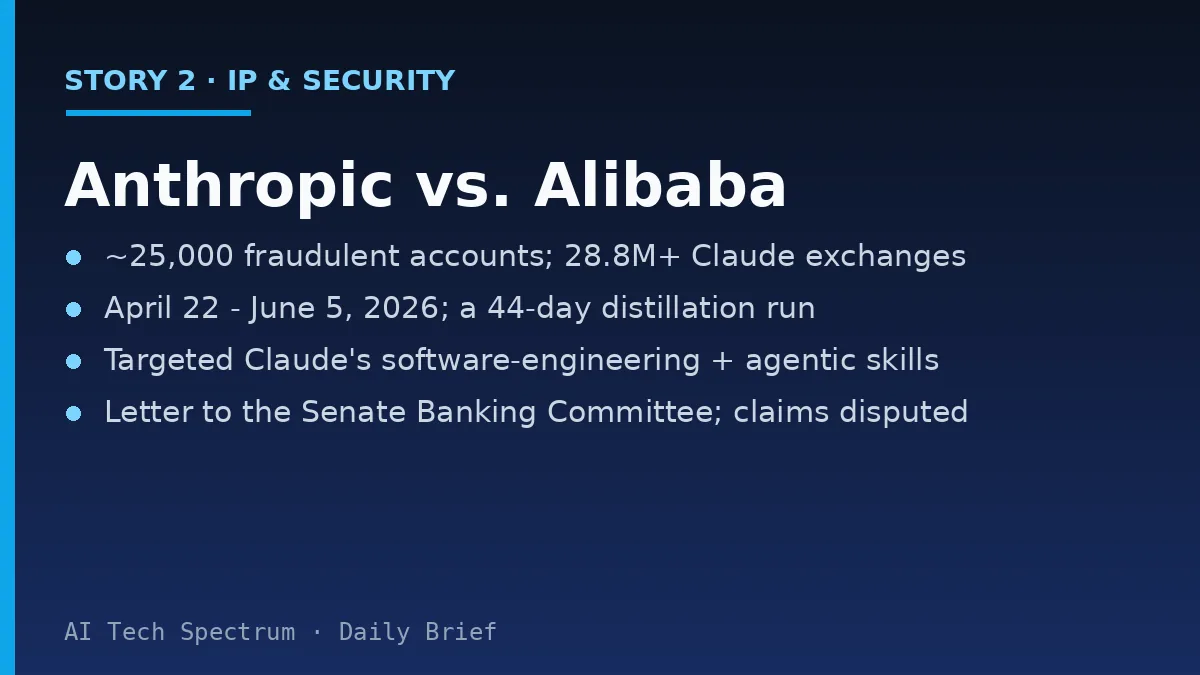
Anthropic told the Senate Banking Committee that it caught the largest known campaign to copy Claude's capabilities — and it is pointing at Alibaba. In a letter to Senators Tim Scott and Elizabeth Warren, the company alleges that operators tied to Alibaba's Qwen lab used roughly 25,000 fraudulent accounts to run more than 28.8 million exchanges with Claude between April 22 and June 5, 2026 — a 44-day "distillation" operation aimed at Claude's software-engineering and agentic-reasoning abilities. Anthropic says the effort dwarfs the campaigns it disclosed in February — attributed to DeepSeek, Moonshot AI and MiniMax — which together involved about 24,000 accounts and 16 million exchanges.
Why it matters. Distillation — training a cheaper model on a stronger one's outputs — is the quiet mechanism behind a lot of fast-following, and these numbers put a scale on it: one alleged operation larger than the previous three combined. It also lifts a technical-IP fight into Senate-committee territory, where the remedy may be policy rather than a terms-of-service ban. What to watch. These are allegations; Alibaba has not conceded them, and account attribution at this scale is hard to prove in public. Watch whether Anthropic releases technical evidence — and whether "someone queried our model a lot" can be drawn as a clean line between competitive benchmarking and theft.
3. Claude closes on ChatGPT among paying consumers
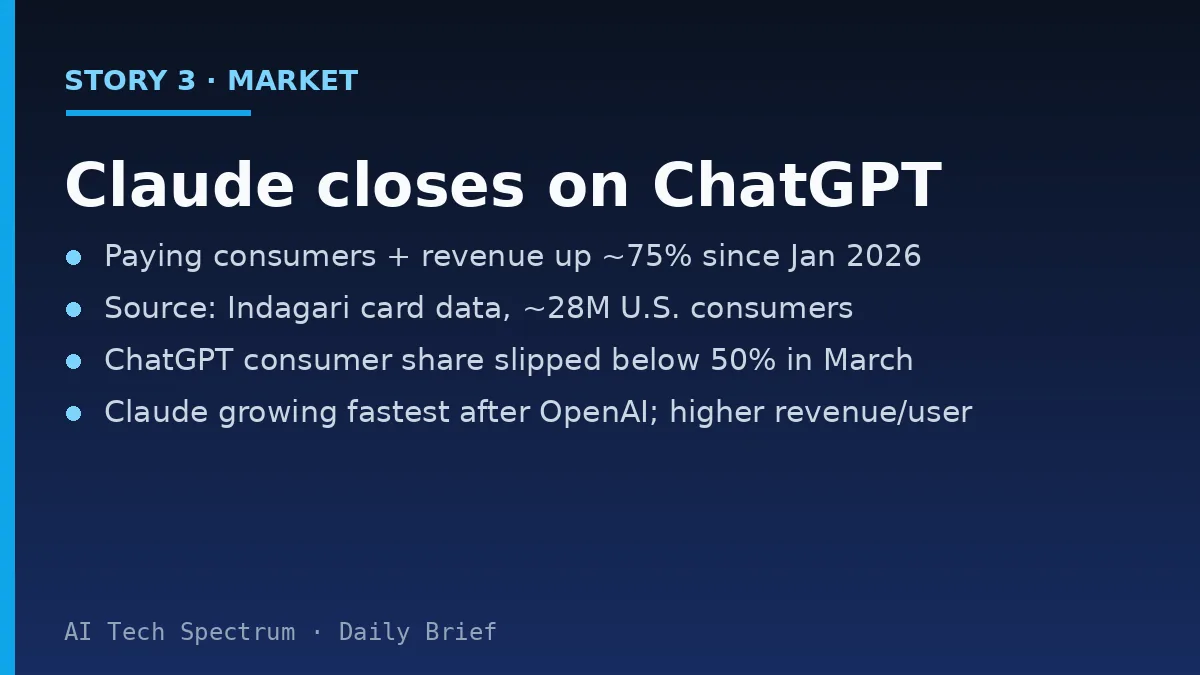
New spending data suggests Anthropic is gaining on the one battlefield ChatGPT has owned: paying consumers. Per analysis of credit-card transactions from roughly 28 million U.S. consumers by the firm Indagari, reported by TechCrunch, Claude's paying consumers and consumer revenue are up about 75% since January 2026. ChatGPT still leads by a wide margin on total users and subscribers, but by this measure its consumer market share slipped below 50% for the first time in March — and Anthropic is reportedly adding paying consumers faster than anyone except OpenAI itself, at a higher revenue per user.
Why it matters. Anthropic's reputation is enterprise and coding; a consumer surge complicates the tidy "OpenAI owns consumer, Anthropic owns the back office" map analysts have been drawing. Higher revenue per user matters more than raw share if it holds — it is the difference between a hobby tier and a business. What to watch. Card-panel data is a proxy: it captures U.S. card spend, not global, bundled or app-store subscriptions, so treat the 75% as directional. The number that would confirm the trend is Anthropic's own consumer-subscriber count — which it has not broken out.
4. Google Finance exits beta with AI and an Android app
Google Finance came out of beta with an AI overhaul and, for the first time in the product's roughly two-decade life, a standalone Android app. The new version adds AI "key moments" that try to explain why a stock moved, an AI research tool, a live financial-news feed and real-time data, and it lets you build a portfolio by dropping in a screenshot, a PDF or a CSV — or just describing your holdings in plain language. The Android app is rolling out globally through the Play Store now; Google says an iOS version is coming later in 2026.
Why it matters. This is Google routing its AI search stack straight at retail-investor behavior — the people who check a ticker five times a day — and it is a direct shot at Yahoo Finance and standalone trackers. "Build a portfolio from a screenshot" is the kind of multimodal-ingestion feature that is quietly more useful than another chatbot. What to watch. AI "key moments" that explain price moves are exactly where a confident-sounding wrong answer does real damage; the open question is how Google sources and hedges those explanations. (As always, this is informational, not investment advice.)
5. Microsoft Research makes brain models testable
For the research beat, Microsoft Research and academic collaborators detailed a method for making AI models of the brain explain themselves. The problem: large language models predict the brain's fMRI responses to language remarkably well, but it stays opaque what features actually drive each region's response. Their approach, generative causal testing, turns those predictive models into short, plain-language hypotheses about what a brain area is selective for, then tests each hypothesis with LLM-generated stimuli in a follow-up scan. It held up across individual voxels and cortical regions of interest, including newly identified micro-regions in the prefrontal cortex.
Why it matters. This is the interpretability problem from the AI side pointed at neuroscience: instead of a black box that merely predicts, you get a testable claim you can try to falsify in the scanner. It is a template for turning "the model is accurate" into "here is the theory, and here is the experiment." What to watch. Generated-stimulus experiments are only as good as the generator; the open question is whether the explanations generalize beyond the datasets they were tuned on. Still, "make the predictive model state a hypothesis, then go test it" is a discipline more AI-for-science could borrow.
What to take from today
One current runs under all five: the frontier-lab race stopped being only about who ships the best model. In a single day it became a question of who is allowed to release one (Washington gating GPT-5.6), who is accused of copying one (Anthropic versus Alibaba), and who is winning the customers (Claude's consumer climb) — with Google pushing AI into everyday finance and Microsoft showing what the compute is ultimately for. The decision framework that keeps paying off: when the news is about governance, IP and distribution rather than benchmarks, the moat to watch isn't model quality — it is access, trust, and who controls the gate.
Tomorrow's brief lands by 15:00 UTC. If you'd rather read this in your inbox once a week — just the stories that actually matter — subscribe here.