Good morning. Five stories, one pattern: the AI stack is being parceled out, and nobody wants to be a tenant. Who deploys it, where it runs, how you steer it, who owns the model, and what it does to jobs — each got a flag planted today. Prefer this once a week? Subscribe to the weekly brief.
- Amazon commits $1B to a forward-deployed AI engineering org
- Claude goes generally available on NVIDIA's Blackwell Ultra in Azure
- Cursor launches an iOS app for steering coding agents
- Base44 starts training its own model to escape frontier dependence
- OpenAI maps how AI could reshape Europe's workforce
1. Amazon commits $1B to a forward-deployed AI engineering org
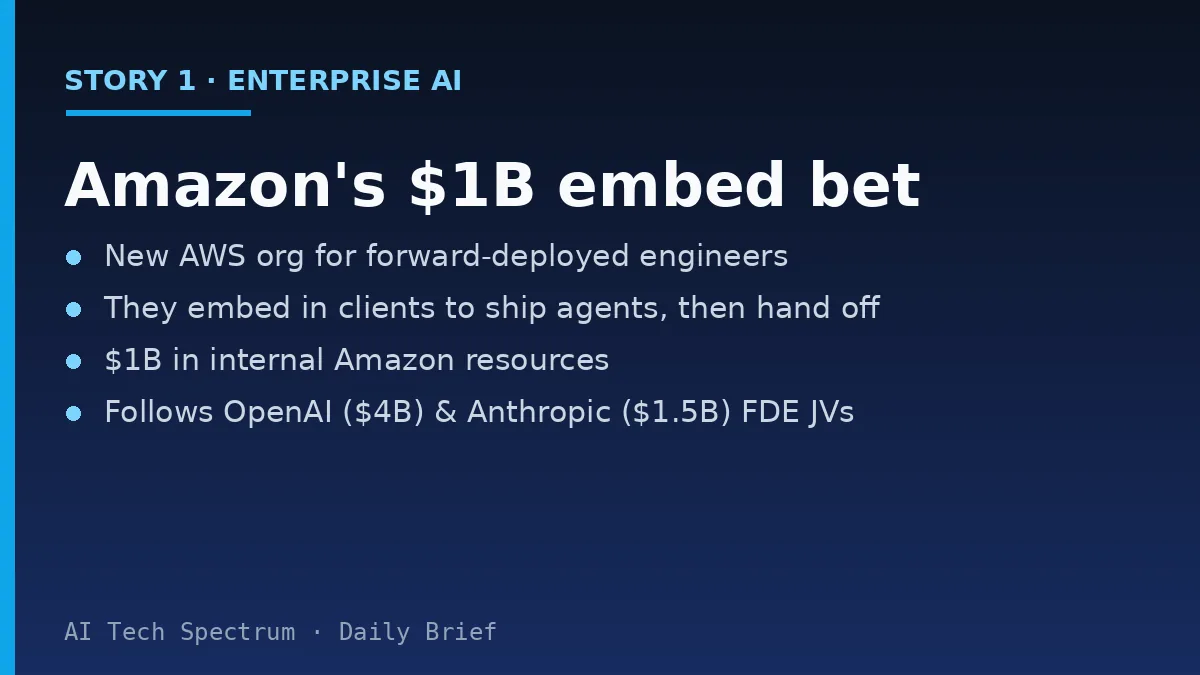
Amazon Web Services launched a new internal organization for AI-focused forward-deployed engineers (FDEs) — staff who embed inside customer companies to stand up purpose-built agents, then hand back the keys, TechCrunch reports. Amazon says it will commit $1 billion to the effort, though it clarified the figure represents internal Amazon resources rather than a joint venture or outside investment. In the announcement, AWS VP of Frontier AI Francessca Vasquez wrote that clients "leave AWS FDE deployments with both new solutions and new engineering capabilities" — gaining "lasting AI skills, workflows, and patterns they can use to innovate independently."
Why it matters. The forward-deployed model — pioneered by Palantir — is becoming the default way enterprises actually get AI into production, and now all three of the biggest names are in. OpenAI and Anthropic launched FDE joint ventures earlier this year valued at $4 billion and $1.5 billion respectively, each paired with a private-equity partner; Amazon is answering with in-house muscle. The shared bet: the bottleneck in enterprise AI isn't the model anymore — it's the integration. What to watch. Whether "we'll embed engineers and leave you self-sufficient" holds up, or whether clients end up permanently leaning on the contractor's corps of FDEs. The cost of staffing that corps is the model's known weak spot, and the first margin numbers will tell the real story.
2. Claude goes generally available on NVIDIA's Blackwell Ultra in Azure
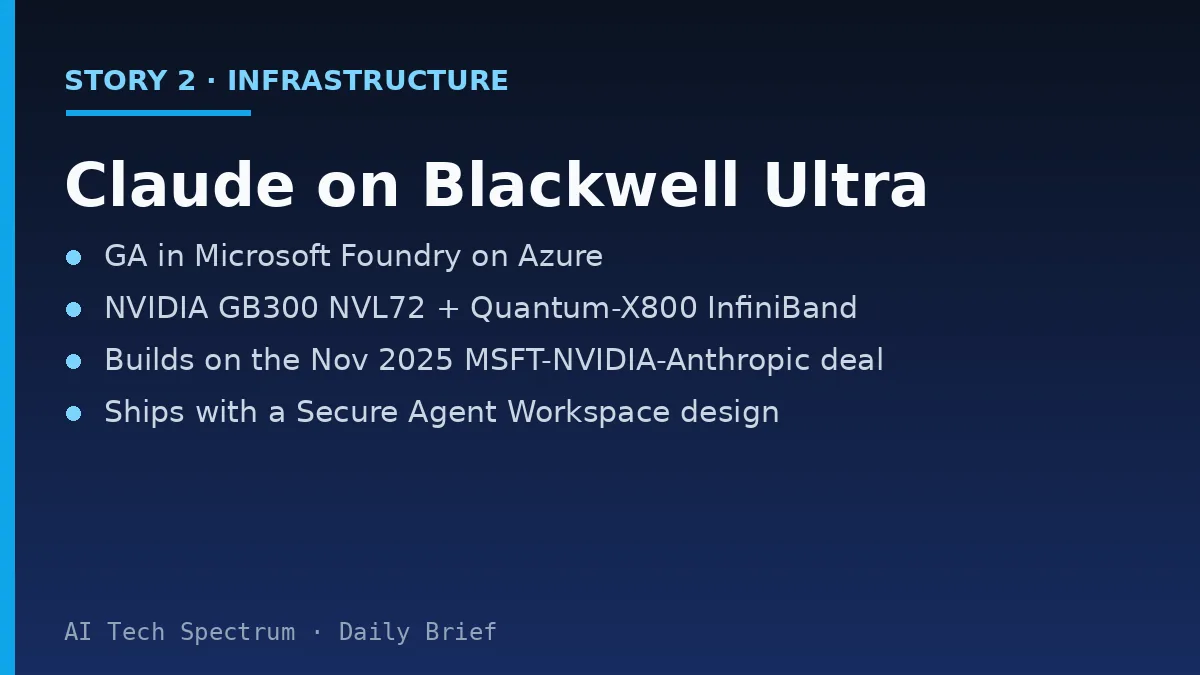
Anthropic's Claude models are now generally available in Microsoft Foundry running on NVIDIA GB300 Blackwell Ultra GPUs — specifically GB300 NVL72 systems with Quantum-X800 InfiniBand networking — giving Azure-native enterprises a new foundation for building autonomous agents, NVIDIA said. It builds on the Microsoft–NVIDIA–Anthropic strategic partnership announced in November 2025, and ships with NVIDIA reference designs (a "Secure Agent Workspace") for governing agents — identity, network access, credentials, runtime policy — at the infrastructure level. Enterprises reach it through the Claude catalog in Microsoft Foundry.
Why it matters. This is the infrastructure layer of the same story: Claude — long associated with Amazon and Google cloud deals — landing as a first-class, generally-available option on Microsoft's Azure, on NVIDIA's newest silicon. For enterprises already standardized on Azure, it removes a reason to look elsewhere, and it underlines how thoroughly the model labs, the chipmaker, and the clouds are now interlocked rather than competing cleanly. What to watch. Real-world throughput and pricing on Blackwell Ultra versus the prior generation — "generally available" is where the benchmarking starts, not where it ends. The governance reference design is the quieter tell: agent security is becoming an infrastructure feature, not an afterthought.
3. Cursor launches an iOS app for steering coding agents
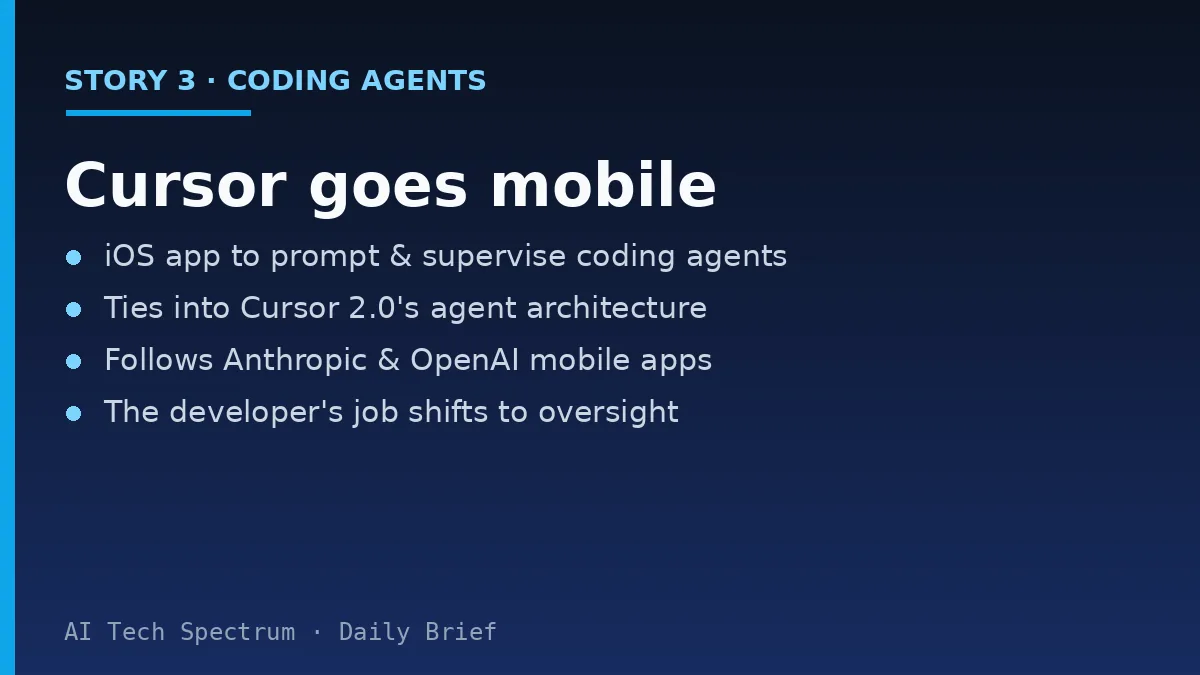
Cursor launched an iOS app that lets developers prompt and supervise coding agents from their phone, the company announced Monday. It plugs into the agent-centric architecture Cursor shipped in its 2.0 release last October: users can kick off new agents or check in on ones started at the desktop. The move follows similar mobile apps from Anthropic and OpenAI, part of a broader shift in which developers increasingly oversee code-writing agents rather than type every line themselves.
Why it matters. The interface to programming is migrating from the editor to the agent queue. When the human's job is to review and redirect rather than write, a phone is enough — Anthropic's head of Claude Code, Boris Cherny, said in a recent talk, "Most of my coding now is on my phone." That's a real change in what "using a coding tool" means, and a land-grab for the one surface developers never put down. What to watch. Whether mobile oversight stays a convenience or becomes the primary surface — and how review quality holds up when someone is approving an agent's diffs from a six-inch screen.
4. Base44 starts training its own model to escape frontier dependence
Base44 — the vibe-coding platform Wix acquired for $80 million about a year ago — has started rolling out its own AI model, called Base1, trained on a dataset drawn from "tens of millions of real user interactions" on the platform, TechCrunch reports. Founder Maor Shlomo argues that "training and owning the model as part of [our] entire stack allows us a lot more optimizations on latency, cost, and efficiency," framing it as making Base44 the only "vertically integrated" vibe-coding company — one that owns its distribution, data, and infrastructure at once. Base44 says it has passed $100 million in annual recurring revenue; rival Lovable, which relies on external models, recently reported $500 million.
Why it matters. This is the model layer of the land-grab — and the clearest test yet of whether apps built on top of OpenAI and Anthropic can defend their margins by training their own. The counter-case is real: Headline VC Jonathan Userovici notes legal-AI startup Harvey abandoned its own-model plans, and frontier labs keep getting cheaper and more capable. Owning the model is expensive insurance against renting it — and only worth it if the rent was about to eat your margin. What to watch. Whether Base1 actually matches frontier quality for app-building, or whether the savings arrive with a capability tax users notice. Watch the margin profile, not the press release.
5. OpenAI maps how AI could reshape Europe's workforce
OpenAI's economic-research team published "The AI Jobs Transition Framework for the EU," extending to Europe a US framework it released in April. Using the EU's official ESCO occupation taxonomy and Eurostat employment data, it sorts jobs into four buckets: roughly 12% of EU employment sits in occupations that may grow with AI, about 14% in ones with higher near-term automation potential, around 27% in roles likely to be reorganized, and the remaining 47% in jobs facing less immediate change. The mix varies by country — Luxembourg, Sweden, and the Netherlands skew toward "may grow," while Germany, Greece, and Italy carry more "higher automation potential" — and the EU overall has a smaller high-automation share than the US (you can read the full report).
Why it matters. OpenAI stresses these are planning categories, not forecasts — but it's notable that the company building the technology is also publishing the map of whom it might displace, and the framing ("reorganize," "adapt") is deliberately gentler than "replace." Read with that in mind, the underlying data is still more rigorous than the usual headline automation stat: official taxonomies and real employment shares rather than a round number. What to watch. Whether EU policymakers treat this as useful early-warning infrastructure or as a vendor shaping the regulatory narrative around its own product. OpenAI says it will expand the work with national and EU stakeholders in the coming months. (Informational, not career or policy advice.)
What to take from today
The thread is consolidation by layer. Amazon is claiming the services layer that gets AI into production; Anthropic, NVIDIA, and Microsoft are wiring up the infrastructure layer; Cursor is fighting for the developer's screen; Base44 is reaching down to own the model itself; and OpenAI is mapping the labor layer its technology reshapes. The decision-useful read for buyers: when you adopt an AI product now, ask which layer the vendor is really trying to own — and whether that leaves you a partner or a tenant. The companies racing hardest to own their own stack are, not coincidentally, the same ones encouraging you to rent yours from them.
Tomorrow's brief lands by 15:00 UTC. If you'd rather read this in your inbox once a week — just the stories that actually matter — subscribe here.