Good morning. Five stories, one direction: the price of AI capability keeps falling, and the capability keeps reaching further — cheaper to run, cheaper to make media with, onto more of your devices, into more fields, and into more of the world. Prefer this once a week? Subscribe to the weekly brief.
1. Anthropic launches Claude Sonnet 5 — near-Opus agents at a third of the price
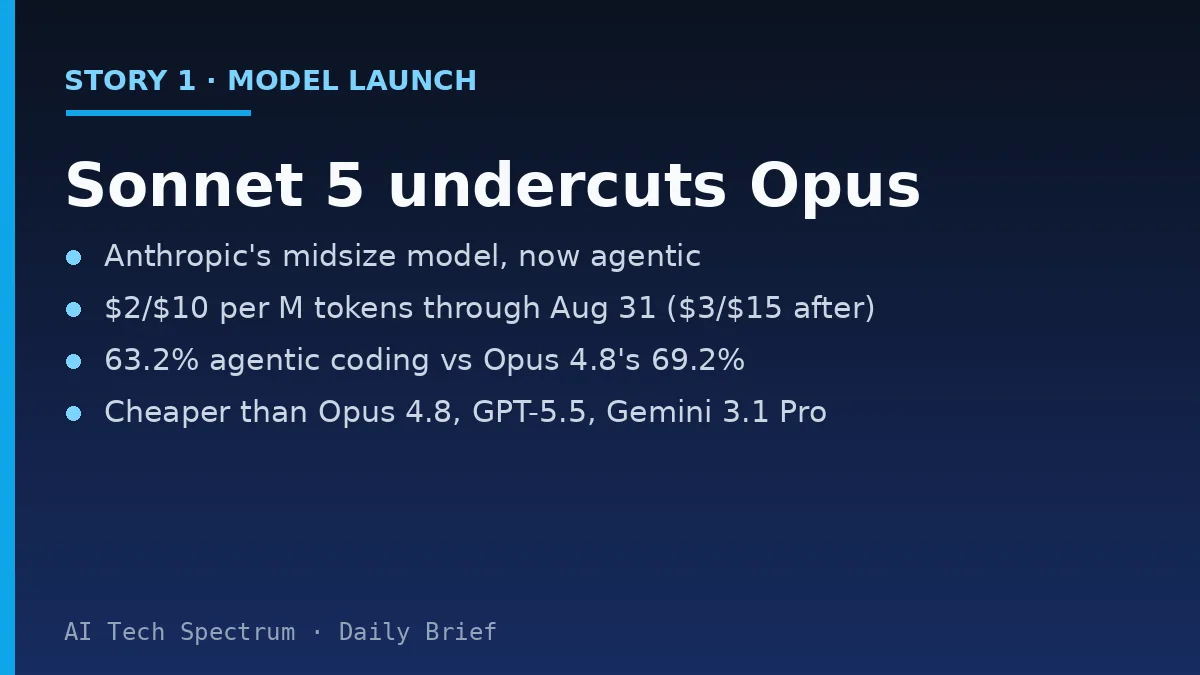
Anthropic released Claude Sonnet 5, a more agentic version of its midsize model that the company says "can make plans, use tools like browsers and terminals, and run autonomously at a level that, just a few months ago, required larger and more expensive models." It becomes the default model for free and Pro plans. Pricing starts at $2 per million input tokens and $10 per million output tokens through August 31, then rises to $3 and $15 — cheaper than Opus 4.8, OpenAI's GPT-5.5, and Google's Gemini 3.1 Pro, though still pricier than Gemini 3.5 Flash. On one agentic-coding benchmark Anthropic cites, Sonnet 5 scores 63.2%, against Opus 4.8's 69.2% and Sonnet 4.6's 58.1%; Anthropic says its overall performance is "close to that of Opus 4.8," and that at higher effort levels it "can match Opus 4.8 on some tasks."
Why it matters. Agentic capability is no longer the differentiator — price is. When a midsize model can run browsers, terminals, and multi-step tasks that used to demand a flagship, the question buyers ask shifts from "can it do agentic work?" to "how cheaply and reliably?" Anthropic is explicit that Opus 4.8 remains the choice for the hardest judgment calls, positioning Sonnet 5 as the value tier you reach for by default and escalate from only when you must. What to watch. Whether that six-point coding gap versus Opus matters for your workload — and how the after-August price step (a 50% jump on both input and output) reshapes the math once the introductory window closes. Anthropic also reports lower rates of hallucination, sycophancy, and successful prompt-injection than Sonnet 4.6, which matters more the more autonomy you hand it.
2. Claude Science opens in public beta, wired to NVIDIA's BioNeMo
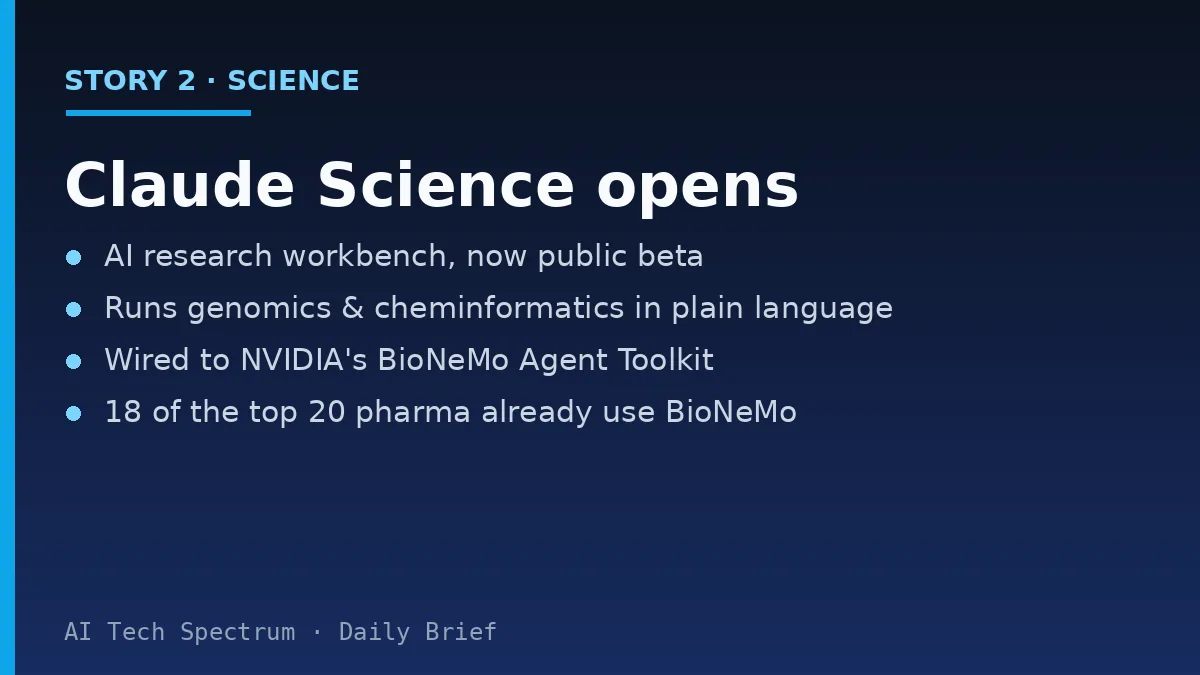
Anthropic opened Claude Science, "an AI workbench for science research" that lets scientists converse with agents in natural language to run genomics, proteomics, single-cell, cheminformatics, and clinical workflows end to end, into public beta. It integrates the NVIDIA BioNeMo Agent Toolkit, which packages accelerated capabilities as callable skills — NVIDIA says tools like nvMolKit speed some cheminformatics operations "by up to 3,000x," and that 18 of the top 20 pharmaceutical companies already use BioNeMo. Other bundled tools go further still: NVIDIA says Parabricks cuts genomic analysis from hours to minutes, and a RAPIDS-accelerated single-cell workflow runs in 25 seconds where it once took 52.
Why it matters. This is the same "cheaper, further" story pointed at a vertical: instead of a general chatbot, a domain workbench where the agent orchestrates real scientific tools rather than just describing them. Pairing Anthropic's orchestration with NVIDIA's accelerated biology stack is a credible bid to make "an AI scientist that actually runs the compute" a product rather than a demo. What to watch. Whether working scientists trust agent-chosen workflows enough to put them in the loop of real experiments — and how Anthropic handles the accuracy and provenance burden that comes with YMYL-grade research claims. Anthropic says it is inviting beta users to request additional domain specialists. (Informational, not scientific or medical advice.)
3. Google's Gemini Spark agent lands on the Mac
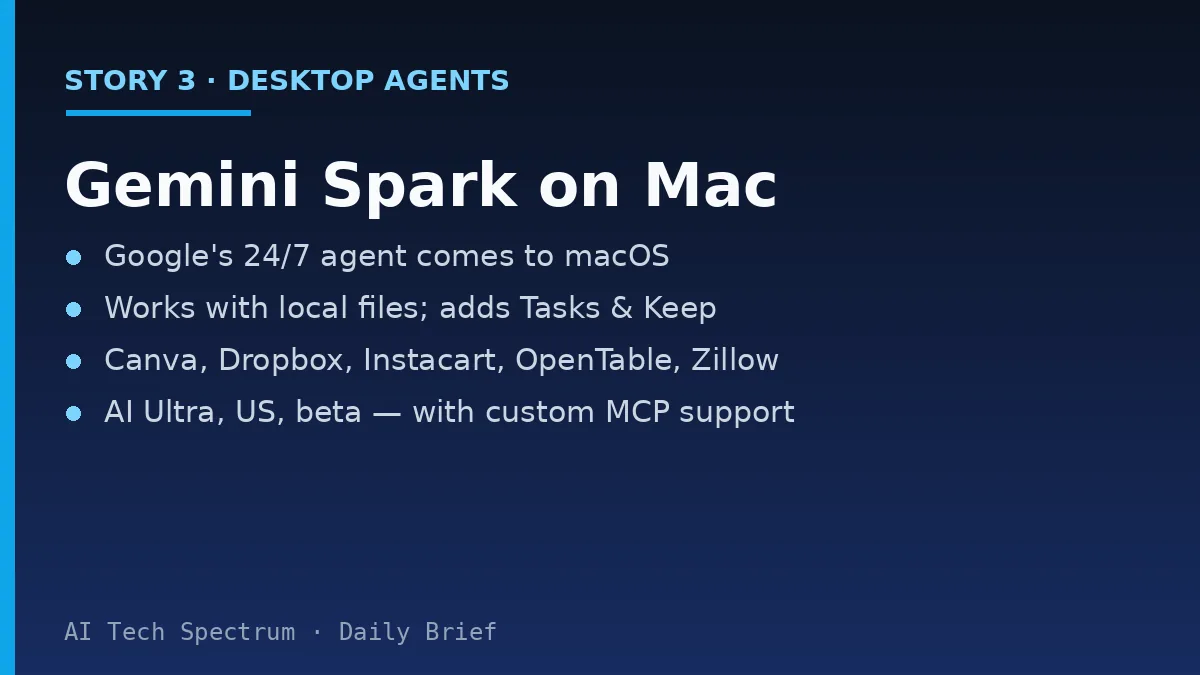
Google brought Gemini Spark, its 24/7 agentic assistant, to the Mac, TechCrunch reports. The macOS beta lets Spark work with local files — Google's example is sorting all the PDFs in your Downloads folder into categories in a single step — and adds real-time topic tracking, connections to Google Tasks and Keep, and third-party integrations with Canva, Dropbox, Instacart, OpenTable, and Zillow Rentals. For now it is limited to Google AI Ultra subscribers in the U.S.
Why it matters. The desktop is becoming the contested surface for agents. Putting a background assistant on macOS — where it can read files and, Google says, "soon" take remote instructions from your phone — is a direct move against Claude Desktop, Microsoft's Copilot, and OpenClaw. The expanding integration list is the quiet tell: Google is racing to make Spark the assistant with the most useful hooks into the apps you already live in, betting that whoever sits on your desktop with the most reach wins the day-to-day. What to watch. The gating — Ultra-only, U.S.-only — signals this is an early, premium rollout, not a mass release. The privacy surface expands the moment an always-on agent can touch your local files; how much control users get over what it reads is the thing to scrutinize before you turn it on.
4. Google ships its cheapest image and video models
Alongside Spark, Google DeepMind released Nano Banana 2 Lite and brought Gemini Omni Flash to developers. Nano Banana 2 Lite (Gemini 3.1 Flash Lite Image) is pitched as its fastest, most cost-efficient image model — Google cites text-to-image outputs in 4 seconds at $0.034 per 1K-resolution image — and is Google's recommended replacement for the original Nano Banana. Gemini Omni Flash, its video-generation-and-editing model, arrives in the Gemini API and AI Studio priced at $0.10 per second of video output (the same as Veo 3.1 Fast), currently capped at 10-second generations. Both carry SynthID watermarking.
Why it matters. This is the media-creation floor dropping in the same week the model floor did. At roughly three cents an image and a dime a second of video, generation stops being a cost you meter carefully and becomes something you throw at high-volume pipelines — drafting, prototyping, ideation at scale. The explicit "swap it in now" framing against the older model is Google pushing developers down its own price curve. What to watch. Whether "Lite" quality holds up in production versus the full Nano Banana 2 and Pro tiers, and how the 10-second video ceiling and preview-stage limits constrain real use. For our own workflows, watermarked, cheap media raises the bar on disclosure — cheaper to make is not the same as free to publish unlabeled.
5. OpenAI's data shows ChatGPT use deepening — and going global
OpenAI published new Signals data on how people use ChatGPT over time. Six months after signing up, users sent 50% more messages per day than they did at signup and doubled the number of distinct tasks they had tried, the company says. Adoption has grown across every continent since July 2023, with the fastest relative growth in Africa and Asia and in lower-Human-Development-Index countries. And usage has grown more global: users whose primary language is not English now make up more than half of active users, led by Spanish, Portuguese, and Arabic — with Uzbek, Kazakh, and Burmese posting the largest gains in share.
Why it matters. Every story above is about supply — cheaper models, cheaper media, agents on more devices. This is the demand side of the same curve: as capability gets cheaper and easier to reach, use deepens (more messages, more tasks) and widens (more countries, more languages). The center of gravity for AI usage is drifting away from English-speaking early adopters, which is where the next wave of products — and the next wave of monetizable audiences — will be built. What to watch. This is first-party data from the company with an interest in the story it tells, drawn from a small anonymized sample of consumer usage; treat the direction as more reliable than any single figure. Independent measures of where and how AI is actually used are the useful check on a vendor's own adoption chart.
What to take from today
The thread is commoditization. A midsize model now does the agentic work a flagship did a few months ago; images cost cents and video costs dimes; a background agent moves onto your desktop; a science workbench turns compute into conversation; and the audience for all of it is deepening and globalizing. The decision-useful read for buyers: stop paying flagship prices for work the value tier now handles, and re-run your model, media, and tooling math every quarter — the floor is dropping faster than most procurement cycles. The labs are racing to make capability cheap because cheap capability is how they win the next billion users. Use that to your advantage before your competitors do.
Tomorrow's brief lands by 15:00 UTC. If you'd rather read this in your inbox once a week — just the stories that actually matter — subscribe here.