Good morning, and happy Fourth. Five stories that sort cleanly into two piles: AI that ships with a way to check it, and AI that ships with a press release. The tell of the week is that the most grounded launch — a science tool that audits its own citations — landed the same 48 hours as a sub-sandwich IPO that couldn't stop saying "AI." Prefer this once a week? Subscribe to the weekly brief.
- Anthropic ships Claude Science — an AI lab that checks its own work
- Anthropic eyes its own chip, and the silicon arms race widens
- Zuckerberg tells staff Meta's AI agents are behind schedule
- The hype tell: a sandwich IPO name-drops AI 22 times
- Fandom's war over AI — and why "detectors" are the wrong weapon
1. Anthropic ships Claude Science — an AI lab that checks its own work
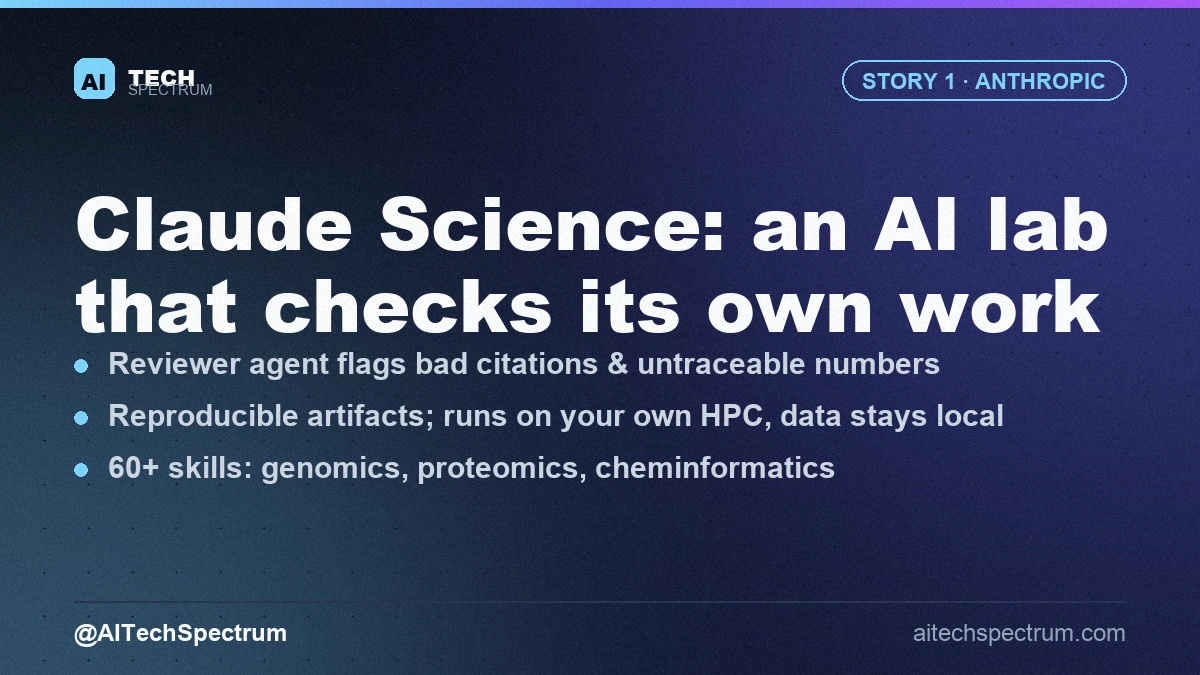
Anthropic launched Claude Science, an "AI workbench for scientists" that pulls the sprawl of research — dozens of databases, bespoke file formats, and a roster of tools like PubMed, Jupyter, and a cluster terminal — into a single environment. A generalist coordinating agent draws on more than 60 curated skills and connectors pre-configured for genomics, single-cell, proteomics, structural biology, and cheminformatics, and can spin up specialist sub-agents. The detail that matters most: a dedicated reviewer agent inspects outputs as the work runs, flagging incorrect citations, untraceable numbers, and figures that don't match the code that produced them, then self-corrects. Every figure ships with the exact code, environment, and message history that made it, so results can be reproduced months later. It runs on your own infrastructure — macOS or Linux, or an HPC login node over SSH — so, per Anthropic, large or sensitive datasets never leave your systems and only the context needed for each step is sent to Claude. The tool connects to NVIDIA's BioNeMo models (Evo 2, Boltz-2, OpenFold3) and is available in beta for Claude Pro, Max, Team, and Enterprise. Anthropic also told The Verge it plans to run its own pre-clinical drug programs aimed at neglected diseases.
Why it matters. This is the anti-hype version of an AI launch. Instead of a benchmark boast, the pitch is auditability: reproducible artifacts, a reviewer agent that checks the math, and compute that keeps proprietary data on the lab's own hardware — the exact features that make a tool usable in regulated science. Anthropic says one early user, a neuroscientist at the Allen Institute, built a multi-agent template that produced long-form literature reviews in roughly a tenth of the time such work used to take, and a UCSF group independently validated Claude Science's glioma analyses. What to watch. Whether the reviewer-agent claim holds up under outside scrutiny — a citation-checker that itself hallucinates would be worse than none — and whether independent labs keep confirming results rather than taking them on faith. (Informational, not medical or investment advice.)
2. Anthropic eyes its own chip, and the silicon arms race widens
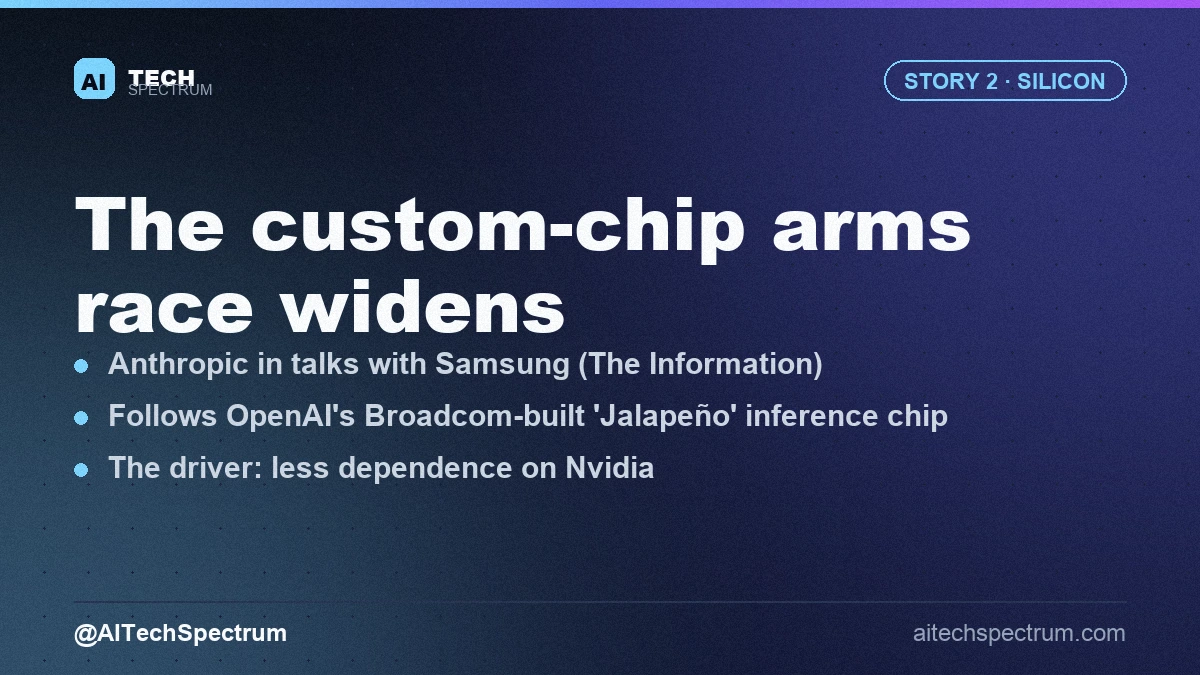
Anthropic is in contact with Samsung to explore building a custom AI chip, The Information reported and TechCrunch confirmed — though the company reportedly hasn't decided what the chip would do, how powerful it would be, or how it fits into a server. Reached for comment, Anthropic told TechCrunch a diversified hardware stack spanning Google, Amazon, and Nvidia "will continue to be pivotal" and had nothing further to add on Samsung. The talks follow Anthropic's April signal (via Reuters) that it was weighing its own silicon to blunt chip shortages, and land about a week after OpenAI unveiled its first custom inference chip, built with Broadcom and nicknamed "Jalapeño," which OpenAI says delivers better performance-per-watt than rival parts. Amazon (Trainium) and Google (TPU) already ship custom accelerators.
Why it matters. Owning the chip is one of the few genuinely durable moats in AI — it lowers cost-per-token, reduces reliance on Nvidia's allocation, and lets a lab tune hardware to its own models. It's the unglamorous, capital-intensive opposite of a demo. What to watch. Whether "in talks" becomes taped-out silicon (custom chips take years and rarely beat Nvidia on the first try), and whether Samsung — already deep in Nvidia's supply chain and in talks with Google — can serve a new lab without conflicts. (Informational, not investment advice.)
3. Zuckerberg tells staff Meta's AI agents are behind schedule
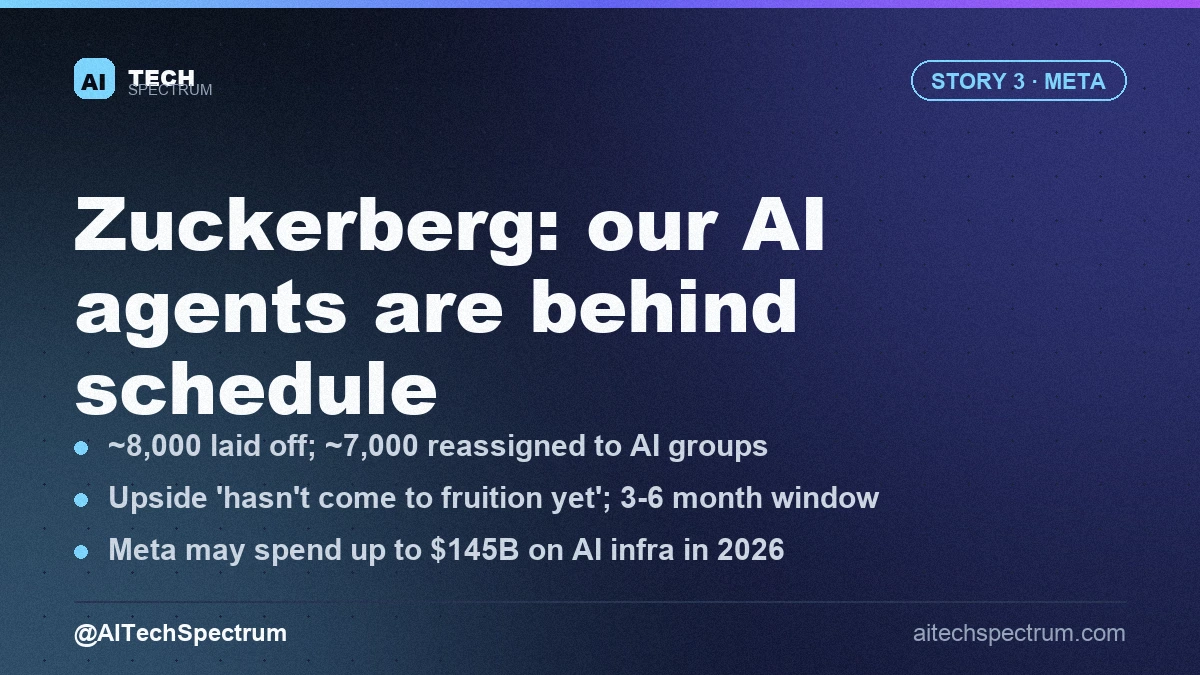
At an internal town hall Thursday, Meta CEO Mark Zuckerberg told staff that AI-agent development had not accelerated the way executives had expected, according to a Reuters report picked up by TechCrunch. It's a striking admission given the scale of Meta's bet: earlier this year the company laid off roughly 8,000 employees — about 10% of its corporate workforce — and reassigned some 7,000 more to AI groups, including one named "Agent Transformation." Zuckerberg reportedly conceded the cuts weren't as "clean" as they should have been and that the restructuring's upside "hadn't come to fruition yet," while predicting improvement over the next three to six months. Meta is expected to spend as much as $145 billion on AI infrastructure this year, per Reuters.
Why it matters. This is a reality check from the company spending the most. When the leader of a $145-billion-a-year AI build says the agent timeline slipped, it recalibrates every roadmap that assumed agents would be reliably doing knowledge work by now — a caution worth carrying into your own vendor promises. What to watch. The three-to-six-month window Zuckerberg set himself, and whether the spend converts into agents people actually deploy — or whether "next quarter" keeps sliding, as it has across the industry (Ford recently rehired veteran engineers after AI fell short).
4. The hype tell: a sandwich IPO name-drops AI 22 times
TechCrunch's Julie Bort did the sort of test that cuts through a hype cycle: she counted the AI mentions in Jersey Mike's IPO filing. The sandwich chain's S-1 mentions "AI" or "artificial intelligence" 22 times — including in its investor risk warnings, with the hand-wave that "we are beginning to use AI Technologies in our business." For comparison, the same filing mentions "software" 52 times and "data" 112 times (as any franchise business might), "weather" five times, and "lightning" — which has literally struck a Jersey Mike's — zero. The company sells subs, not models.
Why it matters. When a sandwich shop hedges its public debut with AI boilerplate, "AI" has become a compliance reflex rather than a signal — the linguistic equivalent of the Meta and Midjourney promises elsewhere in the cycle. It also isn't harmless: Starbucks recently retired an AI inventory tool that miscounted stock and slowed baristas. What to watch. A practical filter for readers and investors: when you see "AI" in a pitch or a filing, ask what it actually does and who verified it — the presence of the word is now worth nothing on its own. (Informational, not investment advice.)
5. Fandom's war over AI — and why "detectors" are the wrong weapon
A fast-moving movement inside fan-fiction communities to root out AI-written work has turned on the writers it meant to protect, The Verge reports. After months of rising accusations, someone created a collection on Archive of Our Own (AO3) that publicly tagged fics they believed were AI-generated; fans quickly reported it as a form of harassment under AO3's terms of service, and, per fandom wiki Fanlore, some accused authors deleted their work or went on hiatus. The core problem is technical as much as cultural: the "detectors" and stylistic tells being used to accuse writers are unreliable, and a human author with a clean, polished voice can trip them.
Why it matters. The backlash against undisclosed AI writing is legitimate — but the enforcement tool is broken, and that gap is not unique to fandom. AI-text detectors have well-documented false-positive problems, which is exactly why they misfire in classrooms and newsrooms too. Punishing people on a detector's say-so launders a guess as proof. What to watch. Whether communities (and schools, and publishers) move toward disclosure norms and provenance signals rather than accusation-by-detector — and, if you're ever on the receiving end, remember these tools flag style, not authorship.
What to take from today
Sort the week into two piles and the instruction writes itself. The durable stories — Claude Science's reviewer agent, the scramble for custom silicon — are about making AI checkable and ownable: reproducible artifacts, audited citations, chips you control. The noisy ones — Zuckerberg's slipped timeline, a sub shop's 22 AI mentions, a detector-driven witch-hunt — are about promises and the pushback they invite. The decision-useful read is the same for a lab buyer, an investor, and a citizen: treat the word "AI" as worth nothing on its own, ask who checked the claim, and price the risk on evidence, not adjectives.
Tomorrow's brief lands by 15:00 UTC. If you'd rather read this in your inbox once a week — just the stories that actually matter — subscribe here.