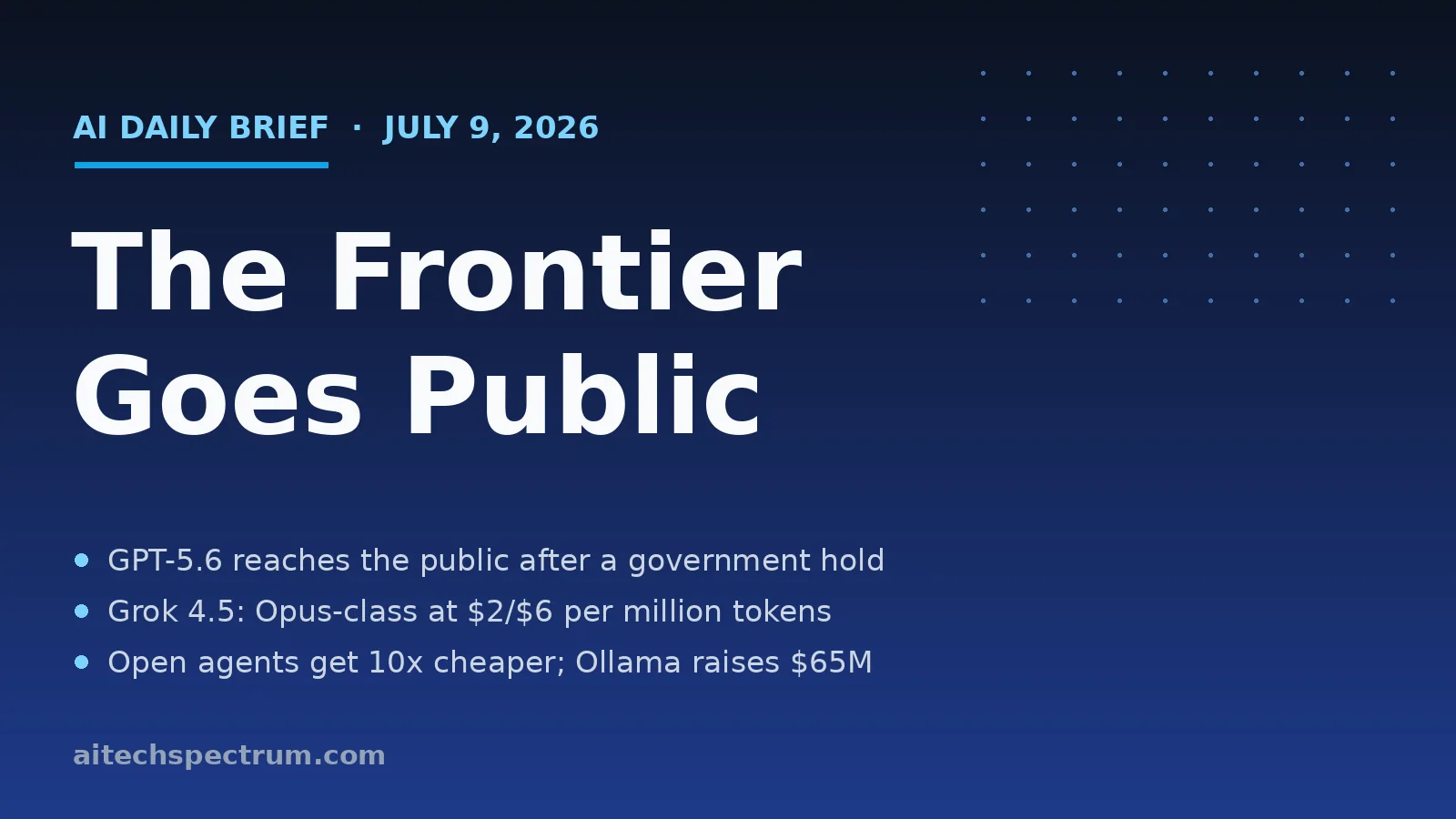
Good morning. For two years the frontier race was scored in benchmark points. This week it flipped to price. Two flagship models arrived within a day of each other — one after a 12-day government hold — and both are pitching the same thing: near-top intelligence for less money per token. Underneath them, the open-source stack got cheaper too. Prefer this once a week? Subscribe to the weekly brief.
- OpenAI starts rolling GPT-5.6 out to the public — after a government hold
- Grok 4.5 arrives as an "Opus-class" model at a third of the price
- NVIDIA and LangChain make open agents 10x cheaper to run
- Ollama raises $65M as local model-running hits 9M developers
- Anthropic ships Claude "Reflect" — a usage mirror that nudges you
1. OpenAI starts rolling GPT-5.6 out to the public — after a government hold
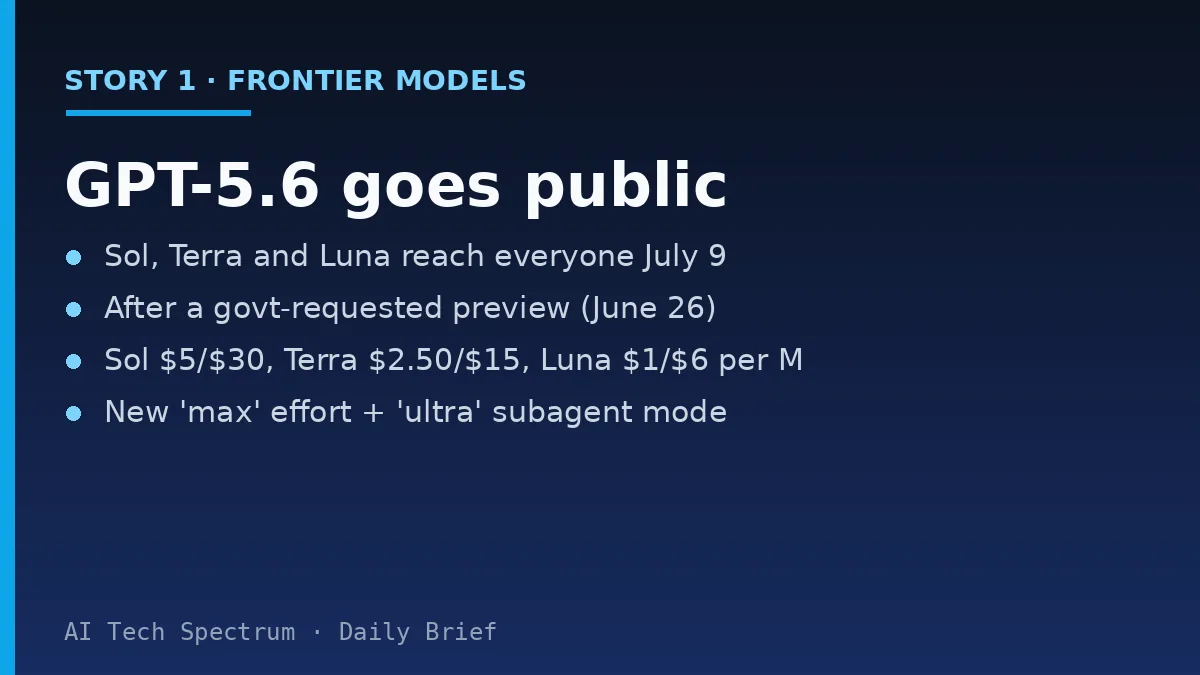
OpenAI began opening its GPT-5.6 family to the public today — the flagship Sol, a balanced Terra that OpenAI says matches GPT-5.5 at 2x lower cost, and a fast, cheap Luna. The models first shipped June 26 in a limited preview: at the U.S. administration's request, OpenAI restricted access to government-vetted partners while agencies assessed Sol's cybersecurity abilities, and the Commerce Department has since cleared a broad launch for Thursday, July 9 (Axios). Per OpenAI's own numbers, Sol runs $5 per million input tokens and $30 output; Terra is $2.50 / $15; Luna is $1 / $6. The release adds a new max reasoning effort and an ultra mode that spins up subagents for complex work, sets a new state of the art on the Terminal-Bench 2.1 coding benchmark, and — OpenAI is careful to note — does not cross the "Cyber Critical" threshold in its Preparedness Framework. Sol also lands on Cerebras at up to 750 tokens per second in July.
Why it matters. The headline isn't the benchmark — it's the process. A frontier model was held back from the public for roughly two weeks at a government's request over cyber capability, then released once an agency signed off. OpenAI itself calls that access process something it doesn't want to become the default. However the policy shakes out, "will the government gate the next model" is now a real variable in every lab's launch calendar. What to watch. Independent review is still thin — many of the loudest early raves came from OpenAI staff, and at least one investor testing it (Matt Shumer) said Anthropic's Fable 5 was "quite a bit better" on most of his tasks. Wait for third-party evals before you migrate a workload.
2. Grok 4.5 arrives as an "Opus-class" model at a third of the price
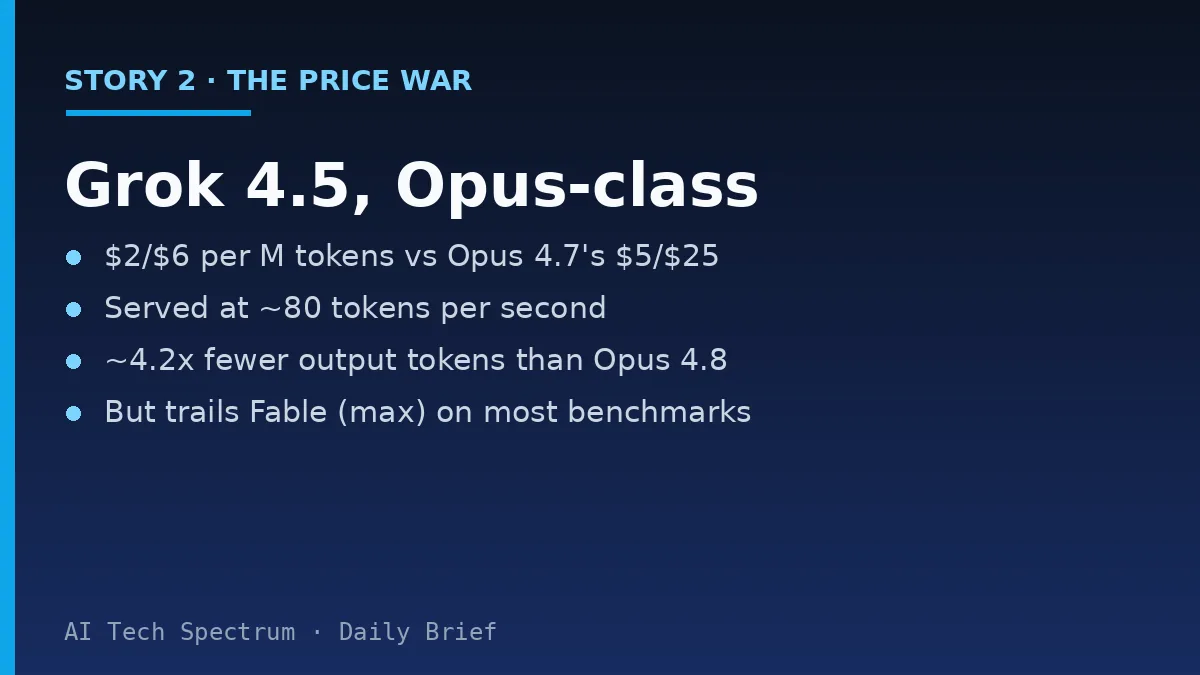
A day earlier, SpaceXAI (the xAI unit now inside the newly public SpaceX) released Grok 4.5, its "smartest model" yet, trained alongside coding tool Cursor on tens of thousands of NVIDIA GB300 GPUs. Elon Musk framed it plainly on X: "It is an Opus-class model, but faster, more token-efficient and lower cost," adding that xAI's internal read is that it's "roughly comparable to Opus 4.7, but much faster." The economics are the pitch: Grok 4.5 is priced at $2 per million input tokens and $6 output — against Opus 4.7's $5 / $25 — serves at about 80 tokens per second, and by xAI's own measurement resolves a SWE-Bench Pro task in ~15,954 output tokens versus 67,020 for Opus 4.8, roughly 4.2x fewer. It's the default model in Grok Build and available in Cursor on all plans; EU availability is expected mid-July.
Why it matters. Read stories 1 and 2 together and the shape of the market is clear: the competition has moved from "who is smartest" to "who delivers near-frontier quality per dollar." Grok 4.5 isn't claiming the crown — it's claiming the value tier, and doing it with a credible cost-and-speed story. What to watch. The honesty check on the benchmarks. In xAI's own published charts, Grok 4.5 trails Fable (max) on SWE-Bench Pro (64.7% vs 80.4%) and Terminal-Bench 2.1 (83.3% vs 84.3%), though it leads the field on the long-horizon SWE Marathon (29.0%). "Opus-class for less" is a fair headline; "best model on the market" is not.
3. NVIDIA and LangChain make open agents 10x cheaper to run
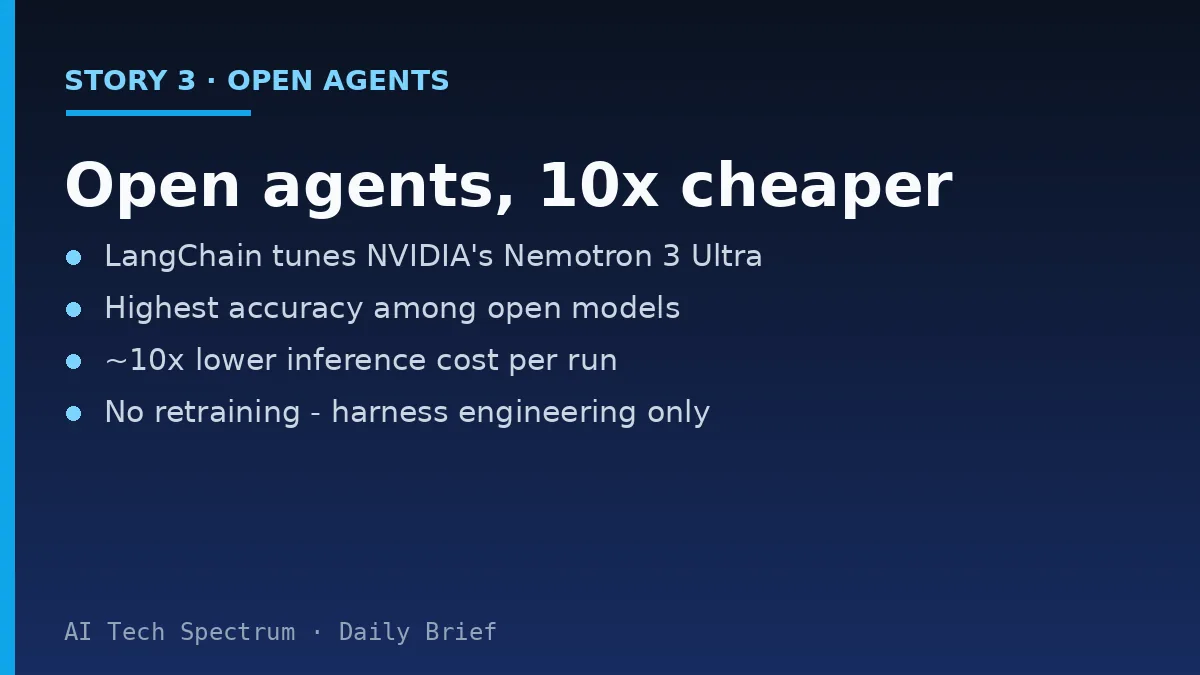
The cost theme isn't only a closed-model story. NVIDIA and LangChain announced that LangChain tuned its Deep Agents harness for NVIDIA's open Nemotron 3 Ultra model — reaching the highest accuracy among open models and business-task parity with the top closed models on LangChain's Deep Agents benchmark, while running at roughly 10x lower inference cost per run. The striking part: no retraining. Every gain came from engineering the environment around the model — system prompts, tool descriptions, middleware — not the weights. "The way to build better agents is to keep improving the system around the model," said LangChain co-founder and CEO Harrison Chase. "Memory, tool use, evaluation and model behavior compound when teams can tune them together." NVIDIA packaged the work as an open "NemoClaw" blueprint, and named Abridge, Amdocs and Box as early adopters embedding specialized agents, with EY helping enterprises deploy. LangChain's platform now sees more than 200 million monthly downloads.
Why it matters. For any team weighing an agent build, this reframes the buy-vs-own math: a fully open stack — open model, open harness, open runtime — at a tenth of closed-model inference cost, that you can run on your own infrastructure and governance. When continuous evaluation is 10x cheaper, you can test far more before shipping. What to watch. Whether the parity claim holds on your tasks. "Harness engineering, not fine-tuning" is a genuinely useful lesson, but the parity was measured on LangChain's own benchmark — pressure-test it against your real workflows before betting a production agent on it.
4. Ollama raises $65M as local model-running hits ~9M developers
Staying with the open stack: Ollama — the tool that lets developers download and run open-weight models on their own machines in minutes — raised a $65 million Series B led by Theory Ventures. It follows a $15M Series A led by Benchmark's Peter Fenton, bringing total funding to about $88 million (FinSMEs). Ollama says it's now used by roughly 8.9 million developers monthly and shows up in 85% of the Fortune 500 — built by a team of just 14. The plan for the money: product, the open-source community, cloud compute, and hiring. Launched in 2023, Ollama has become the default on-ramp for running models like Llama, Qwen and Gemma locally, without sending prompts to anyone's API.
Why it matters. This is the counterweight to stories 1–3. While the labs compete on hosted price, a large and growing slice of developers is choosing to run capable open models on hardware they already own, at a marginal cost near zero and with data that never leaves the building. That's not a fringe anymore at 85% of the Fortune 500. (Full disclosure: our own newsroom automation runs on Ollama, so we're rooting for the home team.) What to watch. Whether "$65M and 14 people" can keep pace with the release cadence of frontier open weights — and whether the cloud offering it's funding complements the local-first pitch or competes with it.
5. Anthropic ships Claude "Reflect" — a usage mirror that nudges you
Away from the model race, Anthropic launched Reflect, a built-in dashboard — quickly dubbed "Claude Wrapped" — that visualizes how you use Claude: your top topics, the kinds of tasks you delegate, and your overall patterns, across one month to a full year. What sets it apart from a Spotify-style recap is that it's designed to make you think about the habit, not just admire it: Reflect periodically surfaces prompts like "What's one thing you want to keep doing yourself, even if Claude could do it faster?", and lets you set quiet hours or schedule nudges to take a break. It's in beta for Free, Pro and Max users who have memory turned on; Anthropic says sensitive conversations appear only at a high level, health-integration chats are excluded entirely, and the data isn't used for other purposes. TechCrunch's Sarah Perez read the launch more skeptically — noting that laying out everything Claude did for you also "subtly reinforces how much of your daily work now depends on Anthropic's chatbot."
Why it matters. Both readings are true, and that's the point. A tool that helps you use AI more mindfully is also a retention tool that deepens the habit — the same dashboard can encourage a healthy break and remind you how much you'd miss it. In a week defined by cheaper, faster models, this is the quieter question worth holding onto: not what AI can do, but how much of your own work you want to hand it. What to watch. Whether "mindful usage" features become table stakes across chatbots — and whether they're measured on users' wellbeing or on engagement.
What to take from today
The through-line is cost, and its cousin, control. Two flagship models launched a day apart selling the same thing — near-frontier quality at a lower price per token — while the open stack quietly got cheaper on both ends: LangChain wringing 10x more efficiency out of an open NVIDIA model, and Ollama funding the local-first path at 9 million developers. For anyone actually building, the decision has shifted from "which model is smartest" to a sharper set of questions: what does this cost at your token volume, whose infrastructure does it run on, and — from Anthropic's Reflect — how much of the work do you actually want to delegate. Intelligence is getting commoditized. Judgment about where and how to spend it is the part that isn't.
Tomorrow's brief lands by 15:00 UTC. If you'd rather read this in your inbox once a week — just the stories that actually matter — subscribe here.