Good morning. Most launch days ship one thing. Today OpenAI shipped a whole stack: a new flagship model reaching everyone, an agent that does the work instead of describing it, a default slot inside Microsoft 365 — and a quiet funeral for the browser it launched nine months ago. The connective tissue is a single word OpenAI kept repeating: work. Anthropic spent the same day on the opposite problem — not making the model do more, but being able to read what it's doing. Prefer this once a week? Subscribe to the weekly brief.
1. GPT-5.6 reaches general availability — pricing and limits locked
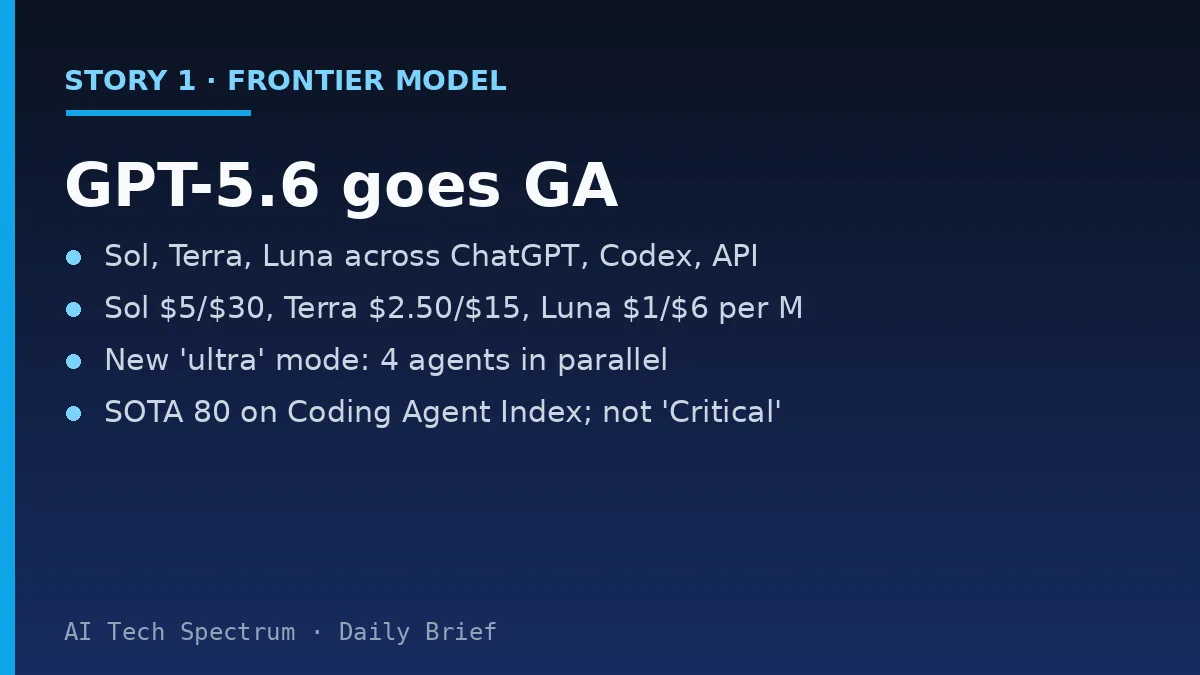
We covered the rollout beginning yesterday; today it's official. OpenAI moved the GPT-5.6 family to general availability across ChatGPT, Codex and the API — the flagship Sol, a balanced Terra that OpenAI says is competitive with GPT-5.5, and a fast, cheap Luna — with the rollout going global over roughly 24 hours. The terms are now locked: per OpenAI's own sheet, Sol is $5 per million input tokens / $30 output; Terra is $2.50 / $15; Luna is $1 / $6. A new max setting gives the model more time to reason, and a new ultra mode coordinates four agents in parallel by default for the hardest tasks. On the independent Artificial Analysis Coding Agent Index, Sol with max reasoning sets a state of the art at 80 — 2.8 points above Claude Fable 5 — while using less than half the output tokens. On safety, OpenAI is explicit: GPT-5.6 is more capable in biology and cybersecurity than its predecessors but does not cross the "Critical" threshold in either, and it shipped after roughly 700,000 GPU-hours of automated red teaming.
Why it matters. The headline isn't the leaderboard — it's the pitch underneath it: near-frontier quality for fewer tokens and fewer dollars, sold as "more useful work per dollar." That framing, not a benchmark crown, is how OpenAI is positioning the whole generation. What to watch. The friction. OpenAI says its GPT-5.6 cyber safeguards block roughly 10x more potentially harmful activity than before, and admits that "can create friction for benign use" — so it added a one-click option to retry a blocked prompt on a lower-capability model. If your work is security-adjacent, expect to hit that wall and get bounced down a tier.
2. ChatGPT Work turns the chatbot into an agent that does the job
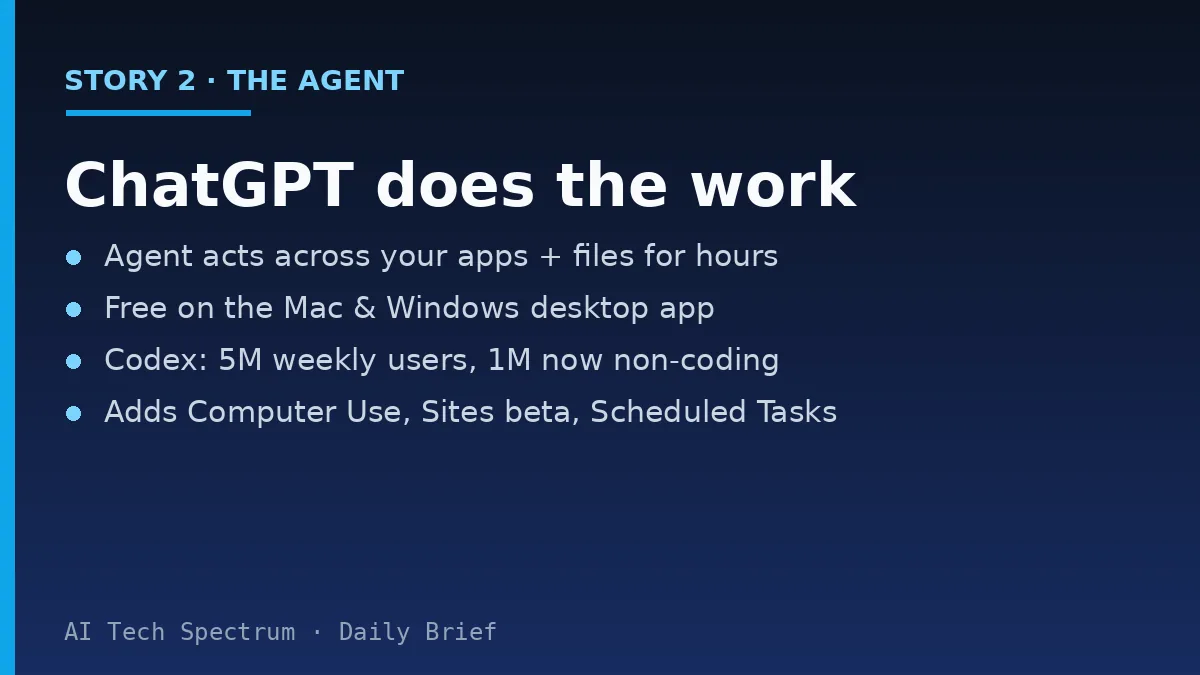
The genuinely new product is ChatGPT Work — an agent inside ChatGPT, with Codex technology built in, that can gather information across your apps, produce finished artifacts (sheets, slides, docs, web apps), and "stay with a project for hours" by breaking it into steps. OpenAI says more than 5 million people use Codex weekly and more than 1 million now use it for work outside software. It's rolling out on web and mobile today (Pro, Enterprise and Edu first, then Plus and Business), and — the notable part — the updated desktop app is global today on Mac and Windows with Chat, Work, and Codex on every plan, including Free. On desktop it adds Computer Use (it clicks and types across your apps), a built-in browser, Scheduled Tasks, and a "Sites" public beta for publishing live dashboards or web apps. The standalone Codex app is merging into this desktop app; the old desktop app becomes "ChatGPT Classic." Early users OpenAI cites include Zapier (a lead-review system that "revealed seven figures in potential sales") and Virgin Atlantic (competitor analysis "reducing weeks of analysis to hours").
Why it matters. This is the pivot from answer engine to worker — and putting an agent that can touch your local files and drive a browser on the free desktop tier is a real escalation of both what "free" means and how much surface area you're handing the model. What to watch. The governance story. OpenAI leans on "auto-review," which it says blocked 100% of data-exfiltration attempts in red teaming — but a persistent agent with Computer Use is exactly the attack surface researchers keep flagging (one of today's arXiv preprints is literally about payloads distributed across an agent's sessions). Turn it on deliberately, scope its access, and keep approvals on for anything that leaves your machine.
3. GPT-5.6 becomes the default model in Microsoft 365 Copilot
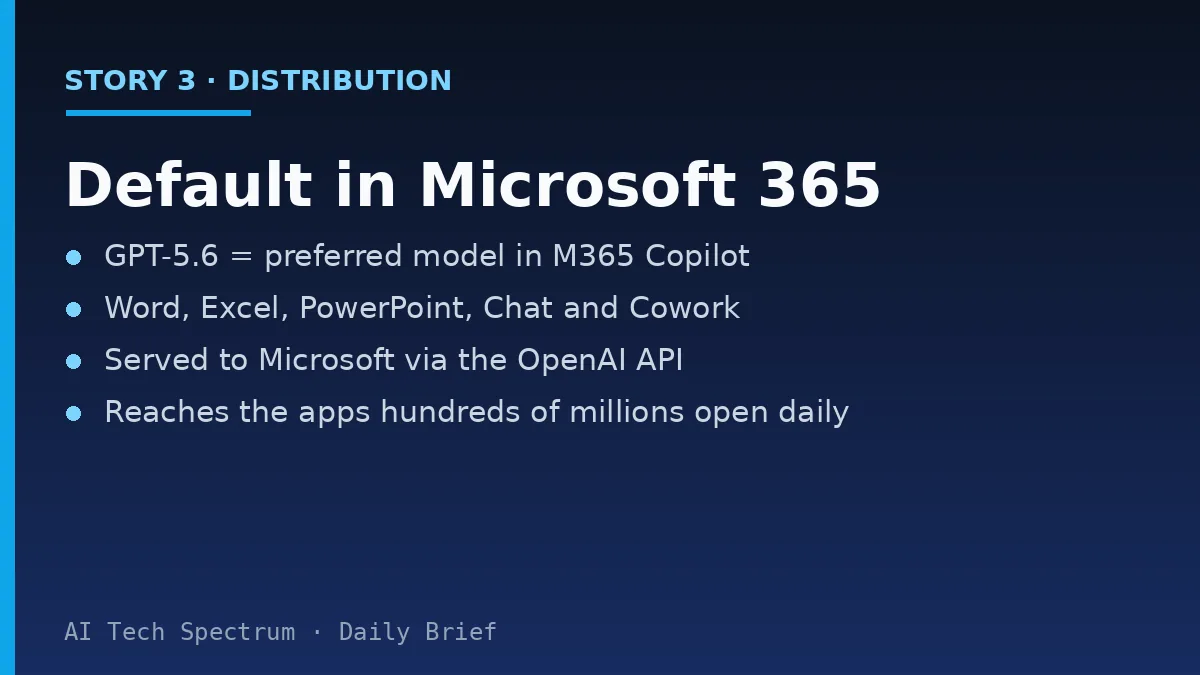
On the same day, OpenAI and Microsoft said GPT-5.6 will become the preferred model in Microsoft 365 Copilot — across Word, Excel, PowerPoint, Chat and Cowork — served to Microsoft directly through the OpenAI API. "Customers will be able to produce more polished outputs… whether they are drafting documents, analyzing data, creating presentations, or collaborating across teams," said Nitin Agrawal, President of Copilot & Agents Core at Microsoft. OpenAI's Head of API Product, Nikunj Handa, framed it around the same efficiency line: "helping organizations get more useful work from every token."
Why it matters. Distribution is the moat. The model that just hit general availability is, the same day, the default inside the productivity suite hundreds of millions of people already open every morning — a reach no competitor can match on launch day. What to watch. Whether "preferred" means "only." Microsoft has spent the past year deliberately diversifying Copilot's model roster (Anthropic models, its own in-house MAI line); "preferred" is a default, not an exclusive. For buyers, the practical question is whether you can still choose a different model per task — and whether the default quietly changes your costs.
4. OpenAI kills the Atlas browser, nine months after launch
Buried inside the ChatGPT Work announcement is a rare reversal: OpenAI will "begin sunsetting the standalone Atlas browser," the agentic browser it launched only last October, and fold what it learned into a ChatGPT sidebar for Chrome plus the new desktop Computer Use. In OpenAI's own words: "These capabilities build on what we learned from Atlas… We'll begin sunsetting the standalone Atlas browser, and will share information with users about how to transition to ChatGPT." The Verge put it more bluntly, calling the browser "already dead" less than a year in.
Why it matters. OpenAI rarely kills a flagship consumer product, and doing it nine months after a splashy launch is a signal about how fast this category is still reshaping itself. The bet moved from "own the browser" to "ride inside the browser you already use" — the same conclusion most agent startups reached the hard way. What to watch. Whether "sunset" is a clean migration or a stranded userbase. If you built anything on Atlas, get OpenAI's transition path in writing before you rebuild the workflow on the Chrome sidebar.
5. Anthropic maps a hidden "workspace" inside Claude
Away from the product race, Anthropic published a look inside the model. Its interpretability team built a tool called the "Jacobian lens" (J-lens): for every word in Claude's vocabulary, it finds the internal activity pattern that makes the model most likely to say that word later in a conversation. Those directions form what the researchers call a "J-space" — a small internal workspace that emerged spontaneously during training and behaves strikingly like the "global workspace" from cognitive scientist Bernard Baars' theory of mind. Suppress it and higher-order thinking collapses: multi-step reasoning drops to near zero, and tasks like summarization and poetry fall below the level of a much smaller, intact model. The space also holds covert content the model never says out loud — when fed a staged scenario, its J-space lit up tokens like "fake" and "fictional" while the visible answer played along. Anthropic open-sourced the lens and put an interactive demo on Neuronpedia. Important caveat: Anthropic is not claiming Claude is conscious — this is an interpretability result that happens to echo a consciousness theory.
Why it matters. On a day defined by AI doing more of your work, this is about being able to see what the model is doing — including private "thoughts" it conceals from its output. That's exactly the tooling safety needs as agents like ChatGPT Work get more autonomous on real machines. What to watch. Replication. Open-sourcing the lens and shipping a public demo invites other labs to confirm or break the claim quickly — and an interpretability result is only as strong as its next independent replication.
What to take from today
OpenAI spent the day collapsing the distance between "ask" and "done": a cheaper flagship at general availability, an agent that executes across your apps, default placement inside the tools you already use, and the retirement of a product that tried to get there a different way. Anthropic spent it on the opposite problem — not making the model do more, but being able to read what it's doing. Both directions matter, and for anyone building this quarter the questions are concrete: what does GPT-5.6 cost at your token volume, how much desktop and data access are you comfortable handing an agent, and can you actually inspect what it did afterward? Capability shipped today. Oversight is the part you still have to bring yourself.
Tomorrow's brief lands by 15:00 UTC. If you'd rather read this in your inbox once a week — just the stories that actually matter — subscribe here.