Good morning. For three years, Meta's AI story had one distinguishing feature: it gave the weights away. Llama was the counterweight to the closed labs — download it, run it, owe nobody anything. This week that story ended quietly. Meta shipped a new flagship agentic model and, alongside it, something it has never had: a price list. The rest of the week's news is what happens downstream of that — cheap autonomous agents need somewhere to run, someone to regulate them, and some way to tell whether they're any good. Prefer this once a week? Subscribe to the weekly brief.
1. Meta ships Muse Spark 1.1 — and starts charging for it
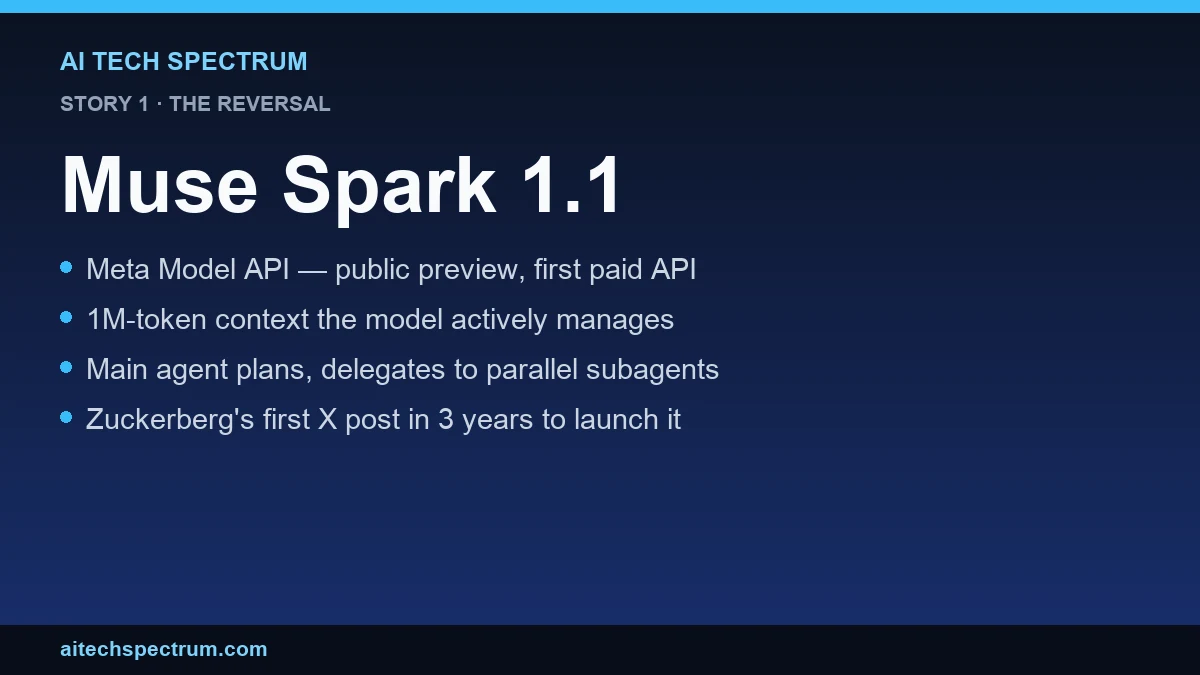
Meta Superintelligence Labs released Muse Spark 1.1, a multimodal reasoning model built for agentic work — and, for the first time, put its own frontier model behind a paid API. The model itself is a serious piece of engineering: a 1 million-token context window that the model actively manages (it retrieves from earlier work and compacts in a way that preserves the steps it will need later), multi-agent orchestration where Spark acts as a main agent that plans and delegates to parallel subagents, and a computer-use policy Meta trained deliberately — "write scripts when automation is faster, click when direct interaction is simpler." Meta says it zero-shot generalizes to new tools, MCP servers, and custom skills. On safety, Meta reports it evaluated Spark 1.1 under its Advanced AI Scaling Framework and found it operates "within safe margins" across chem-bio, cybersecurity, and loss-of-control — a vendor-published claim, not an independent audit.
The real news is the business model. The Meta Model API is in public preview, and Reuters reports (via TechCrunch) that Meta will charge $1.25 per million input tokens and $4.25 per million output. Mark Zuckerberg marked the launch by posting on X for the first time in three years, calling Spark "a strong agentic and coding model at a very low price." Early partners quoted by Meta include Replit's Amjad Masad, who called it "a complete agentic foundation," and Cline's Saoud Rizwan, who framed the appeal as "strong tool use at a price point that makes it viable to run real coding workloads at scale."
Why it matters. Meta spent three years as the open-weights alternative — the reason you could build without a metered API at all. Muse Spark 1.1 is not on Hugging Face; it's on a price sheet. That's a strategic reversal, and it removes the industry's biggest free-tier pressure valve at exactly the moment agents start burning tokens by the million. What to watch. Whether Llama survives as a real open line or becomes a legacy brand. Meta says it has "more capable models in training" — the question is whether any of them ship with weights attached.
2. The 72 hours that reset what an AI agent costs
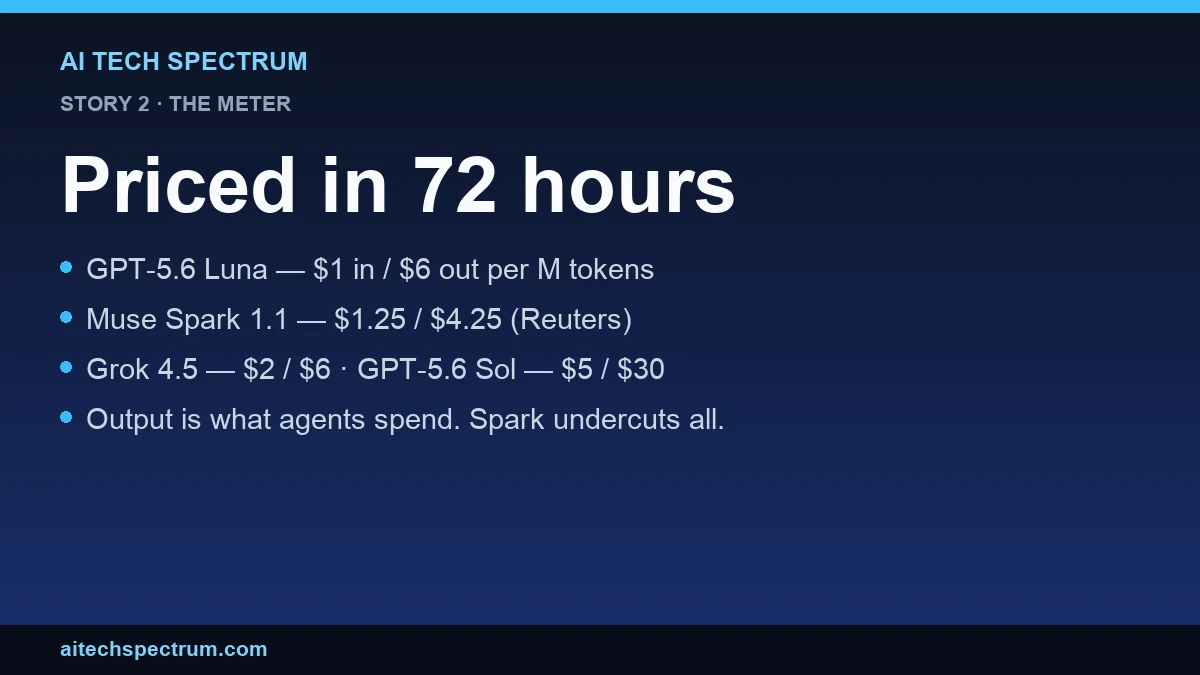
Step back from the launches and look at the price sheets. In the space of three days, four agentic models were priced, per million input / output tokens:
- GPT-5.6 Luna — $1 / $6 (OpenAI's cheap tier; Sol, the flagship, is $5 / $30 and Terra $2.50 / $15)
- Muse Spark 1.1 — $1.25 / $4.25 (Reuters-reported)
- Grok 4.5 — $2 / $6 (SpaceXAI, which Elon Musk described as "Opus-class")
The interesting number is Spark's output price. Output tokens are what agents actually spend — a coding agent that reasons, calls tools, and rewrites files generates far more than it reads — and at $4.25, Meta undercuts every model on that list on the expensive side of the meter, including OpenAI's own budget tier. That is a deliberate wedge, not an accident.
Why it matters. Sticker price is now a bad way to choose. Two models at the same $/token can differ by 3–4x in what they actually spend on the same task, depending on how verbosely they reason and how many tool calls they burn — OpenAI's own pitch for GPT-5.6 is "more useful work per token," which is an admission that the meter, not the rate, is the cost. What to watch. Run your own workload. Take one real task you'd hand an agent, run it on two or three of these, and compare the invoice — not the rate card. It is the only comparison that reflects how your agent actually behaves, and it's the one no vendor can run for you.
3. Sunrun wants to put an AI data center in your house
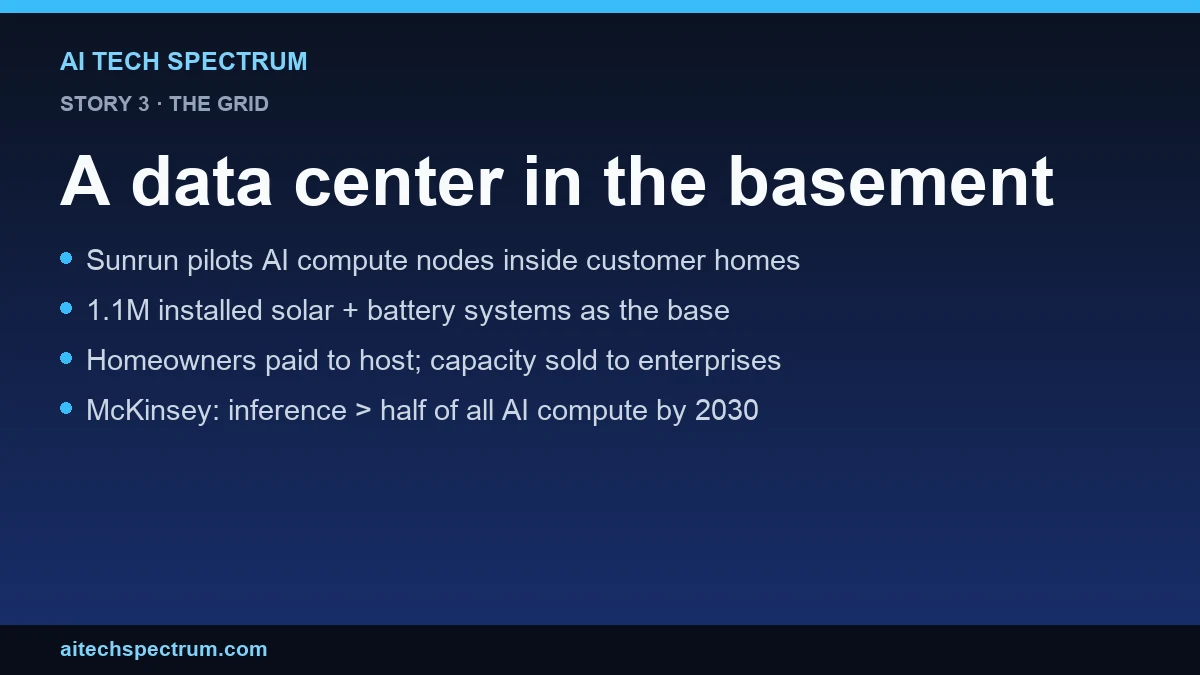
Sunrun (Nasdaq: RUN) launched a distributed AI compute pilot: AI inference nodes placed inside customer homes that already have Sunrun solar and battery systems, with homeowners paid to host the hardware and Sunrun selling the resulting inference capacity to enterprise buyers. The company's stated advantage is its installed base — more than 1.1 million existing home systems it already monitors and services — versus the years a conventional data center spends on land, permits, transmission, and the utility interconnection queue. The logic rests on a real asymmetry: training needs massive tightly-synchronized clusters, but inference is modular, geographically distributable, and latency-sensitive. Sunrun cites a McKinsey projection that inference will overtake training to become more than half of all AI compute by 2030, with demand growing around 35% a year. "AI companies are scrambling to secure greater access to energy and computing power," said Sunrun President and CRO Paul Dickson.
Why it matters. The binding constraint on AI is no longer chips — it's power and the queue to plug into the grid. Sunrun's pitch is that a million homes with panels and batteries are a data center that has already been permitted, wired, and energized. If that arbitrage works even partially, it's a genuinely new supply curve. What to watch. Read the fine print, in both directions. This is a pilot, and Sunrun's own release is candid that scale, pricing and the customer offer are all still undetermined — the stock reaction was muted for a reason. And if you're ever offered money to host one: enterprise inference running on hardware in your house raises real questions about security, noise, heat, your electricity bill, and what happens to the box when you sell the home. Get those answers in writing.
4. China's AI-companion rules land Wednesday — platforms are already pulling features
On July 15, China's Interim Measures for the Administration of Artificial Intelligence Anthropomorphic Interaction Services take effect — the first national framework anywhere aimed squarely at AI companions. Issued in April by the Cyberspace Administration of China together with four other agencies, the rules cover any service that simulates human personality and communication style to provide ongoing emotional interaction, and they are unusually specific (see the translated text and the analyses from Hogan Lovells and Bird & Bird). Providers must build over-dependence warnings and "emotional boundary" guidance into the product; they must detect users in acute distress and route them to help rather than play along; virtual-companion and virtual-family-member services are barred for minors outright, with guardian consent required below 14 and a mandatory minor mode carrying time limits and parental controls. Reporting from Quartz indicates ByteDance and Alibaba have already begun disabling AI companion features ahead of the deadline.
Why it matters. Most AI regulation so far has argued about model capability — training compute, frontier risk, disclosure. This one regulates the relationship, and it does so with product requirements a lawyer can check: age gates, dependency warnings, crisis routing. Whatever you think of the regime writing them, these are the first rules that treat emotional attachment to a chatbot as the safety surface. What to watch. Whether the pattern travels. The EU AI Act's transparency articles and several US state bills are circling the same problem from different angles, and companion apps are one of the few consumer AI categories with genuine engagement — which is precisely why they draw fire. If you build in this space, assume the age-gate and dependency-warning requirements are coming to your market next, whatever the statute ends up being called.
5. Everyone shipped an agent. Nobody agrees how to grade one.
A group from HKU's MMLab published UniClawBench, and its premise is a quiet indictment of the week you just read about. Existing agent benchmarks, the authors argue, mostly run in sandboxes, score a single turn, and lump unrelated skills into one "task category" — so when an agent fails, you can't tell why. Their alternative is capability-driven: 400 bilingual real-world tasks organized around five distinct abilities (skill usage, exploration, long-context reasoning, multimodal understanding, cross-platform coordination), executed in live Docker containers and scored against step-by-step checkpoints rather than a pre-recorded answer key. The evaluation loop itself is three agents — an executor, a hidden supervisor, and a user agent that simulates realistic multi-turn feedback without leaking the grading criteria. Crucially, they run each model under multiple agent frameworks, to separate what the base model can do from what the scaffolding around it is doing. The benchmark and code are public.
Why it matters. This week four labs each claimed agentic superiority, and each did it on a different scoreboard — Meta on its internal coding bench, OpenAI on the Coding Agent Index, xAI on its own harness. UniClawBench's finding that base-model capability and framework design jointly determine performance is the part every buyer should internalize: a large share of what you're told is model quality is actually harness quality. What to watch. Whether any lab adopts it. A benchmark only disciplines an industry when the industry agrees to be measured by it — and the incentive to keep grading your own homework has rarely been stronger.
What to take from today
The through-line is commoditization arriving faster than the tooling to handle it. Meta abandoned its differentiating position — free weights — because selling agentic tokens is now the better business, and it undercut the field on the output side of the meter to make the point. But cheap agents surface every problem downstream: where the inference physically runs (Sunrun's answer: your basement), who is accountable when a model becomes a relationship (China's answer, effective Wednesday), and how you tell a good agent from a well-scaffolded one (nobody's answer, yet). If you're picking a model this quarter, the useful move isn't reading the launch posts — it's running one real task on three of them and reading the invoice. The rate card is marketing. The meter is the product.
Tomorrow's brief lands by 15:00 UTC. If you'd rather read this in your inbox once a week — just the stories that actually matter — subscribe here.